Physical Sciences

Swift Mission Nabs Its First Distance Measurement to Star Explosion
Image
Peter Roming
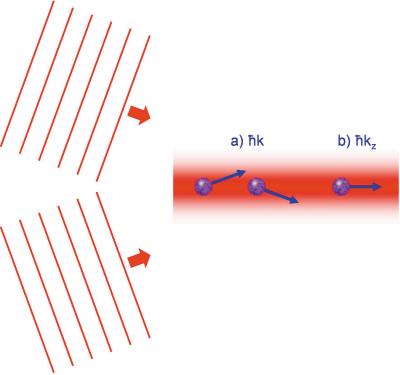
Ultra-Cold Temperature Physics Opens Way to Understanding and Applications
Image
David S. Weiss
Scientists Announce Smallest Extra-Solar Planet Yet Discovered and Find Outer Limits of the Pulsar Planetary System
Image
All photos courtesy of the NAIC - Arecibo Observatory, a facility of the NSF.
Swift Sees Pinwheel Galaxy, Satellite Fully Operational
Image
This UVOT image of the pinwheel galaxy M101 is a 'false-color' image generated with the near-UV, the blue, and yellow filters, represented by blue, green, and red, respectively. This image shows more light from the central regions of the galaxy, where older, cooler stars dominate the emission.
Swift Mission Images the Birth of a Black Hole
Image
Penn State scientists, David Burrows (left) and John Nousek, reacting to the launch they have just viewed from the beach at their hotel in Cocoa Beach, The smoke trail from Swift's launch is still visible in the sky behind them.
Clusters of Aluminum Atoms Found to Have Properties of Other Elements Reveal a New Form of Chemistry
Image
Artist's rendition of an aluminum-iodine "Superatom" identified by the Castleman group at Penn State and the Khanna group at Virginia Commonwealth University. Credit: D.E. Bergeron, P.J. Roach, A.W. Castleman, N.O. Jones, and S.N. Khanna
Spying on Black-Hole Eating Habits with LISA
First Search in Stellar Graveyard Yields Two Possible Planets
Image
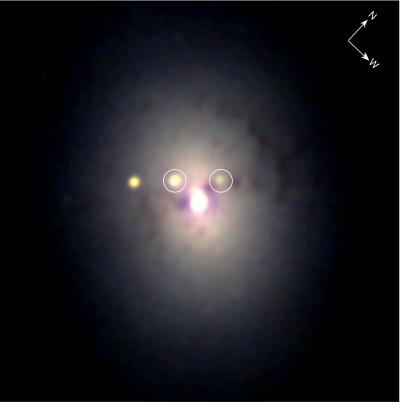
Shown here is one of the 20 target white dwarfs of our survey. The white dwarf is at the center of the image and has been masked out. North is up and east is to the left. Nearby to the east is a candidate companion (circled), which if associated would be a massive planet or low mass brown dwarf. It needs further observations to confirm or refute its association with the white dwarf.
Swift X-ray Telescope Sees Its First Light and Captures Its First Gamma-Ray-Burst Afterglow
Image
First-light image from the Swift X-ray Telescope, of the Cassiopeia A supernova remnant.
Molecular Chains Line Up to Form Protopolymer
Image
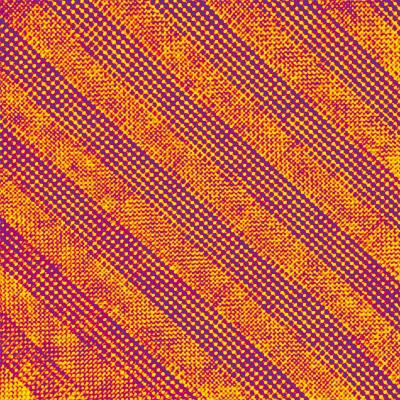
Protopolyphenylene is composed of molecules lined up for reaction and held in place by the copper substrate surface and intermolecular interactions. The image of a 270-angstrom (27-nanometer) square area of the surface was recorded with a scanning tunneling microscope at 77 K in ultrahigh vacuum. The ridged ring structure is the protopolymer; the angled lines are one-atom-high steps of the copper substrate.
Subscribe to Physical Sciences