Physical Sciences

A Swift Kick to the Career Path
Cosmic Explosion Could Be Black Hole Swallowing Neutron Star
Image
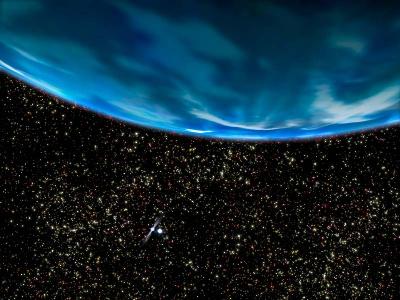
Scientists, including astronomers and astrophysicists at Penn State, have found evidence of a black hole swallowing a neutron star in the afterglow of a split-second flash of intense energy known as a short gamma-ray burst. The events leading up to the gamma-ray burst are shown here. In the minutes and hours that followed, the black hole gobbled up the remaining remnants of the neutron star, producing a series of X-ray flares. Credit: NASA
A First: Hydrogen Atoms Manipulated Below the Surface of a Palladium Crystal
Image
The writing is less than half an Angstrom (0.00005 microns) "tall" off the surface. The characters are less than 500 Angstrom (0.05 microns) high. They were created when Weiss and his team moved hydrogen atoms underneath a palladium surface using a custom-built, ultrastable, low-temperature, scanning tunneling microscope.
Scientists Find Possible Birth of Tiniest Known Solar System
Image
This artist's conception compares a hypothetical solar system centered around a tiny "sun" (top) to a known solar system centered around a star, called 55 Cancri, which is about the same size as our Sun. Credit: NASA/JPL-Caltech
Scientists Discover How to Flip a Molecular Switch
Image
Credit: Lewis et al. Sequential STM images of FAPPB/R1ATC9 obtained at alternating sample biases of +1.0 and -1.0 V. The majority of the FAPPB molecules (apparent protrusions, displayed as bright spots) switch conductance states between OFF at +1.0 V and ON at -1.0 V sample bias. The red and green boxes follow one FAPPB molecule that exhibits this bias dependence. Imaging conditions: 4000 Å × 4000 Å, I = 2 pA.
Swift Satellite Hailed as "Best of What's New" in Popular Science
Image
Swift Satellite Hailed as "Best of What's New" in Popular Science
Penn State Astrophysics Major Chosen as Marshall Scholar
Short Flash from Enormous Explosion Solves Cosmic Mystery
Image
Credit: Derek Fox/Penn State University Hubble Space Telescope image of the sky surrounding the afterglow and host galaxy of the HETE short burst of July 9, 2005. The circle indicates the region of sky that HETE saw the burst from; according to the HETE team we would find the burst within this region. The box, inset, indicates where the X-ray and optical afterglow of the burst was ultimately found. The colors indicate the intensity of red light (814 nm) as seen by the Advanced Camera for Surveys instrument
NASA Satellite, Controlled by Penn State, Detects Most Distant Explosion
Image
Image Credit: Nicolle Rager Fuller/NSF
South African Telescope, Patterned After Hobby-Eberly Telescope, Sees First Light
Image
Image courtesy of South African Large Telescope, © SALT
Subscribe to Physical Sciences