
Scientists Watch Black Hole Born in Split-Second Light Flash
Image
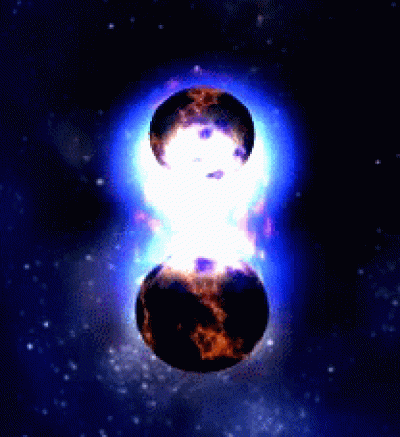
Neutron star collision: The Swift spacecraft's Gamma Ray burst observation fits the theory of a collision between some combination of black holes or neutron stars.
Planetary Protection: X-Ray Super-Flares Aid Formation of "Solar Systems"
Image
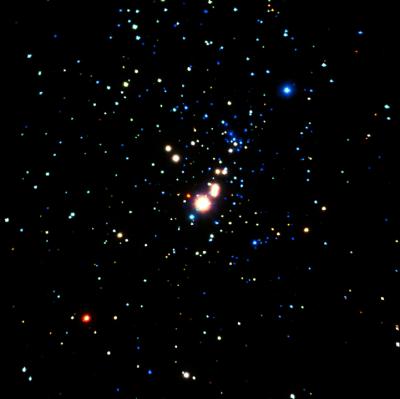
Credit: NASA/CXC/Penn State/E.Feigelson & K.Getman et al.
Sky Survey Detects Cosmic Magnification
Image
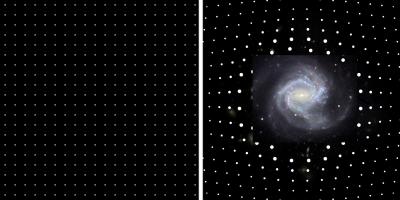
The left panel shows a grid of points representing background quasars. The right panel is the same grid after being “gravitationally lensed” by the cluster of galaxies shown in the center of the panel (the magnitude of the effect is exaggerated to make it apparent by eye).
Discovery of Growth-Spurt Era for Black Holes and Galaxies
Image
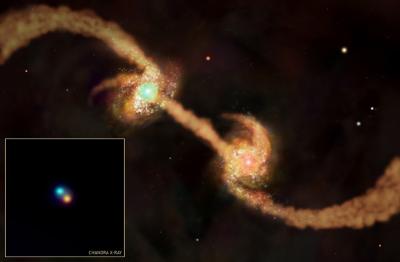
The illustration shows two young galaxies in the process of merging. Credit: NASA/CXC/Penn State/D. Alexander et al.
Swift Mission Nabs Its First Distance Measurement to Star Explosion
Image
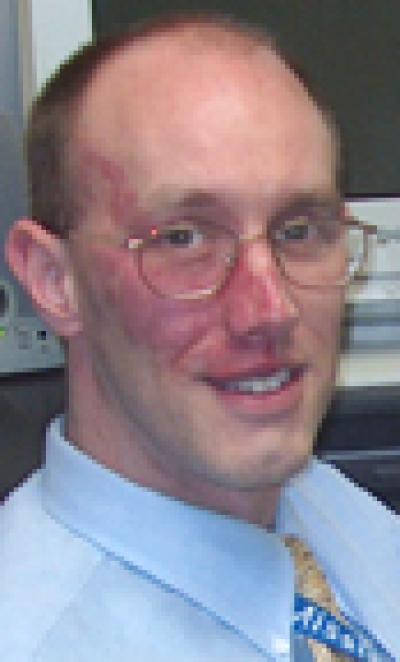
Peter Roming
Ultra-Cold Temperature Physics Opens Way to Understanding and Applications

Image
David S. Weiss
Scientists Announce Smallest Extra-Solar Planet Yet Discovered and Find Outer Limits of the Pulsar Planetary System
Image
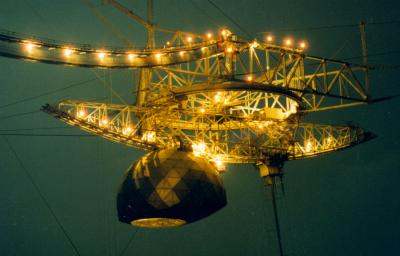
All photos courtesy of the NAIC - Arecibo Observatory, a facility of the NSF.
Swift Sees Pinwheel Galaxy, Satellite Fully Operational
Image
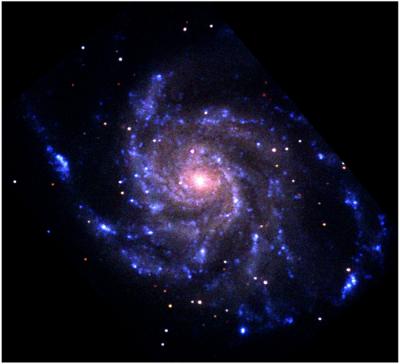
This UVOT image of the pinwheel galaxy M101 is a 'false-color' image generated with the near-UV, the blue, and yellow filters, represented by blue, green, and red, respectively. This image shows more light from the central regions of the galaxy, where older, cooler stars dominate the emission.
Swift Mission Images the Birth of a Black Hole

Image
Penn State scientists, David Burrows (left) and John Nousek, reacting to the launch they have just viewed from the beach at their hotel in Cocoa Beach, The smoke trail from Swift's launch is still visible in the sky behind them.
Spying on Black-Hole Eating Habits with LISA
Subscribe to Astronomy and Astrophysics