
First Search in Stellar Graveyard Yields Two Possible Planets
Image
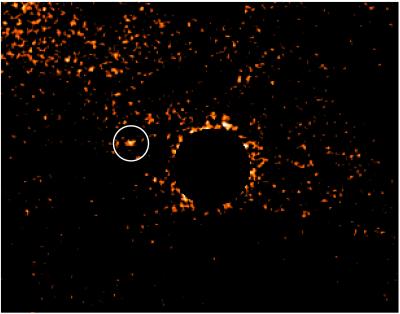
Shown here is one of the 20 target white dwarfs of our survey. The white dwarf is at the center of the image and has been masked out. North is up and east is to the left. Nearby to the east is a candidate companion (circled), which if associated would be a massive planet or low mass brown dwarf. It needs further observations to confirm or refute its association with the white dwarf.
Swift X-ray Telescope Sees Its First Light and Captures Its First Gamma-Ray-Burst Afterglow
Image
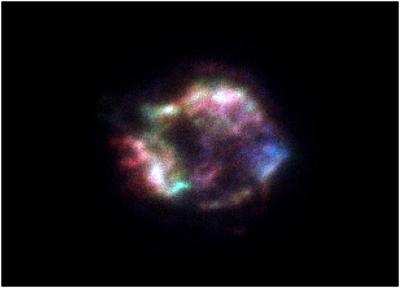
First-light image from the Swift X-ray Telescope, of the Cassiopeia A supernova remnant.
Mysterious Cluster of Stars Discovered Near Milky Way
Image
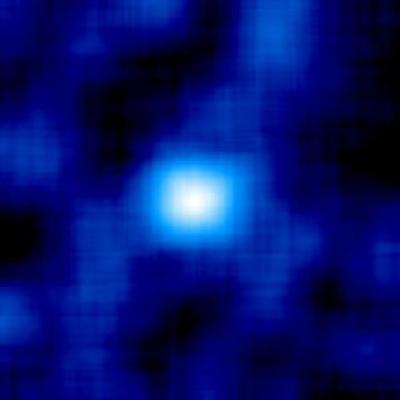
This clump of newly discovered stars in Ursa Major is in a region the size of the full moon centered on Willman 1. To be able to see this ultra-faint object in the SDSS data, the distribution of stars was filtered to enhance its signal relative to the much more numerous closer stars of the Milky Way Galaxy. (Credit: Beth Willman, New York University, The Sloan Digital Sky Survey).
Sloan Digital Sky Survey Supports Dark Energy as the Primary Constituent of the Universe
Image
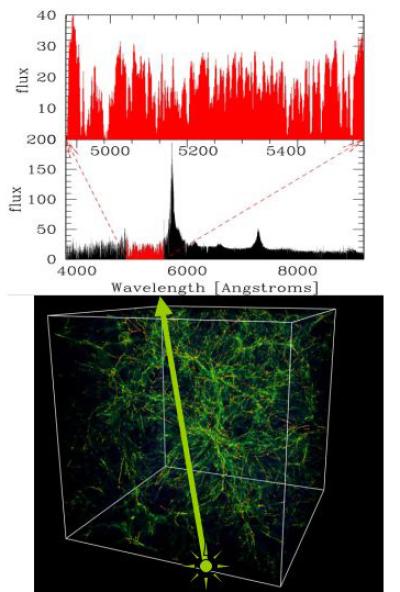
This figure shows the SDSS spectrum of a quasar at a distance of 12 billion light years.
Chandra Looks Over a Cosmic Four-Leaf Clover
Image
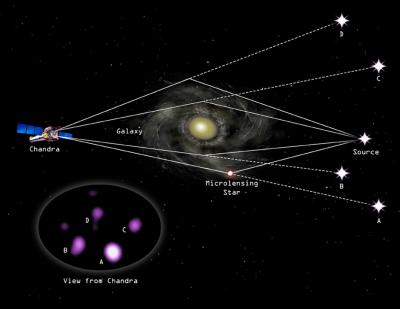
The Cloverleaf quasar is a single object whose image has been reproduced four times in a cloverleaf-like arrangement through a process known as gravitational lensing.
Hobby-Eberly Telescope Witnesses Vaporizing of a Comet-like Body by a Very Young Hot Star
Image
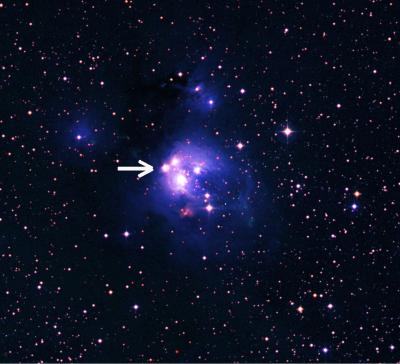
Location of the star LKHa 234 in the star-forming nebula NGC 7129  Photo: Lars Lindberg Christensen, ESA/Hubble
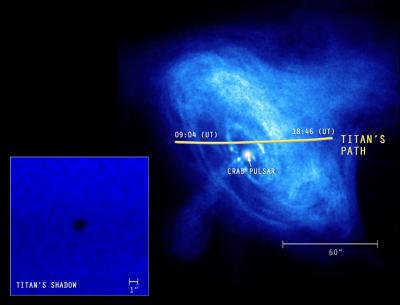
Titan, a Moon of Saturn, Casts Revealing Shadow
Image
Photo credit: NASA/CXC/Penn State/K.Mori et al.
Penn State Senior's Research Will Help Astronomers Analyze Quasars
Penn State Sophomore Helping to Develop Software for Swift Satellite
Infant Galaxies in Nearby Group
Image
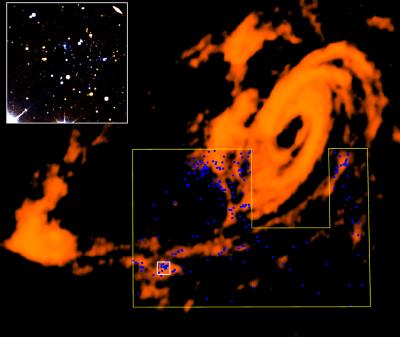
A false-color radio image (data supplied by Dr. Min Yun, University of Massachusetts) of the hydrogen gas in the M81 Group.
Subscribe to Astronomy and Astrophysics