
Two Milky Way Companion Galaxies Discovered
Image
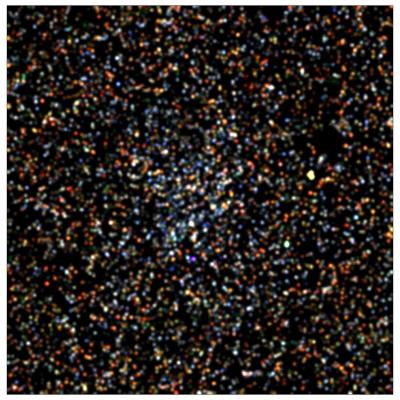
The Constellation Bootes
Penn State Joins New Survey to Monitor the Sky
Image
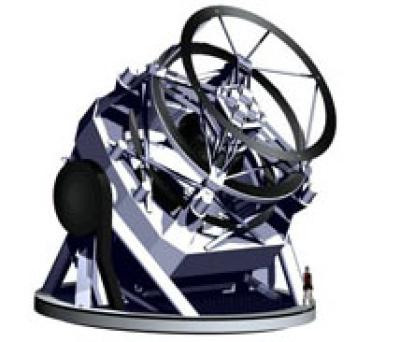
A current rendering of the 8.4-meter LSST which will use a special three-mirror design, creating an exceptionally wide field of view. The LSST will have the ability to survey the visible sky in only three nights. Credit: LSST Corporation
Scientists Piece Together the Most Distant Cosmic Explosion
Image
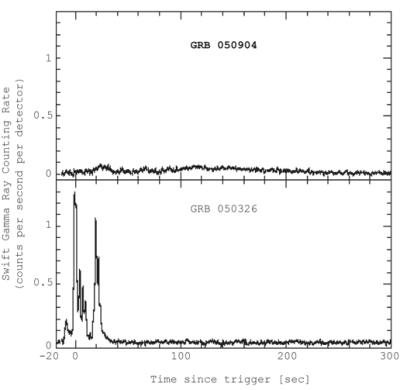
Image credit: Dr. Neil Gehrels Figure above: Shows the counting rate in the gamma-ray instrument on Swift for two gamma-ray bursts. The top panel is for the high redshift burst observed on September 4, 2005 (GRB 050904). The bottom panel shows a typical burst for comparison; it is the one Swift detected on March 26, 2005 (GRB 050326). GRB 050904 is fainter and much longer than typical.
Swift Satellite Detects Unusual Cosmic Explosion
Image
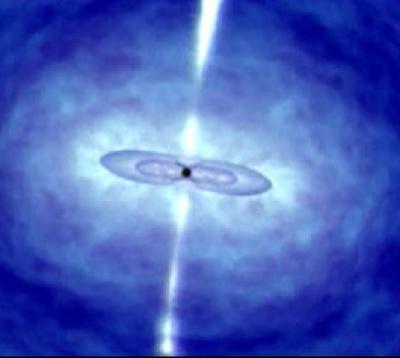
The collapsing star scenario that is one of the leading contenders as the cause of gamma-ray bursts. Dr. Stan Woosley of the University of California at Santa Cruz proposed the collapsar theory in 1993. This artist's concept of the collapsar model shows the center of a dying star collapsing minutes before the star implodes and emits a gamma-ray burst that is seen across the universe. Credit: NASA/Dana Berry
Deep X-ray Surveys Reveal Black Hole Population, Glimpse at the Universe
Planet Discovered by a New Detection Technique
Image
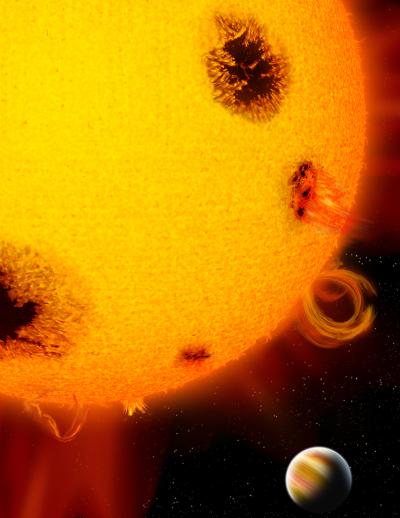
An artist’s rendition shows a planet orbiting a very young, active star pocked with dark star spots and speckled with flares and other surface activity.
Cosmic Jet Looks Like Giant Tornado in Space
Image
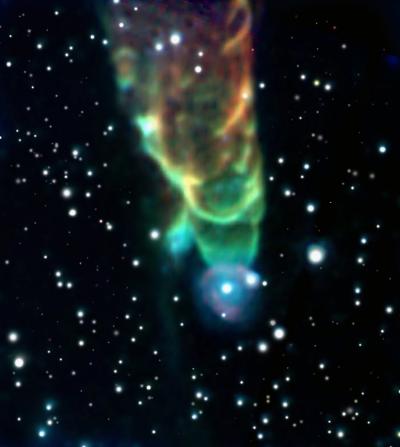
NASA's Spitzer Space Telescope has revealed an object that looks like a giant tornado in space. The helical structure actually results from shock waves where a powerful protostellar jet hits neighboring gas and dust. Credit: NASA / JPL-Caltech / J. Bally (University of Colorado)
Supernova Survey Explodes with New Findings
Image
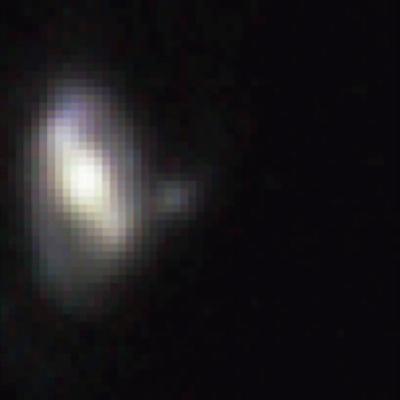
SDSS-II images of a Type Ia supernova on the rise
Huge Star Cluster Discovered in Neighborhood of Milky Way
Image
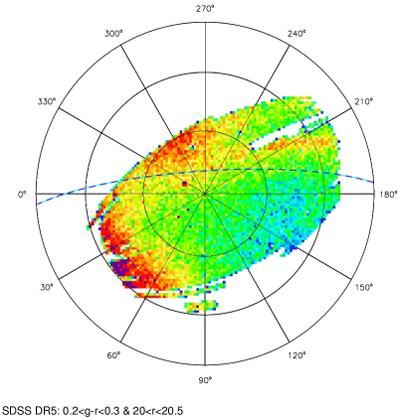
The figure, a map by Mario Juric of Princeton University, shows the counts of faint blue stars selected from a narrow magnitude and color range and corresponding to a distance from Earth of about 10 kpc. Credit: M. Juric/SDSS-II Collaboration
A Swift Kick to the Career Path
Subscribe to Astronomy and Astrophysics