
Seven or Eight Dwarf Galaxies Discovered Orbiting the Milky Way
Image
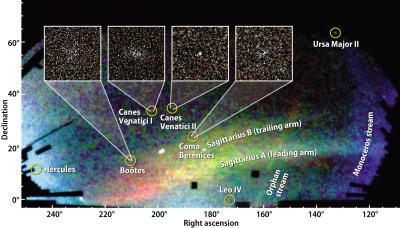
Researchers from the Sloan Digital Sky Survey (SDSS-II) announced the discovery of eight new dwarf galaxies, seven of them satellites orbiting the Milky Way.
Astronomers Discover New Kind of Black-Hole Explosion
Image
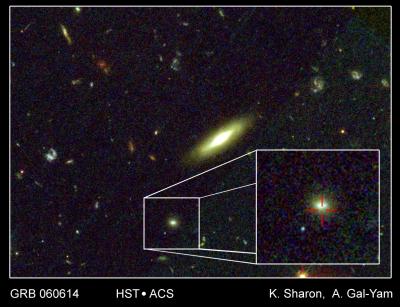
Hubble Space Telescope image of the host galaxy of the "hybrid gamma-ray burst" GRB 060614 (centered in the small box).
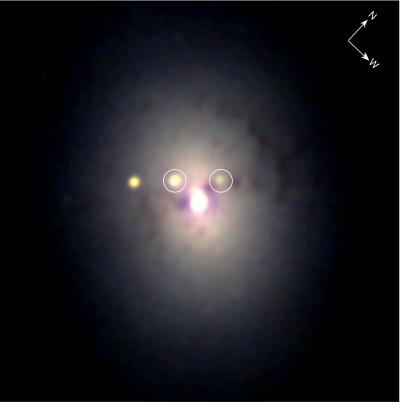
Twin Star Explosions Fascinate Astronomers
Image
Credit: NASA/Swift/Stefan Immler
Astronomers See Inside a Quasar for the First Time
Image
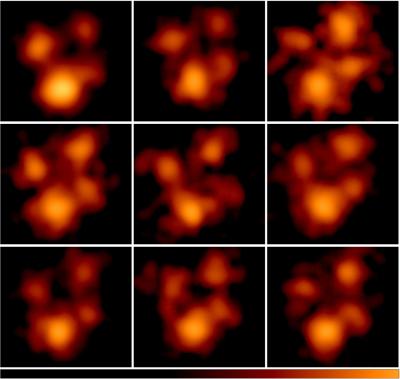
A mosaic of X-ray images of the quasar Q2237+0305, magnified by a gravitational lens. The bright spots are four magnified images of the same quasar, which change in brightness over time. Credit: C.S. Kochanek, Ohio Sate University
Scientists Snap First Images of Brown Dwarf in Planetary System
Image
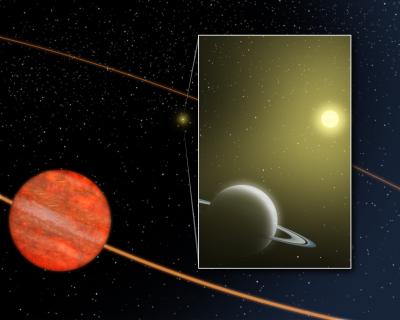
This is an artist's concept of the star HD 3651 as it is orbited by a close-in Saturn-mass planetary companion and the distant brown dwarf companion discovered by Spitzer infrared photographs. Credit: NASA / JPL-Caltech / T. Pyle (SSC)
Earth-Like Planets May Be Common in Known Planetary Systems
Image
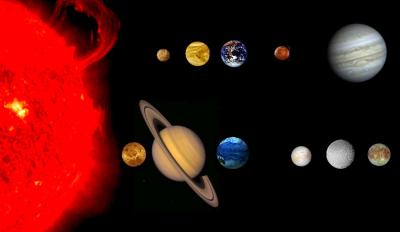
This image shows the differences (not to scale) between the inner regions of our Solar system, and a simulated planetary system containing a "hot Jupiter".
Planet or a Failed Star? . . . Discovery Reveals One of the Smallest Stellar Companions Ever Seen
Image
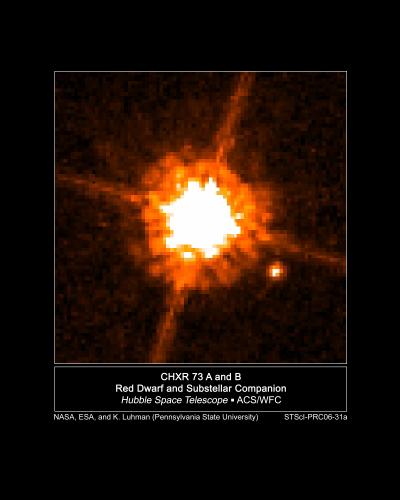
This NASA Hubble Space Telescope image shows one of the smallest objects ever seen around a normal star. Astronomers believe the object is a brown dwarf because it is 12 times more massive than Jupiter. The brown dwarf candidate, called CHXR 73 B, is the bright spot at lower right. It orbits a red dwarf star, dubbed CHXR 73, which is a third less massive than the Sun. At 2 million years old, the star is very young when compared with our middle-aged 4.6-billion-year-old Sun.
South African Clone of Penn State Telescope Makes First Scientific Discovery
Image
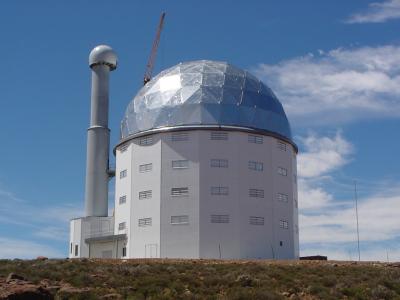
The Southern African Large Telescope
How Big is Big? Probing the Conditions of the Universe on the Largest Scales
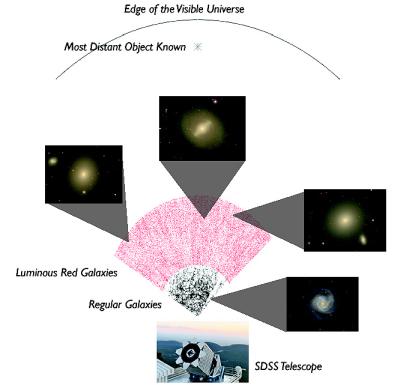
Image
Credit: Hogg, SDSS-II collaboration The SDSS telescope at Apache Point, NM has been used to create a map of regular galaxies (black points) and luminous red galaxies (red points) out to 40% of the distance to the edge of the visible universe. Light from the most distant red galaxies has taken 5.6 billion years to reach us, while the edge of the visible universe is 13.7 billion light years away. This map of the universe allowed astronomers to detect galactic structures more than a billion light years across.
X-rays Fly as Cracking Comet Streaks Across the Sky
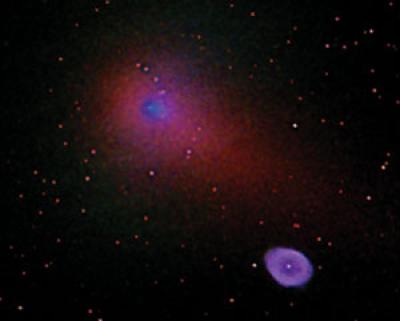
Image
NASA's Swift satellite captured this image of comet 73P/Schwassmann-Wachmann 3 as it chanced to fly in front of the Ring Nebula.
Subscribe to Astronomy and Astrophysics