
AccuWeather.com® Partners with Penn State to Take "Astronomy Center" Web Site to New Heights
Image
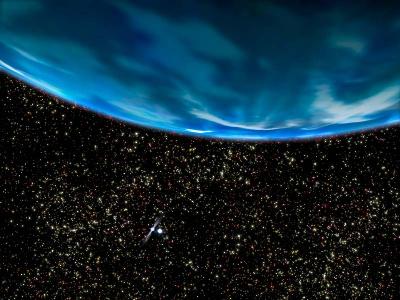
Credit: NASA and G. Bacon (STScI)
Discovery Links Highest-Energy Cosmic Rays with Violent Black Holes
Image
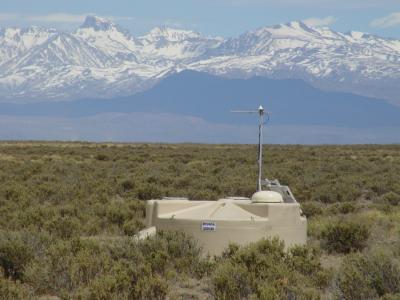
Credit: Pierre Auger Observatory  A surface detector station with the Andes in the background
Possible Closest Neutron Star to Earth Found
Image
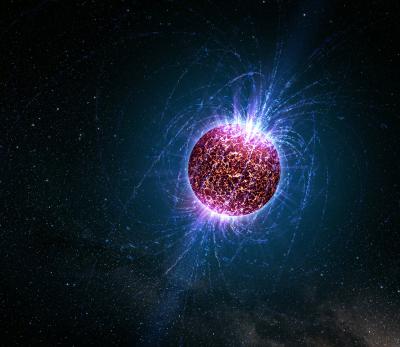
Artist's illustration of an "isolated neutron star" — a neutron star that does not have an associated supernova remnant, binary companion, or radio pulsations.  Reproduction is permitted under a Creative Commons Attribution Non-Commercial 3.0 License. Credit: Casey Reed, courtesy of Penn State.
Planet Orbiting a Giant Red Star Discovered with Hobby-Eberly Telescope
Image
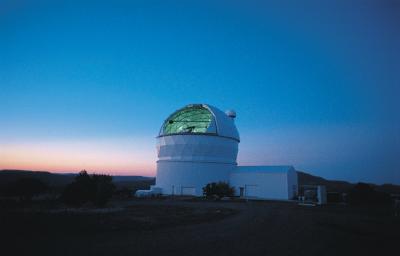
The Hobby-Eberly Telescope, one of the largest and most powerful telescopes in the world, photographed at dusk by Penn State Astronomer Lawrence W. Ramsey, a leader in the conception, design, construction, and operation of the telescope. Credit: Lawrence W. Ramsey, Penn State
Richards Named Shapley Lecturer by American Astronomical Society
Schneider Receives C.I. Noll Award in Excellence in Teaching
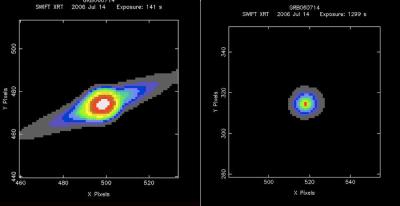
Gamma-Ray Bursts Active Longer than Previously Thought
Image
The X-ray Telescope on NASA's Swift satellite captured the intensity of a bright X-flare from GRB 060714. The elongated blue and gray regions are an artifact of the image processing (left). After the flare, (right) the GRB's X-ray emission faded considerably, revealing a faint afterglow. Click image to enlarge. Credit: NASA / Swift / XRT Science Team.
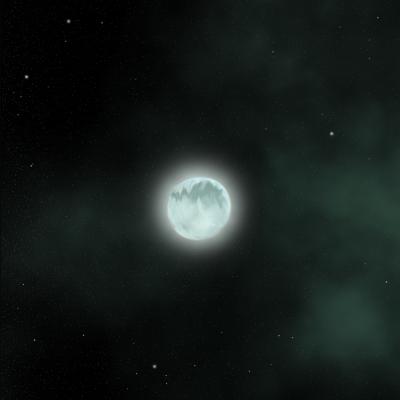
Gamma-Ray Birth Cries Suggest Massive Magnetic Engines
Image
The core of a massive star in a distant galaxy collapses, ending its life — though there is little effect visible at the surface. Deep inside, twin beams of matter and energy begin to blast their way outward. (Image Credit: NASA/Swift/Sonoma State University/A. Simonnet)
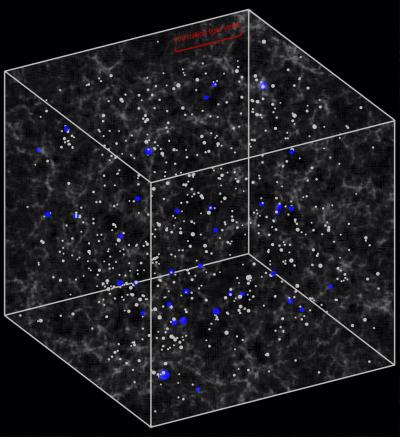
Discovery Reveals that Distant Quasars Live in Massive Dark-Matter Halos
Image
The illustration shows the distribution of dark matter, massive halos, and luminous quasars in a simulation of the early universe, shown 1.6 billion years after the Big Bang. Credit: Paul Bode and Yue Shen, Princeton University
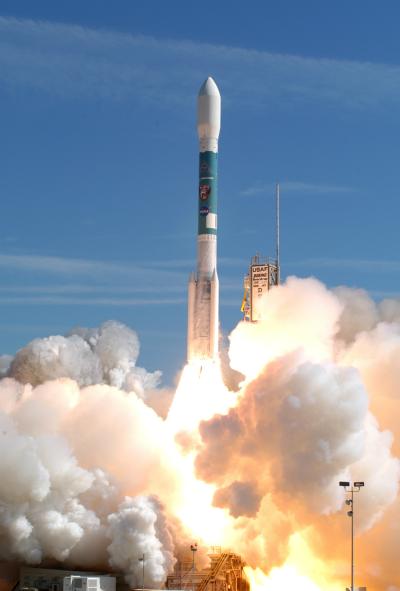
Top High-Energy Astronomy Prize Awarded
Image
Top High-Energy Astronomy Prize Awarded
Subscribe to Astronomy and Astrophysics