Watching the Detectors
Image
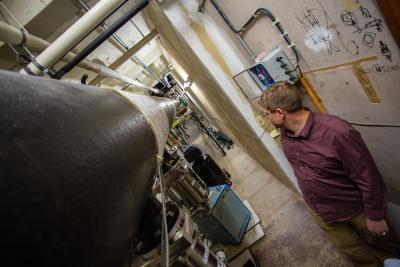
ABE FALCONE, RESEARCH PROFESSOR OF ASTRONOMY and astrophysics, looks down the length of the 47-meter, long-cell X-ray beam in the subbasement of Osmond Laboratory. Credit: Nate Follmer - Penn State.
X-Ray Spectographs
Image
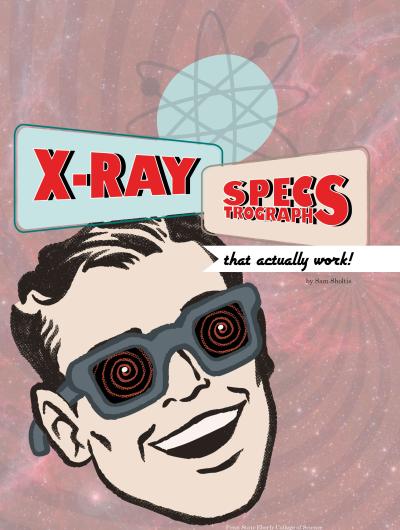
illustration of man wearing x-ray glasses
Palma awarded C.I. Noll Award for Excellence in Teaching
Russel E. Marker lectures in Astronomy and Astrophysics set for October 8, 9, and 10

Image
Timothy Heckman
The surprising environment of an enigmatic neutron star
Image
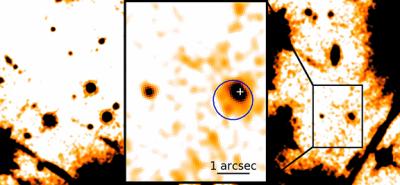
Infrared image of a neutron star (source on right in box) with an extended infrared emission obtained from observations with the Hubble Space Telescope. The blue circle indicates the pulsar's X-ray position (obtained with the Chandra X-ray Space Telescope), the cross marks the position of the pulsar in the UV-Optical (measured with the Hubble Space Telescope). Credit: Bettina Posselt, Penn State
Water worlds could have stable climate, perhaps support life, study says
Births, deaths and collisions: Swift’s telescope snaps one millionth UV image
Image
On the left is an image of the nearby galaxy NGC 3623 taken with UV. On the right is an optical image. The galaxies spiral arms — where new stars are being born — stand out in the ultraviolet wavelengths emitted by these hot objects. Image: NASA/Swift/L.McCauley, Penn State, CC BY-ND
New era of space research launched by IceCube Observatory and global team of astronomers
Image
A flaring supermassive black hole 3.7 billion light-years from Earth in the constellation Orion is the suspected source of a super-high-energy subatomic particle -- a neutrino -- that has launched a new era of space research. Credit: Nate Follmer, Penn State
Dawson honored with Powe Award
Image
Rebekah Dawson
AstroFest turns twenty! Four Evenings of Astronomy Activities and Stargazing During Arts Festival 2018
Image
Observatory on the roof of Davey Lab. Credit: Penn State
Subscribe to Astronomy and Astrophysics