
Seven faculty from the Eberly College of Science featured on Clarivate Analytics’ 2017 Highly Cited Researchers List
Image
Jan Winter 2018 Science Journal Cover bench bedside
The hunt for more planets to call home
Image
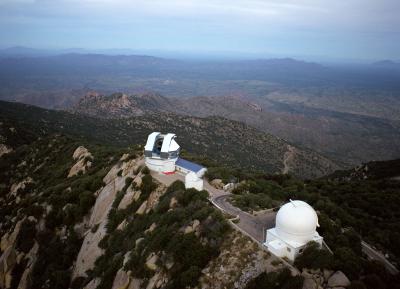
Kitt Peak National Observatory in Arizona
The Arisian Lens
Image
ESTABLISHING THE RESOLUTION OF THE ARISIAN LENS To determine the resolution limit of the Arisian Lens, the Mahadevan team used a standard created by the United States Air Force. Resolution is determined by the largest set of three bars that a system cannot distinguish. The Arisian Lens was able to distinguish even the smallest group of bars, suggesting that it has a resolution limit at, or below, 0.78μm. Credit: Arpita Roy, Mahadevan Lab
Nobel Laureate Rainer Weiss presents “Probing the Universe with Gravitational Waves” on April 18, 2018
Image
Rainer Weiss / credit Bryce Vickmark
NASA scientist to present Friedman Lecture in Astronomy on April 10, 2018
Image
Joseph Masiero
Penn State to participate in consortium to demonstrate remote monitoring of nuclear reactors
Image
Boulby potash, polyhalite and salt mine on the northeast coast of England is Great Britain's deepest mine and the home of the Science and Technology Facilities Council’s Boulby Underground Laboratory.  The mine, operated by ICL-UK /Cleveland Potash Ltd, is expected to be the site of the Advanced Instrumentation Testbed project, a new international multi-laboratory and university collaboration for nonproliferation research.
NASA set to launch Penn State led experiment
Image
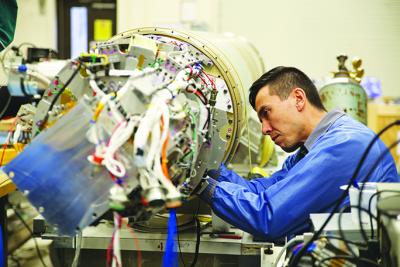
Randall McEntaffer, professor of astronomy and astrophysics and of physics at Penn State and principal investigator of WRX, works on the instrument during integration at the NASA Flight Facility.   Credit NASA/Berit Bland
"How to Hunt for Signs of Alien Life," a free public lecture on February 24
Image
Lisa Kaltenegger higher res
Three from Eberly College of Science named Alfred P. Sloan Research Fellows
Image
Sloan Fellowships Logo
Big black holes outpace their galaxies in growth
Image
An image from the Chandra Deep Field-South (blue, the deepest ever obtained in X-rays) combined with an optical and infrared image from the Hubble Space Telescope (HST; red, green, and blue). Each Chandra source is produced by hot gas falling towards a supermassive black hole in the center of the host galaxy, as depicted in the artist’s illustration.
Subscribe to Astronomy and Astrophysics