
New Center Provides Hands-On Research Opportunities and Strong Sense of Community to Math Students




Some of the first math courses that incoming math students take at Penn State tend to be full of students in other programs like engineering, making it difficult for math students to connect with others in their major. In 2025, the Experiences for Undergraduates in Learning, Exploration, and Research (EULER) Center was created to give math students a community and offer an umbrella of resources that they can utilize throughout their Penn State careers.
When Jennifer Chubb joined Penn State in fall 2024 as a teaching professor of mathematics and Eberly College of Science Glas Leadership Fellow, she was tasked with coordinating undergraduate research in math and supporting related efforts in the college. Out of that role, the EULER Center was created to support the various needs of math students as they navigate their degree program and beyond.
The center is led by Chubb and Lisa Melanson, associate teaching professor of mathematics, who created it with specific goals in mind: help students find their community in the math department, advance students’ career interests, and open pathways for students to get involved in undergraduate research.
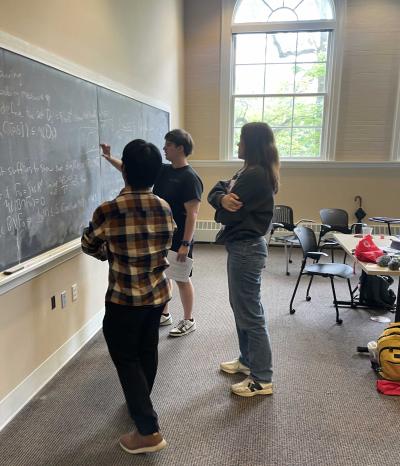
Last summer, the EULER Center kicked off its inaugural summer lab, a two-week undergraduate research experience in which participants used mathematical techniques to analyze brain activity data from children with epilepsy. After a few days of learning about the data and how to work with it, students broke into small groups and were each tasked with working on one piece of a larger problem.
“The goal is for students to continue working on the project throughout the summer and into the coming academic year,” said Chubb. “By next summer, some will have graduated, but we expect others will want to stay involved, and we’ll bring in a new group of students to work alongside them. Ideally, it becomes a year-to-year model, similar to how a research lab functions in other sciences.”
One participant in the summer lab said that it was a fun and educational experience.
“The program was very well-run with a lecture on relevant information before we moved onto practice problems for the first few days,” said Diddi Ragan Steinsson, who is double-majoring in physics and math. “I was able to experience what math research is like and how collaboration may work in a research group.”
As Chubb and Melanson prepare for the next academic year, they have two programs that they intend to bring to life—the EULER Cohort and EULER Scholars.
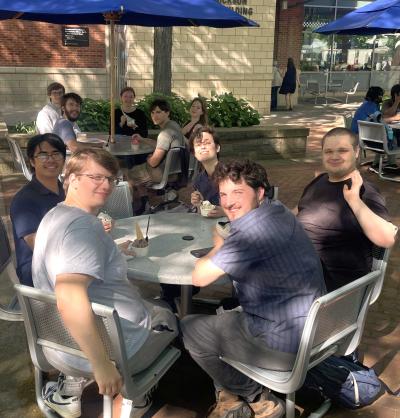
The EULER Cohort will start in fall 2026 with a two-part focus: helping first-year math students form connections with their peers and with faculty in the department and exposing them to ideas from higher-level math.
“The idea behind the cohort is to help students find a sense of community and belonging in the Department of Mathematics, as well as help grow their mathematical identity,” said Melanson. “I’m also looking forward to sharing more advanced mathematics with our first-year students to get them excited about being a math major.”
As part of the efforts to foster a sense of community and expose students to the breadth of mathematics, the EULER Center will be piloting an experiential learning course for the cohort. Titled Math Lab, this First-Year Seminar course will provide an opportunity for the students to connect with peers and explore new mathematics.
“The plan is to have this group of students work together their first semester on interesting problems outside the scope of the standard curriculum,” added Melanson. “There will also be a second semester sequence of courses, including a more applied math lab that integrates with the Pritchard Fluids Lab, a physical lab space that is currently undergoing renovations to support undergraduate involvement. Students will be in the lab observing experiments and connecting what they see back to theory from the classroom. I think most math students would never imagine getting this kind of practical lab experience.”
The second program in the works, the EULER Scholars, will be a semi-selective program for which interested students will need a faculty endorsement to join. Chubb said that this program would be open not only to students that start in the math major, but also to those that come to math further along in their academic careers. The Department of Mathematics typically welcomes around 35 new first-year students each fall, but the graduating classes are closer to 100 in size.
“With the EULER Scholars program, we want to offer resources for students who are engaging in mathematics in a deeper, more sustained way,” said Chubb. “Our hope is that it will strengthen the department from within and draw students who may not have originally seen math as their academic home.”
Chubb said she hopes the Scholars program will offer funding to students to travel to academic conferences, allow them to take supplementary short courses with department or visiting faculty, and connect them with research experiences.
Chubb and Melanson said they are excited about seeing the EULER Center’s vision come to fruition.
“The summer program that’s wrapping up has been a great experience, and I’m looking forward to growing that,” said Chubb. “I’m also excited about putting together the courses for the cohort pilot and laying the groundwork for the Scholars program.”
Melanson added, “The cohort program is going to be a great way to help students who might not feel connected to a home within the University see that they belong here.”