
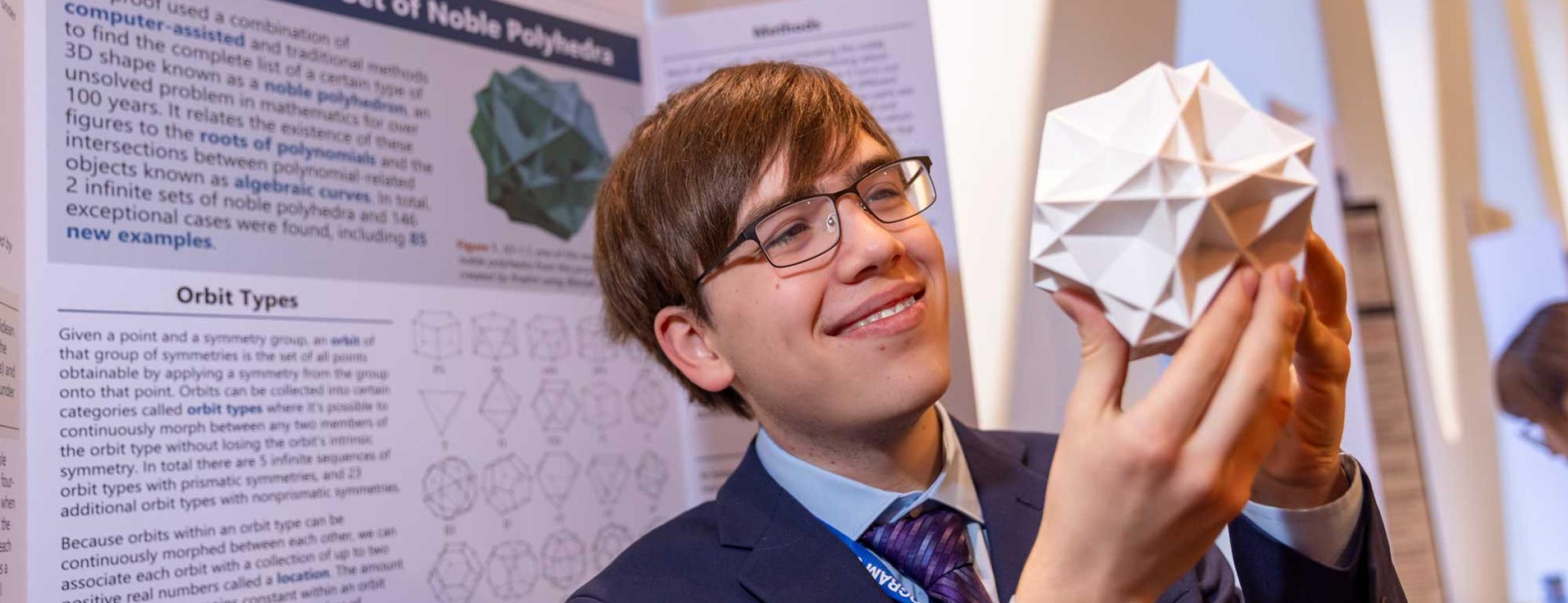
Pursuing a Mathematical Proof Pays Off for Dual-Enrollment Student





When Connor Hill reached out to a Penn State mathematics professor as a ninth grader in high school, he had no idea how it might shape his future. What started as attending math seminars at Penn State eventually led to conducting independent research and competing in—and winning—a prestigious national competition for high school STEM students.
Hill, who graduated from Delta High School in State College, Pennsylvania, in spring 2026, said he has always been interested in STEM (Science, Technology, Engineering, and Mathematics) fields. He participated on the Centre County 4-H Robotics team, volunteered at summer camps at Penn State's Shaver’s Creek Environmental Center, and worked with his school’s tutoring center to help other students, including for a calculus class. But he also enjoyed learning about math in his free time, and his interest in a particular kind of mathematics called set theory led him to Jan Reimann, associate professor of mathematics in the Penn State Eberly College of Science.
“I wasn’t quite sure what to expect the first time I met with Connor, but I quickly realized that he really knows his stuff.” Reimann said. “Over the years, he has essentially become another member of my research group, acting much like a graduate student. It’s amazing to see how quickly he absorbs things.”
After that initial meeting, Hill quickly became a regular attendee of a public research seminar that Reimann hosted and later took 200-level math courses through Penn State’s dual enrollment program. Knowing that Hill was up for the challenge, Reimann also allowed Hill to audit one of his 400-level courses.
“The seminar introduced me to a lot of fascinating areas of mathematics that I never would have thought to look into before, and the courses provided good foundational knowledge to build upon,” Hill said. “It’s been so great to have these opportunities and to work with Jan.”
After becoming a familiar face at the seminars, Hill began meeting with Reimann to discuss how to dig deeper into one of the questions that he had discovered.
“I had found a topic online that really interested me and I wrote a computer program to do the calculations to explore this question,” Hill said. “But when I went to formalize these ideas to write a proof that could be published, I realized I was out of my depth, so I reached out to Jan again.”
Hill was investigating a type of polyhedron—a shape with flat sides and straight edges, like a cube or pyramid—referred to as noble polyhedra. To be considered noble, Hill said, the sides of the polyhedra must be the same shape, and the angles at each corner must be the same.
“A cube is a good example of a noble polyhedron, because all of its faces are the same shape—squares—and all of its corners are the same angle of 90 degrees,” he said. “But noble polyhedra can be far more complex, especially if the sides are allowed to intersect each other. Mathematicians had previously discovered 61 isolated examples as well as two infinite sets of noble polyhedra, but most of this was based on trial and error and guesswork. I wanted to produce a mathematical proof called an enumeration that essentially listed out every possible noble polyhedron.”
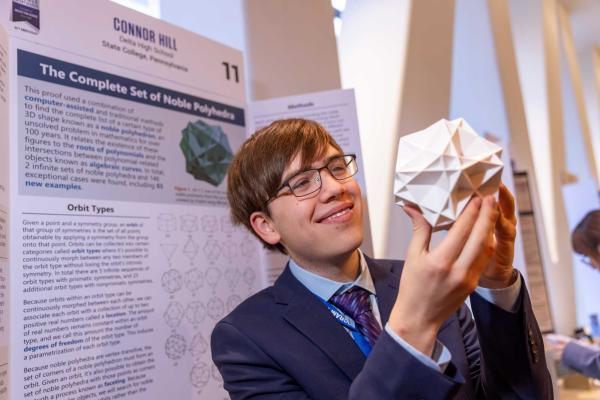
Combing different approaches from algebra, Hill developed a new strategy to identify noble polyhedra, eventually coding a computer program to work through the millions of candidates.
“We met almost weekly for a time,” Reimann said. “We had really long, intense discussions about math. We went over his proofs step by step. Together, we figured out which points needed to be clarified, and where using a different mathematical concept could simplify things. I learned a great deal from our discussions as well. It was very much like working with a graduate student.”
Hill determined that, in addition to the two infinite sets, there are 146 noble polyhedra. The result, he said, is interesting mathematically even if it may not have any immediate applications, but he hopes that the approach could be used, for example, to find shapes made by interconnecting multiple polyhedra.
“There are many examples of math concepts being pursued out of curiosity that later were quite impactful,” he said. “For example, a type of mathematical operation called the Fourier transform was initially investigated for its mathematical aspects but now is extremely useful in audio processing. It goes to show that even when mathematics doesn’t seem immediately useful, it can eventually be helpful in our daily lives.”
When a family friend learned that Hill was conducting research at Penn State, he suggested Hill compete in the Regeneron Science Talent Search, the oldest and most prestigious science and math competition for high school seniors in the United States. Although Hill wasn’t convinced his work would be competitive, he decided to apply. Of more than 2,600 entrants, Hill was selected as one of 40 finalists, for which he was awarded a monetary prize and was invited to participate in the week-long competition in Washington, D.C. in March 2026. There, he met other finalists and leading scientists, presented his research, and was evaluated on his general STEM knowledge and scientific reasoning skills.
“When I learned I was a finalist, I was floored,” he said. “I never expected to move on. I really enjoyed going to D.C., meeting the other finalists, and hearing about their research, which was so different than mine. In between events, they had a break room where we could play board games and connect with other finalists, which was really enriching.”
At the end of the week, the top ten competitors were announced at a gala.
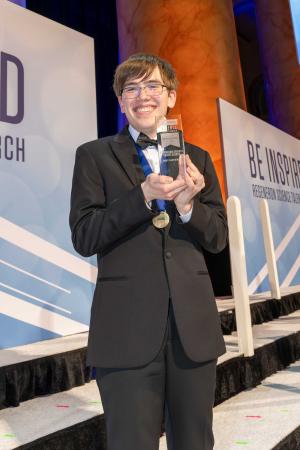
“By the time they were announcing the top three, I assumed that I hadn’t gotten into the top ten,” he said. “It was exhilarating to hear my name announced as first place. It was an amazing feeling.”
Since graduating high school, Hill has been working with Reimann to submit his proof for publication in a scientific journal. Thanks to the prize winnings from the Regeneron Science Talent Search, he is now majoring in mathematics at MIT in the fall and rooming with a fellow finalist.
“It was really meaningful to get recognized by the Regeneron Science Talent Search,” Hill said. “I was close to not even applying because I thought that it wasn't that important of a research topic, so the fact that I've been proven wrong in such a good way has been really inspiring. I hope this could be inspiring for other high schoolers as well, who might be interested in pursuing their own research.”
Hero image credit: Society for Science/Chris Ayers Photography