Physical Sciences

Penn State Astronomers Discover Well-Established Black Holes in Distant Quasars
Image
Penn State Astronomers Discover Well-Established Black Holes in Distant Quasars
Planets of the Phoenix: Astronomers Predict Rebirth of Planetary Systems in the Embers of Dead Stars
Image
A diagram of how planets become unstable around white dwarfs. As a star becomes a white dwarf the planets expand their orbits slowly. They then become unstable and experience chaotic orbits that eventually become radically different, drastically affecting their surroundings. This illustration was created by actual output of computer simulations performed at Penn State and presented at the American Astronomical Society meeting in Washington, DC on 7 January 2002 PHOTO CREDIT: John Debes, Penn State
Penn State a Partner in New Global Data Grid
In Powerful Gamma-Ray Bursts, Neutrinos May Fly Out First, Scientists Say
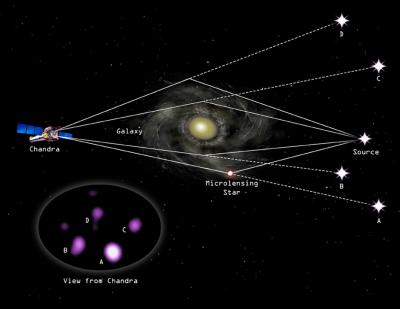
X-ray Emissions Detected from Elusive Cosmic Object
Image
X-ray Emissions Detected from Elusive Cosmic Object
Penn State and SurroMed Describe Submicrometer-Scale Metallic Barcodes
Image
Penn State and SurroMed Describe Submicrometer-Scale Metallic Barcodes
New Center for Gravitational Wave Physics Established at Penn State
Supercomputer Simulations Reveal Strongest Carbon Nanotubes
Image
A computer-generated color image of the structure of a carbon nanotube. Image courtesy of Vincent Crespi and Dragan Stojkovic, Penn State.
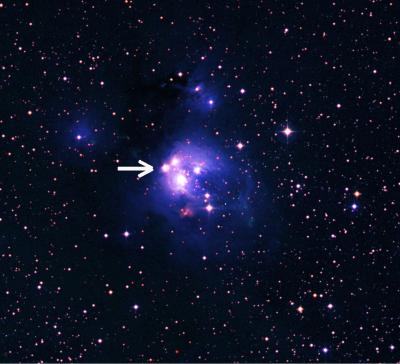
Young Stars in Orion May Solve Mystery of Our Solar System
Scientists Find X-Rays from Stellar Winds That May Play Significant Role in Galactic Evolution
Image
A smoothed X-ray map of the Rosette Nebula region. The colors represent the energy of the X-radiation: red shows low-energy (0.5-2 keV) X-rays while blue shows high-energy (2-8 keV) emission. The mosaic is formed from four ACIS images, starting with the OB association at the center of the Rosette Nebula on the right and stepping southeast (left) into the Rosette Molecular Cloud.
Subscribe to Physical Sciences