Life Sciences

Sensory response to environmental stimuli modulated by form of vitamin B3 in worms
Image
An adult Caenorhabditis elegans worm. A form of vitamin B3, nicotinamide, modulates the worm's sensory response to environmental stimuli. Credit: Kbradnam, https://creativecommons.org/licnses/by-sa/2.5/
Using satellite images to better target vaccination
Image
Composite image of the Earth at night assembled from data acquired by the Suomi National Polar-orbiting Partnership (Suomi NPP) satellite over nine days in April 2012 and thirteen days in October 2012. Population estimates based on similar satellite data can help improve vaccination campaigns. Credit: NASA Earth Observatory/NOAA NGDC.
RNA, gravitational waves focus of two new grants
NSF grant to promote more diversity, inclusion in STEM fields
Image
NSF-INCLUDES is aimed at broadening STEM participation among underrepresented groups, including women, Hispanics, African Americans, Native Americans, persons with disabilities, people from rural areas and people of low socioeconomic status. Image: © iStock Photo Steve Debenport
Katriona Shea Elected as Fellow of Ecological Society of America
Image
Kat Shea
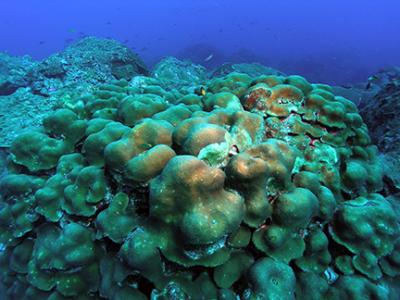
Coral conservation efforts aided by computer simulations: New research shows that endangered corals in the eastern Pacific Ocean are isolated from healthy coral populations in the west
Image
Coral releasing egg/sperm bundles which will be fertilised in the water to form poppy-seed-sized larvae. Credit: Jamie Craggs, Project Coral, Horniman Museum and Gardens
John Lin to Represent Penn State's Eberly College of Science as Student Marshal at Summer Commencement 2016
Image
John Lin
New clues could help scientists harness the power of photosynthesis
Image
Model of the newly-identified clorophyll f synthase enzyme that converts chlorophyll a into chlorophyll f. The model is based on the known structure of the Photosystem II reaction center -- a core unit of the machinery of photosynthesis to which the enzyme is related. The bright green molecules near the bottom of the structure represent chlorophyll a molecules that would be modified in light to produce chlorophyll f. Credit: Bryant lab, Penn State University
Discovered: How to unlock inaccessible genes
Image
This image shows the binding profile of chromatin remodelers on 12,000 distinct genes. The researchers used bioinformatics tools to visualize a great number of genes, here aligned by their promoters and arranged according to their nucleosome distribution. Credit: Matthieu Gérard, University of Paris-Sud
Penn State, TB Alliance, and GSK Partner to Discover New Treatment Options for Tuberculosis
Image
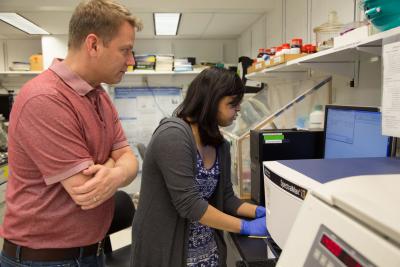
Professor of Biochemistry and Molecular Biology Kenneth Keiler and biochemistry, microbiology, and molecular biology graduate student Farina Haque work in Keiler's lab.
Subscribe to Life Sciences