
Renewable resource: sulfur is used, replenished to produce lipoic acid
Image
Model of the crystal structure of the lipoyl synthase enzyme (LipA) from the bacteria Mycobacterium tuberculosis revealing the destruction of one of its iron-sulfur clusters (orange and yellow balls) to use as a sulfur source for the production of lipoic acid. New research demonstrates that the iron-sulfur cluster that is destroyed during the production of lipoic acid is replaced by an iron-sulfur carrier protein, NfuA, so that LipA can continue to produce lipoic acid. Credit: Booker laboratory, Penn State
Stone Memorial Lecture set for October 23
Image
Michael Laub
New statistical method for evaluating reproducibility in studies of genome organization
Image
Schematic representation of the HiCRep method. HiCRep uses two steps to accurately assess the reproducibility of data from Hi-C experiments. Step 1: Data from Hi-C experiments (represented in triangle graphs) is first smoothed in order to allow researchers to see trends in the data more clearly. Step 2: The data is stratified based on distance to account for the overabundance of nearby interactions in Hi-C data. Credit: Li Laboratory, Penn State University
Simpson and Priestley Lectures set for October 2 and 3, 2017
Image
Balasubramanian poses for the camera.
Pollard Lecture Set for September 28
Image
Richard Henderson
$4.92M gift to Penn State for new industrial biotechnology center

Image
A rendering of the proposed Shared Fermentation Facility lab.
Bryant receives D.C. White Research and Mentoring Award from the American Society for Microbiology
Image
Don Bryant
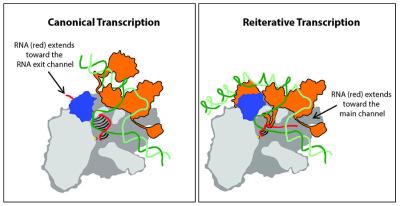
Out through the window: Crystal structure reveals details of nonstandard RNA transcription
Image
Schematic of alternative pathways for transcription elongation complex formation. During canonical transcription (left) the growing strand of RNA extends toward the RNA exit channel of RNA polymerase. New, high-resolution crystal structure determined in this study shows that during reiterative transcription (right) the RNA extends toward the main channel of RNA polymerase. Credit: Murakami laboratory, Penn State
Graduate student Ericka Reed awarded Gilliam Fellowship by the Howard Hughes Medical Institute

Image
Ericka Reed at the lab bench
New, more sensitive sensor for evaluating drug safety
Image
Image of cells expressing the AgHalo sensor before (left) and after (right) cellular stress. The AgHalo sensor is turned on when misfolded proteins begin to aggregate and provides a quantitative measure of cellular stress that can be used to evaluate drug safety. Credit: Yu Liu, Penn State University
Subscribe to Biochemistry and Molecular Biology