
Astronomy and Psychology Student Shines Light on Light Pollution




Nearly 80 percent of North Americans can’t see the Milky Way in the night sky due to light pollution, according to “The New World Atlas of Artificial Night Sky Brightness,” a study conducted in 2016. Elise Abbott, an undergraduate student studying planetary science and astronomy and psychology, spent her summer in State College working on a research project to raise awareness about the negative effects of light pollution.
As part of the project, the research team developed two different planetarium shows designed to teach viewers about the night sky and the challenges caused by light pollution, which range from decreased sky visibility to impacts on circadian rhythms and behavior of both humans and animals. Each show was presented five times, and the researchers also investigated whether watching the show encouraged viewers’ motivations to combat this type of pollution.
Abbott joined the research group, co-led by Julia Plummer, professor of education in the Penn State College of Education, and Christopher Palma, teaching professor of astronomy and astrophysics in the Penn State Eberly College of Science in the fall of 2024. Since then, Abbott has assisted with writing and editing the scripts for the planetarium shows and conducting data analysis and surveys of attendees.
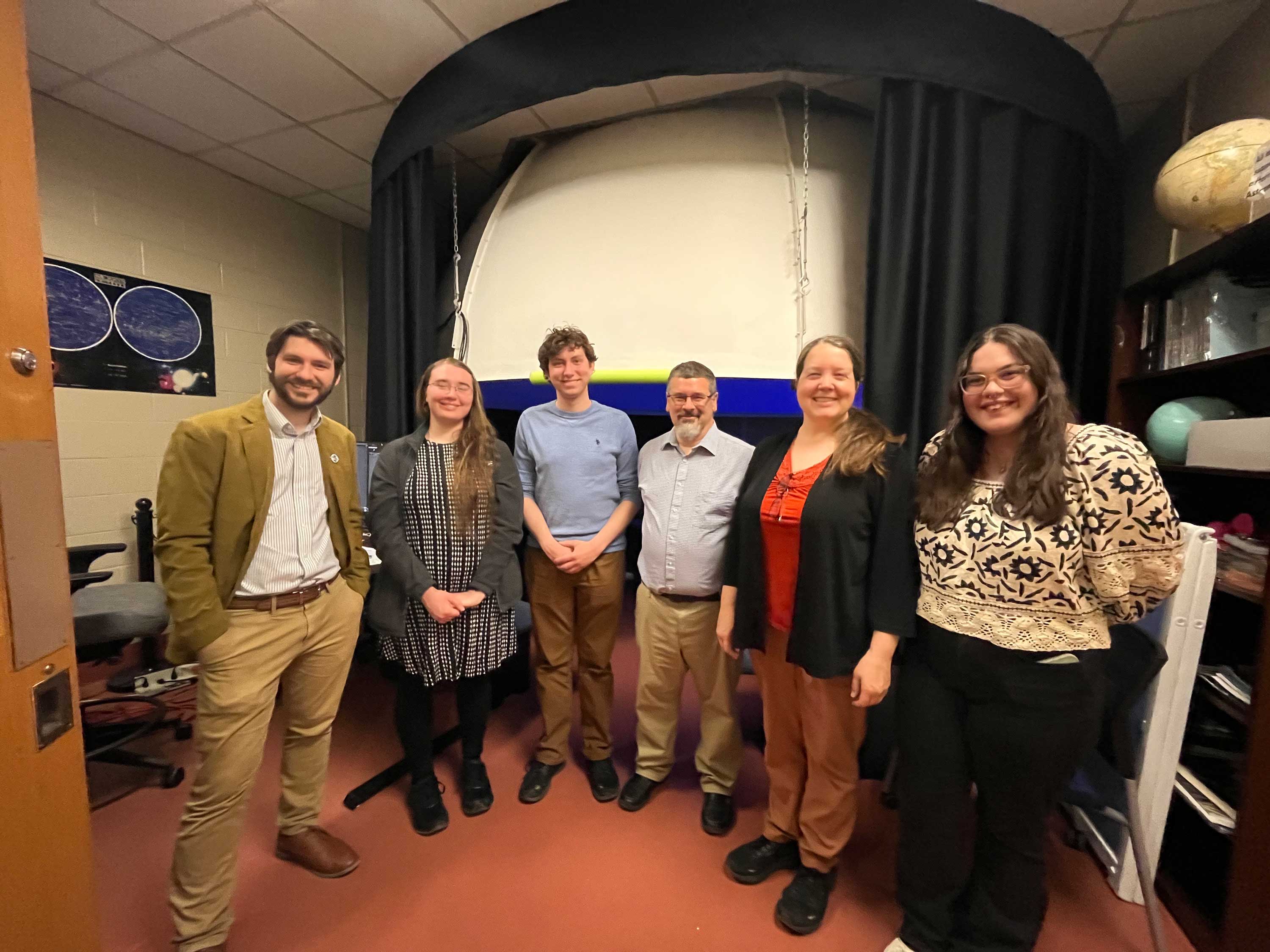
The research project began when Palma and Plummer agreed to start a new project that took advantage of the planetarium’s new projector, which was acquired by the Department of Astronomy and Astrophysics in 2023.
“I suggested we could study how audiences learn from storytelling in the planetarium, while Chris suggested that we could focus on developing a program focused on light pollution as this is an important area of concern in astronomy,” said Plummer. “These goals worked together well, which then became the focus of the research and planetarium development.”
In 2025, Abbott received an Erickson Discovery Grant to pursue this research after expressing interest in using this project for her honors thesis. The Rodney A. Erickson Grant program is administered by the Office of Undergraduate Education and is designed to support undergraduate student engagement in original research, scholarship and creative work under the supervision of a research mentor.
“This project seemed like a perfect balance between my two majors, and the narrative learning aspect especially sparked my interest,” said Abbott. “Once we got started, it was easy to get invested in stopping light pollution. It’s frustrating how badly it affects our health and environment, but it’s also one of the most easily reversible forms of pollution.”
She hopes to see even a small impact as a result of this research.
“Any small difference can help,” Abbott said. “Even if it’s improving your own experience with light pollution, the idea is to make people more aware of the issue and more willing to speak up.”
Some examples of ways to combat light pollution, according to DarkSky.org, include using warm-colored LED lightbulbs, lights with motion sensors and timers, and avoiding blue lights at night.
Abbott said she enjoyed the opportunity to blend her passions with this project.
“The scriptwriting process and learning contents of the program align with my astronomy major, whereas the survey design and data analysis component utilize what I’ve learned from my psychology major,” she said. “I’m thrilled to be a part of a project that allows me to build on both of my majors.”
The team is currently working on finishing their data analysis and submitting proposals to present and disseminate their findings at various science education conferences.