

We've Got an App for That: Statistics for Students, by Students




Most people interact with apps every day on their computer or phone—some to check emails, scroll on social media, or even to learn statistics.
Since 2017, many undergraduate students have spent their summers engaging in a full-time research experience developing free web applications for statistic courses at Penn State. Over the last seven years, students have helped develop the Book of Apps for Statistics Teaching, or BOAST, which functions much like an interactive statistics textbook and has grown to span twelve chapters ranging from introductory topics to advance statistical course material.
The program, originally developed in 2017 by Dennis Pearl, research professor of statistics, has been co-led by Pearl and Neil Hatfield, assistant research professor of statistics, since 2019. In the years that the program has been active, more than 60 undergraduate students have contributed to the development and creation of these apps.
“At its core, BOAST is about students helping other students learn important ideas in statistics and data science,” said Hatfield. “During the summer, students typically work in small teams to develop new statistics apps and refresh existing apps.”
Typically, these projects are student-led with participants either pitching new applications to be developed or selecting from a pool of faculty suggestions.
“In the summer of 2024, I participated in the BOAST program as a research assistant, where I helped work on several apps including one that teaches variable types via a matching game, one that explores the assumptions for an analysis of variance test, as well as a correlation and regression line game,” added Nathan Pechulis, a fourth-year student majoring in statistical modeling data science and a member of the Schreyer Honors College.
After a topic has been selected, students work in groups to deepen their statistical knowledge in that area and then transition from students to teachers. Groups then think about how they can creatively translate statistical concepts into interactive apps for their peers to use. They then build the app, gaining expertise in the programming language, R, and the app-coding package, R Shiny.
Once the app has been created, students self-evaluate, participate in peer review of the applications, and present their app during a one-credit course in the fall. The process of app development, testing, and evaluation mimics what students might go on to experience if they helped develop apps in industry settings.
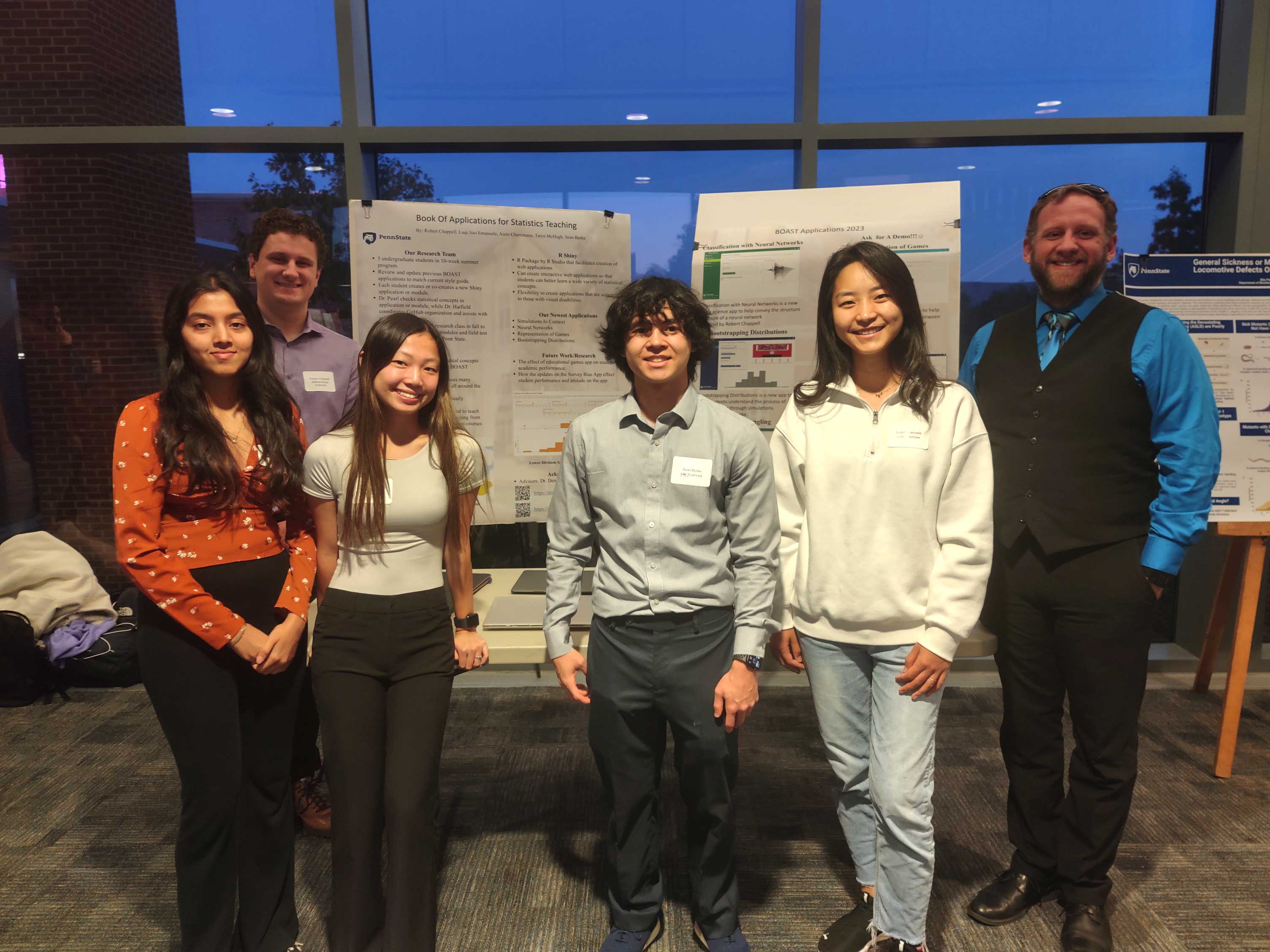
“I really enjoyed my work in the BOAST program, and it was a great learning experience for someone who had no academic-related work experience prior to the program,” said Pechulis.
Once apps have been tested and refined, they are integrated into statistic courses at Penn State.
“Courses ranging from the 100 to 400-level use BOAST apps, in and outside of the classroom,” shared Hatfield, who personally uses BOAST in his class, STAT 184: Introduction to R, where students learn the fundamentals of the programming language R. “Students in my section use the Data Wrangling app to deepen their understanding of data organization and categorization. This allows them to build fluency in the functions they will eventually use in R as the course progresses.”
BOAST has also expanded into other disciplines, and students have developed several biology-specific apps. Additionally, faculty at the University of Georgia, Appalachian State, and the University of Virginia have integrated BOAST apps into some of their statistics courses.
Pearl and colleagues published a research paper in 2017 describing the short-term educational outcomes from courses that used BOAST apps in laboratory sections. Additionally, Hatfield and Pearl received an award in 2024 from the Multimedia Educational Resource for Learning and Online Teaching (MERLOT) system, recognizing BOAST as an exemplary online resource for teaching and learning. Although the grant that initially supported BOAST has concluded, Hatfield is currently seeking additional funding to extend this successful program. In the meantime, BOAST apps will continue to provide an engaging way to learn concepts in statistics and other fields at Penn State and beyond.