

Who Needs a Membrane?




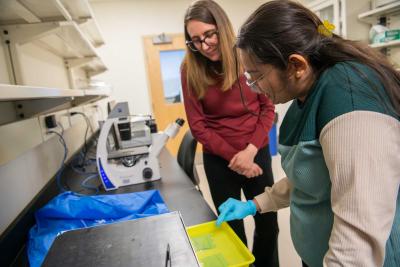
Sometimes when things go wrong in science it can lead to new insights that can help guide the trajectory of a career. Marina Feric, Robert and Peggy Schlegel Early Career Professor of Biochemistry and Molecular Biology and assistant professor of chemistry at Penn State, had one of these “happy accidents” as a postdoctoral researcher at the National Institutes of Health and the National Cancer Institute.
Feric studies the principles underlying how cells are organized, research that is motivated by a desire to understand aging, with the ultimate goal of increasing the human health span.
“I have a quote from the evolutionary biologist George C. Williams on my lab website, which lays out why aging is such a biological mystery,” Feric said. “Basically, the quote asks how an organism, like a human, can go through the unimaginably complex steps of developing from a single cell into an adult—requiring maybe billions of things to go right at the right time—then not be able to do the comparatively simple task of maintaining itself.”
The primary focus of Feric’s research is on a type of cellular organization that is likely unfamiliar to many. Most of us have seen the classic textbook illustration of a prototypical cell. The cell is bounded by a membrane and inside are several structures, called organelles, many of which have a membrane of their own—things like the nucleus, which contains most of the genetic material in the cell, or the mitochondria—the so-called powerhouse of the cell.
“Membranes are great at compartmentalizing cells,” said Feric. “They can sequester components required for a particular cellular function, which can increase efficiency and help to accelerate reactions. But there are many structures in cells that don’t rely on membranes, including some organelles, like, for example, the nucleolus and p-granules, yet can still maintain their own composition. Understanding these membraneless structures—now referred to as biomolecular condensates—and the role they may play in aging, is the focus of my research.”
Biomolecular condensates can form through a process called phase separation. A common example of which is how oil will begin to separate and form droplets that coalesce and grow after being thoroughly mixed in a vinaigrette. In cells, condensates form as droplets containing specific types of biomolecules that concentrate together for a particular function. Describing these membraneless structures as biomolecular condensates of the cell has been a huge paradigm shift in cell biology, Feric explained.
As an undergraduate student, Feric studied chemical engineering thinking she might eventually transition to becoming a medical doctor. Instead, she continued her studies as a graduate student at Princeton, where she focused on the biophysics of membraneless organelle formation. After earning her doctoral degree, she began studying these processes within the mitochondria as a postdoc at the NIH. Mitochondria have long been thought to play a role in the aging process—mitochondrial dysfunction is a major hallmark of aging, but it is still largely unclear why mitochondrial activity declines with age.
“Mitochondria are extremely active organelles, and they are unusual in that they contain their own genome, separate from what we tend to think of as ‘the genome’ found in the nucleus,” Feric said. “Mitochondrial DNA, or mtDNA, doesn’t just float around in the mitochondrial matrix, it is package by proteins and forms membraneless droplets, called nucleoids.”
While trying to image these nucleoids at the NIH, Feric noticed that instead of staying uniform in size and evenly spaced across the mitochondria, the nucleoids quickly started to fuse together, forming larger, much more prominent droplets, which resembled pathogenic nucleoids in a premature aging disease she was interested in.
“It turned out that one of the labels I was using to visualize the mitochondria reacted to the light of the microscope forming reactive oxygen species that stressed the mitochondria, mirroring what I saw in the premature aging disease,” Feric said. “I was taken by surprise, but it helped us develop a much more controlled system that we are now using to study how these coarsened nucleoids form over the course of aging.”
Feric’s lab now focuses on these biomolecular condensates of mtDNA and proteins within the mitochondria and their role in aging and age-related diseases using approaches including biophysics, biochemistry, cell biology, and advanced microscopy. To do so, she has recruited graduate students from diverse scientific backgrounds, whose areas of expertise complement one another. Their research ranges from how mitochondrial condensates form, what role they play in controlling gene expression from mtDNA, what can go wrong that influences aging, and how these condensates coordinate with the activity of the nuclear genome.
“We are trying to build our understanding of the structure and function of these biomolecular condensates from as many different angles as we can,” Feric said. “Eventually, we hope that this leads to breakthroughs that could increase human health span and potentially reverse the interactions that lead to aging.”