

Is AI for exam prep cheating?




Students must constantly navigate new tools and technology to help them learn class material. They want to do as well as possible in their classes, but somewhere there is a line, that if crossed, turns “using technology” into something that could be unethical. “Can I use a calculator on this test?” Depends. “Can I use a writing assistant, like Grammarly, to check my essay?” Maybe. “Can I ask ChatGPT to write my term paper?” Almost certainly not!
As technology advances, the questions only become more fraught, and opportunities to cross over the line become easier. While large-language models, like ChatGPT and Microsoft’s Copilot, or other AI tools can be used in ways that would raise issues of academic integrity, if used properly, they can also be effective study tools. Since the fall of 2024, students in the honors section of CHEM 110—an introductory chemistry course—have been getting first-hand experience in using AI to help them prepare for exams in ways that are appropriate and effective. The course’s instructors tracked the students’ experiences and how their perceptions of AI use changed during the course.
“I am extremely interested in education research and care deeply about how my students learn, so I wanted to see if we could incorporate a fun research project into the course,” said Morgan Vincent, a graduate student in chemistry and teaching assistant for the class. “We came up with the idea of integrating the use of AI as a study tool for exam prep. We wanted to see if we could introduce the students to a new tool, teach them how to use it, and see how it impacted their study habits.”
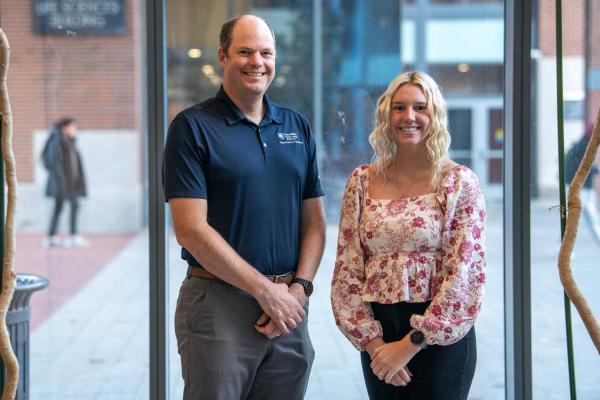
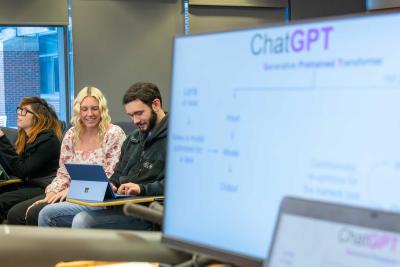
Vincent worked with Professor of Chemistry Ben Lear, the instructor for the course, to incorporate the use of AI into the curriculum. They started with a pre-course survey to gauge the students’ knowledge, comfort level, and opinions about AI. They then dedicated a class session to walking the students through ChatGPT—what it is and how it works—and how it can be used appropriately for their course.
“Every class is going to be different, so we talked about how students can check for AI policies on syllabuses or talk to their professors,” Vincent said. “For our class, we said that students could use AI for anything that they would use a friend for—help with homework problems or studying, things like that.”
Over the course of the semester, students were asked to use AI to explore a question from a practice exam that they struggled to understand. Vincent and Lear coached the students on how to provide effective prompts to get relevant and accurate information, and students were asked to reflect on the process before and after taking the actual exam.
“These AI tools are going to be around in one form or another,” said Lear. “It feels to me like when the internet first was introduced. Educators struggled to know what to do with it and students were wary of it—and rightly so. We are taking this proactive step to try to help students navigate how to use AI in a way that is effective for them and how to know when they should use caution. It seems like an important thing to do.”
Vincent and Lear published their findings on using AI for exam preparation in the Journal of Chemical Education. Vincent will defend her dissertation early in 2026 then plans to continue to work with Lear to develop innovative ways to improve chemistry education as a postdoc.
Editor's Note: This story is part of a larger feature about artificial intelligence developed for the Winter 2026 issue of the Eberly College of Science Science Journal.