Q&A: IceCube Observatory upgrades improve search for elusive cosmic messenger




Buried within the Antarctic ice are more than 5,000 light sensors that work together to detect some of the highest energy particles in the universe. These tiny particles, called neutrinos, provide insight into the extreme cosmic events that created them as well as phenomena that challenge traditional physics.
Located at the U.S. National Science Foundation’s Amundsen-Scott South Pole Station, the IceCube Neutrino Observatory takes advantage of the pristine ice to detect the tiny, nearly massless neutrinos. Then, the international IceCube collaboration, with more than 450 scientists from around the world, reconstructs the neutrino’s characteristics and the direction it came from to determine its origin. Because neutrinos rarely interact with matter, they can travel across the universe without losing information and can therefore provide information about their sources that other particles, like photons, cannot convey.
The IceCube Observatory recently completed a major upgrade, the first since the observatory began operations in 2011, which will pave the way for new cosmic discoveries.
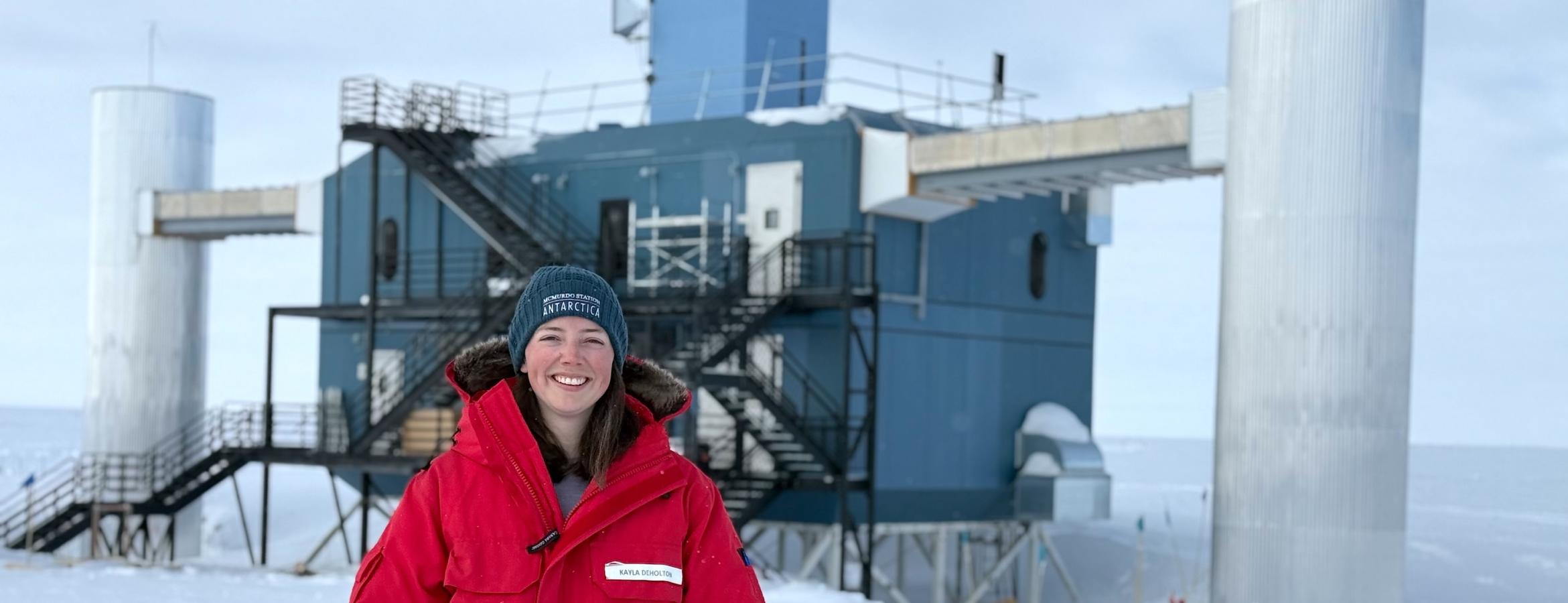
In the following Q&A, IceCube researchers Kayla DeHolton, Eberly Research Scholar in the Penn State Department of Physics, and Doug Cowen, professor of physics and of astronomy and astrophysics in the Penn State Eberly College of Science, discuss Penn State’s role in the IceCube collaboration and how the upgrades will support their research into extreme physics and astrophysical events.
Q: What are neutrinos, and what do they allow us to study?
Cowen: Neutrinos are tiny, nearly massless particles that can be produced by many different types of sources, including fusion in our sun’s core. For IceCube, we are mainly interested in astrophysical neutrinos created by some of the most energetic events in the universe, like exploding stars, gamma-ray bursts, and the mergers of black holes and neutron stars. Because neutrinos can travel through space without being deflected or absorbed, these cosmic messengers have a unique ability to provide information about where they came from, even if they originated billions of light years away.
DeHolton: Another way neutrinos are produced is when cosmic rays collide with Earth’s atmosphere. The resulting atmospheric neutrinos allow us to study a phenomenon known as neutrino oscillations. Neutrinos come in several different types, called flavors: electron, muon and tau. Sometimes, after a neutrino has travelled a long distance, it changes to a different flavor. It would be like going to the Penn State Berkey Creamery and getting a scoop of Grilled Stickies, but when you sit down at the table it has changed to Death by Chocolate. It’s very strange! So, some of the questions we are asking are how long a neutrino has to travel before changing flavors, or if a particular flavor can transform into new flavors we don't even know about yet. The IceCube observatory, and particularly the new upgrades, will help us answer these questions, even though the original IceCube detector wasn’t designed for this purpose.
Q: How does IceCube work? What will the upgrade allow you to accomplish?
DeHolton: IceCube has more than 5,000 sensors arranged in an array on cables, or strings, buried in the ice in Antarctica. As neutrinos pass through the pristine ice, they produce secondary charged particles that emit faint light. The IceCube team studies this light pattern to determine a neutrino’s flavor, energy and where it came from. The upgrade includes six new strings containing more than 600 new sensors and more precise calibration equipment. The upgrade will allow us to detect more events and to see events in more detail.
Cowen: The new strings are closer together and have much more accurate and controlled calibration equipment. The remotely controlled light sources we buried in the ice can emit light at different wavelengths and in many directions to really improve our understanding of how light moves through the ice. Ultimately, this will allow us to pinpoint the sources of astrophysical neutrinos with much greater precision. In fact, we can also look back at all of our previous data and sharpen the detected neutrinos’ directions from the patterns we already have seen. For example, we might be able to determine if two neutrinos came from the same or different sources, once a better understanding of the ice allows us to define a narrower window of the direction they came from.
Q: How have Penn State researchers been involved the upgrades?
Cowen: Before we made the proposal to NSF for the upgrades, we had to show that the upgrade would do what we wanted it to do. Here at Penn State, we simulated data that we would expect to get and analyzed the simulated data to quantify the expected performance. We recently published a paper that essentially shows how good the upgraded detector would be once it was put in the ice. A former Penn State postdoctoral scholar also helped develop the firmware for some of the new sensors.
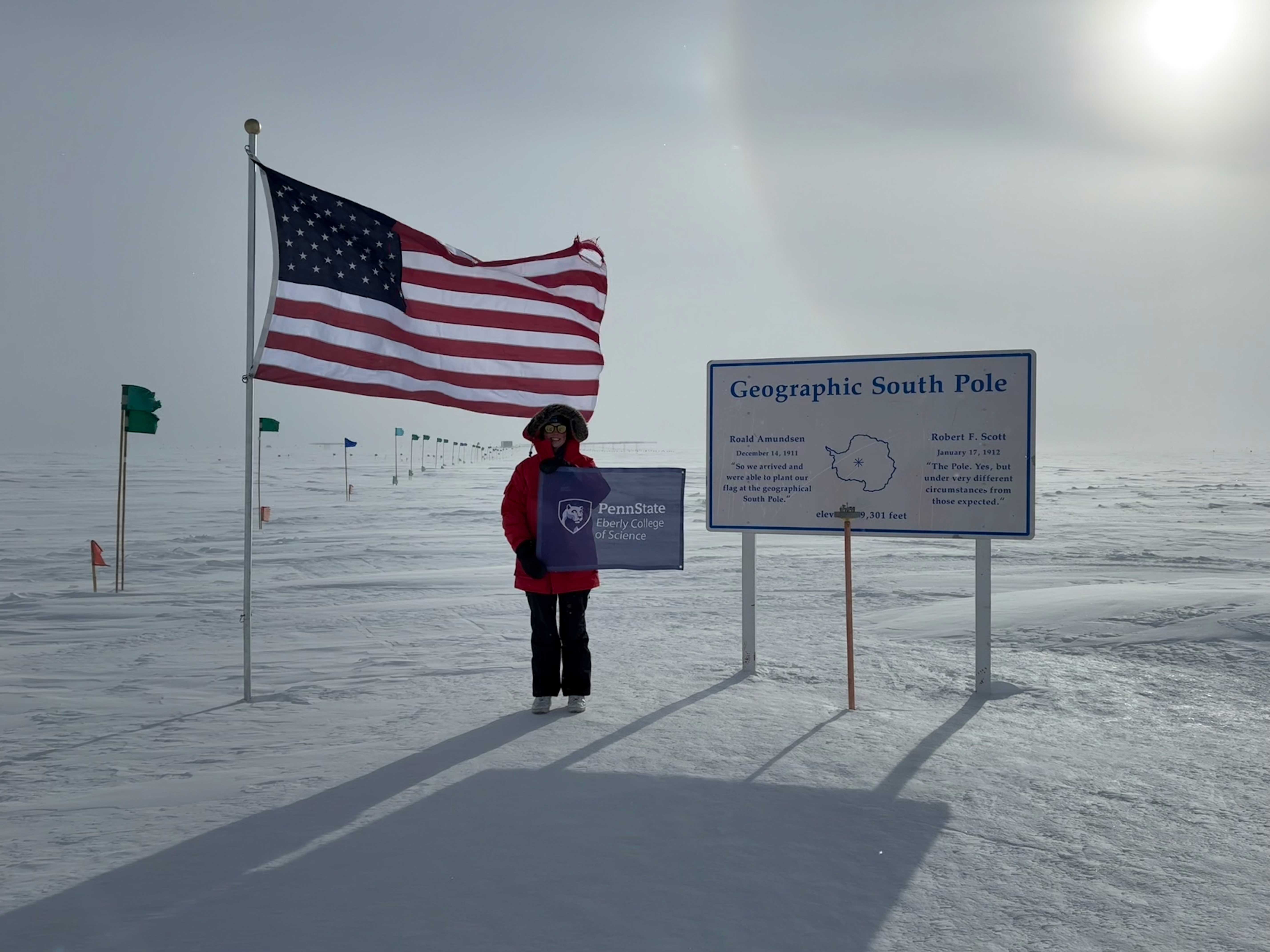
DeHolton: I co-lead the 30-member international working group dedicated to studying neutrino oscillations, and I also had the opportunity to travel to the South Pole to help with the installation of the upgrades. Because Antarctica is so remote, we did the on-ice upgrades over three 10-week field seasons over three years. I went during the second field season, where I built the electronics rack, installed power supplies and cables, and helped install the exterior cables from the main building to the location of the new strings. It was such an amazing experience. We had members there from across the world, including the U.S., Germany, Sweden, Japan, Tawain and Thailand. We were there over the new year, and everyone brought snacks and items for celebrations from home. It was very cool to see a little slice of life from so many different places.
Q: What is next for your team and the IceCube collaboration?
DeHolton: There are a lot of steps initially to make sure the detector is operating properly and that we are actually seeing neutrinos amidst the background noise before we start collecting data. One of the graduate students at Penn State plans to look at the first six months or year of data to help validate if the detector is performing as expected. Then we can really dig into analyzing newly detected events, improving our understanding of the ice, and looking back at archival data.
Cowen: We are also looking forward to IceCube Gen2, which would extend the detector to about 10 times the size — and ten times the sensitivity — than it is currently. The current upgrades and aspirations like Gen2 help ensure that IceCube remains at the forefront of neutrino astronomy for years to come.