
Q&A: Boosting NASA’s Swift Observatory to support continued space observation




NASA’s “rapid-response” space telescope is slowly falling out of orbit, but a daring mission this summer could allow the Neil Gehrels Swift Observatory to continue scanning the sky for many more years to come. In the first mission of its kind, a spacecraft will launch from Earth and rendezvous with Swift to boost it to a higher altitude and extend its life. Working together on the boost mission are Katalyst Space of Flagstaff, Arizona; NASA’s Swift team, which includes the Mission Operations Center at Penn State; NASA’s Goddard Space Flight Center; and Northrop Grumman.
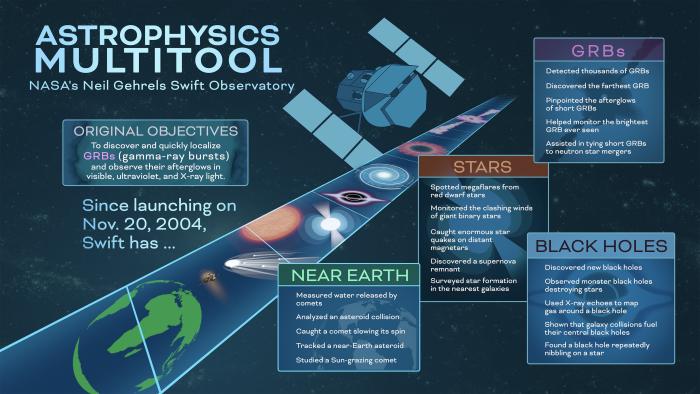
Since its launch in 2004, Swift has observed the most explosive events in the universe, called gamma-ray bursts, and a myriad of other phenomena. Its ability to rapidly point in the direction of cosmic events, sometimes on the scale of minutes, and to alert other observatories to follow up, has provided critical information for astronomical breakthroughs.
In this Q&A, John Nousek, Swift’s director of mission operations and professor of astronomy and astrophysics, and Michael Siegel, Swift’s Ultraviolet/Optical Telescope lead and research professor of astronomy and astrophysics, both in the Penn State Eberly College of Science, discuss Swift’s role in scientific discovery, the upcoming boost mission and activities at the Swift Mission Operations Center.
Q: What is Swift, and why is mission control at Penn State?
Siegel: Swift was originally designed to find and quickly observe gamma-ray bursts, which are some of the most powerful explosions in the universe. These explosions last only a few milliseconds to a few minutes. Their afterglows, which can produce X-rays, optical light and radio waves, can last from minutes to months. When Swift’s Burst Alert Telescope detects a burst, it automatically orients the spacecraft to take a closer look with its other two instruments, the X-Ray Telescope and the Ultraviolet/Optical Telescope. It also acts as a dispatcher, broadcasting the location to ground and space observatories that can follow up as well.

Nousek: When NASA announced Swift as part of its Explorer Mission, 53 groups put in proposals. In the end, the Penn State proposal with our collaborators at NASA Goddard and several international institutions was selected, I think in part due to the expertise in instrumentation at Penn State. We led the development of two of the three Swift instruments. Specifically, Penn State managed the electronics and provided the flight software for the X-Ray Telescope, which was originally led by David Burrows, professor emeritus of astronomy and astrophysics. Penn State also provided the flight software and leads the Ultraviolet/Optical Telescope, which is currently led by Mike.
I advocated for the Mission Operations Center to be located at Penn State because I wanted the opportunity for the folks who built the instruments to be able to stay on and operate them, which isn’t typical. We are one of few universities with an operations center on campus. We have engineers on the flight operations team, who are responsible for the health and safety of Swift, and a science operations team, who coordinate with researchers from across the world to identify other targets of interest.
Q: How does Swift contribute to scientific discovery?
Nousek: Swift has detected more than 1,760 gamma-ray bursts in its history, which tell us about collisions of neutron stars and black holes. But Swift observations tell us so much more. Long-term studies of galaxies provide information about the black holes at their centers — and the ones that stray from galaxy centers — and we have studied many supernovae as dying stars explode with a flash of X-rays.
At Penn State, we have groups studying populations of stars in nearby galaxies, the effects of dust on ultraviolet light, rare and unusual stars, and binary systems where a neutron star or black hole accretes material from a nearby star. We have also made some contributions to comet science, which was not something we anticipated when we built Swift. If it's not a planet or the sun, we probably have looked at it.
Siegel: Because of Swift’s capabilities of rapid response and obtaining simultaneous X-ray and ultraviolet imaging, researchers have found many interesting things to do with the satellite. Most observatories require planning days, weeks or more in advance, but we can hijack what we designed for gamma-ray bursts to respond quickly to other triggers — like gravitational waves or supernovae — often automatically without any human involvement within a matter of minutes.
For example, when an observatory like the Laser Interferometer Gravitational-Wave Observatory (LIGO) detects a gravitational wave, we can rapidly follow up to try to identify other signals — other cosmic messengers — from the same source, really embracing the idea of multi-messenger astronomy. Swift helped capture a part of the electromagnetic spectrum that you can’t get from the ground, and it was this combination of signals in 2017 that helped confirm the source of the very first gravitational waves that LIGO detected 100 years after Einstein first predicted them.
Q: Why is Swift falling out of orbit, and why did NASA decide to boost it?
Nousek: In the normal course of orbiting the Earth, Swift interacts with particles in the atmosphere, which causes it to slow down, so its altitude has gradually decreased over the years. As it gets lower, where the atmosphere is thicker, there is even more drag that slows it down even more. And a recent period of unusually high stellar activity temporarily warmed the atmosphere enough to cause even more drag. Swift doesn’t have any propulsion of its own, so we originally made a plan for it to enter Earth’s atmosphere at the end of its life, as with many satellite missions. However, Swift is still perfectly functional and has immense scientific value.
This is the first boost mission using a purpose-built satellite, and it also serves as a proof-of-concept. For example, NASA’s Hubble Space Telescope was maintained and boosted every time it rendezvoused with the space shuttle, but there is no longer a space shuttle to perform that function. There is interest in private companies helping to maintain, boost and safely deorbit satellites, which are used not only for scientific purposes, but for a variety of every-day uses like communications, broadcasting and navigation.
Siegel: Katalyst, NASA and Northrop Grumman have been working quickly to develop all the necessary elements to lift Swift. Here at the Mission Operations Center, we have been working closely with NASA Goddard to keep Swift in space for as long as possible. We recently paused scientific operations so we could orient the satellite in a very specific way that reduces the amount of drag and slows its fall. Part of what makes this mission possible is the institutional memory we have here at Penn State and at Goddard, to keep Swift up as long as possible and to manipulate it in such a way that it can interact with a spacecraft that it was not designed to interact with.
Q: What will happen during the boost mission?
Nousek: The plan is to send Katalyst’s robotic servicing spacecraft, LINK, to rendezvous with Swift in orbit, where it will boost Swift to a higher altitude. LINK’s journey has several phases, which involves getting a ride on Northrop Grumman’s Pegasus XL rocket. First, the L-1011 Stargazer airplane — suspending Pegasus and LINK beneath it — will take off. Once at 40,000 feet, Pegasus will carry LINK into orbit. Then LINK will separate and use its own propulsion system to make its way to Swift, which will take about a month. Then, LINK will use its three arms to clamp on to Swift
will take about another several months to boost Swift to an ideal altitude before LINK lets go.
Q: What will the Missions Operations Center be doing during the mission?
Nousek: Prior to the rendezvous, we’ll be doing a lot of what we typically do at the Missions Operations Center, monitoring real-time information from the spacecraft to ensure health and safety of the satellite and its instruments. We stay on call 24 hours a day in case we get an alert that something is out of normal operating range. Swift orbits the Earth every 96 minutes, and each time it passes overhead, there’s a window of about 7 to 10 minutes where we can send commands and Swift can send additional data to the ground, so that’s when we would usually send information about scientific targets.
As we get closer to the rendezvous, we will be extra vigilant. We’ll also use the cameras on LINK to take close-up pictures of Swift to assess 20 years of wear. The cameras will help us send commands to orient Swift to just the right position for LINK to clamp on. We’ve already practiced this process of posing for pictures, using ground and space satellites which are much further away.
Q: How can we follow along with the boost mission?
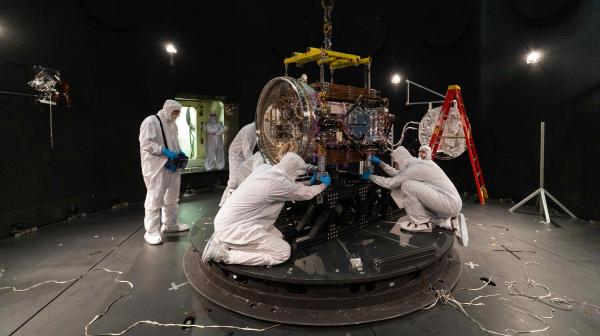
Siegel: The initial launch should occur in late June, and NASA will be posting updates on the Swift website. In May, LINK completed vibration testing at NASA Goddard to ensure it can stand up to the shaking of the rocket and recently traveled to NASA’s Wallops Flight Facility in Virginia to be inserted into the rocket. We’re excited for this mission, and we hope the result is another 10 to 20 years of observation and discovery.
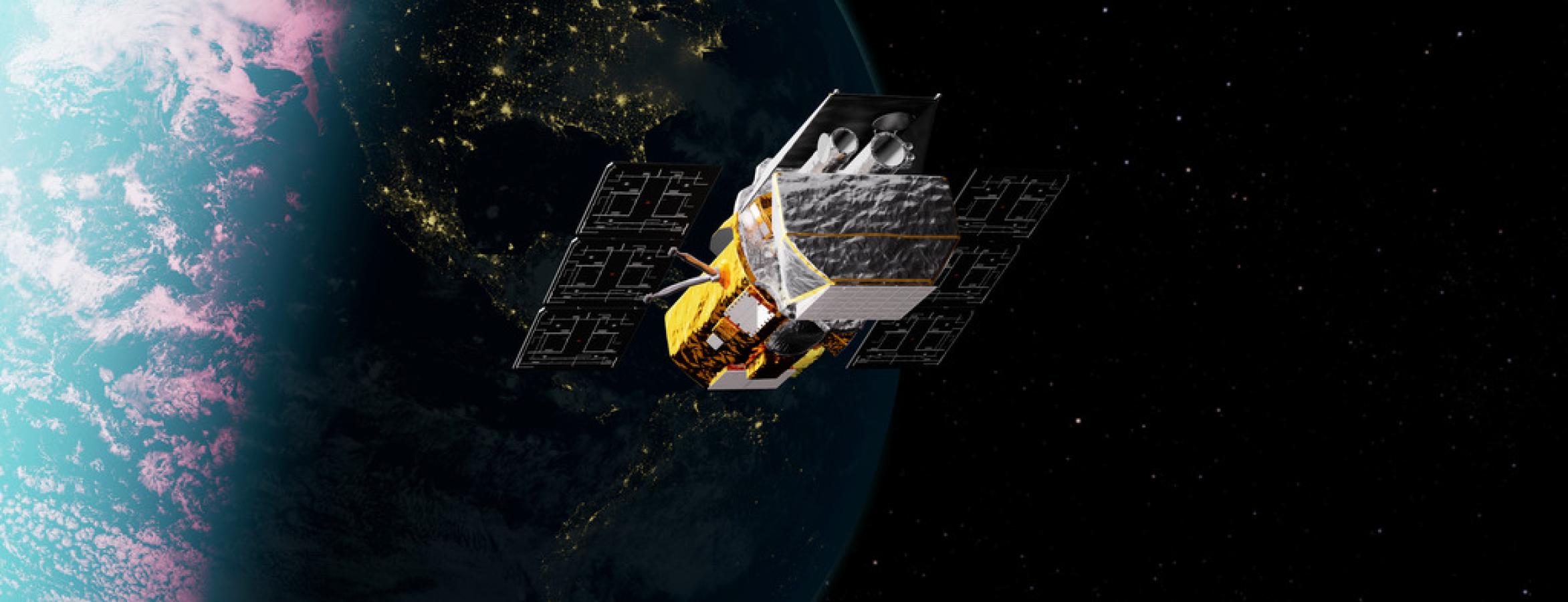
Hero image credit: An artists' concept of the NASA’s Neil Gehrels Swift Observatory. Credit: NASA’s Goddard Space Flight Center Conceptual Image Lab