
A Match Made in Lab


How do you assign approximately 100 teaching assistants to 155 laboratory sections each year, all while balancing their availability, preferences, experience, and the needs of each course?
Despite the title of teaching “assistant,” TAs often serve as the primary instructors of undergraduate laboratory sections, teaching classes, supervising experiments, and grading assignments. For decades, laboratory coordinators for the core biology courses in the Penn State Eberly College of Science’s Department of Biology would send emails to TAs, receive their preferences, and draft a lab schedule with TA assignments for individual lab sections. However, this process was tedious, often requiring the reshuffling of sections as individual TA schedules changed.
“Previously, we were solving the TA scheduling puzzle by hand with pencil and paper which was a process that required many email exchanges, and would sometimes take weeks,” shared Lauren McCarthy, associate teaching professor of biology. “That’s just how it was always done.”
That is, until in the fall of 2025 when Troy LaPolice, then a bioinformatics and genomics doctoral candidate, approached McCarthy with a potential solution to the TA scheduling problem.
“I was inspired by my own experience as a TA and seeing the challenge that coordinators faced when trying to schedule our laboratory sections,” said LaPolice. “It started as an independent side project. I made a basic online form to collect TA schedules and a python script to streamline assignment, but by the end of the semester there was a team of three of us building a platform to ease the burden of scheduling—for both the TAs and those coordinating courses.”
To tackle this challenge, LaPolice brought on Julien Mutton, an undergraduate honors student double majoring in computer science and mathematics, and Gustavo Foz, an undergraduate computer science major and Schreyer Scholar.
“Julien and I have been doing side coding projects and building real-world solutions to existing problems since our first year at Penn State, and this problem seemed like a great opportunity to help people,” said Foz.
“It was really a team effort, and MatchMyLab would not be where it was without Julien and Gustavo,” LaPolice added.
Realizing their problem was ubiquitous in departments across campus, LaPolice, Foz, and Mutton sought to hear from individuals outside of the biology department to determine how they operated. From this feedback, they designed MatchMyLab’s standard process.
“First, a coordinator enters their courses, lab sections, and times, adds a list of TA emails, and then MatchMyLab does the rest,” explained Foz and Mutton. “It collects every TA’s availability and preferences through one form and turns them into a schedule. The coordinator stays in control, reviewing and adjusting it before anything reaches TAs. If a TA’s availability changes, there’s no starting over. The schedule can be simply regenerated.”
As LaPolice, Foz, and Mutton designed their scheduling tool, “fairness,” and transparency were things they considered at each step.
“In the past an instructor would use their best judgment when scheduling TAs,” said McCarthy. “This meant that sometimes, by chance, some TAs would get their first preference while others would get their last.”
“With MatchMyLab, the goal is for everyone to get their first choice, but when that isn’t possible, we aim to distribute assignments fairly so that everyone’s preferences are considered,” said Mutton.
From the beginning, LaPolice, Foz, and Mutton designed MatchMyLab to account for both individual TA preferences and course-specific scheduling constraints. Through conversations with instructors and TAs using the system, the team continued refining how these requirements were incorporated into assignments. For example, TAs might prefer to teach back-to-back lab sections, while lab coordinators might request experienced TAs for the first sections of the week, limit undergraduate TAs to teaching one lab section, or pair first-year co-TAs with more experienced TAs. Beyond incorporating user feedback into the scheduling process, the team also collaborated with technology and accessibility specialists in the college to improve the platform’s accessibility and meet or exceed applicable standards.
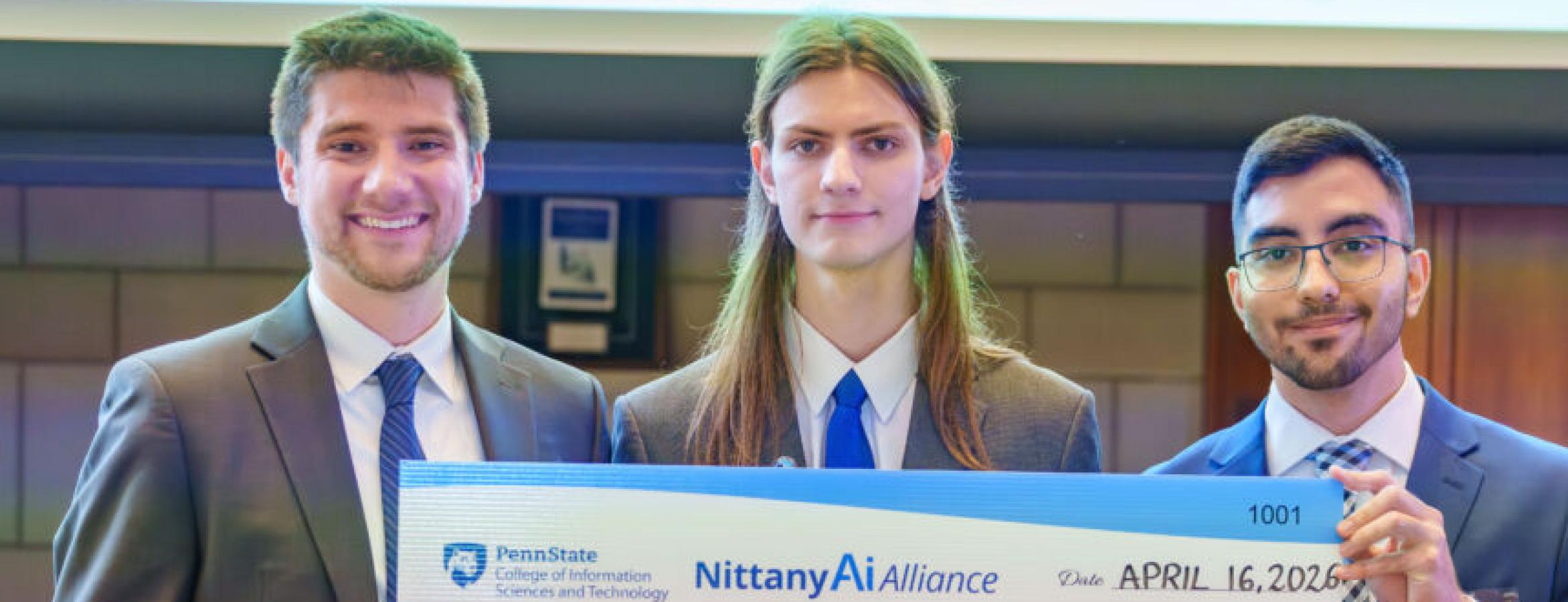
By November of 2025, LaPolice, Foz, and Mutton had started talking about entering the Nittany AI Challenge, an annual competition where multidisciplinary teams compete for funding to develop AI-based solutions to real-world issues. Foz and Mutton were already familiar with Nittany AI, having both competed in their first year together and served on the executive board for the Nittany AI Student Society.
“As a team, our skills were very complementary,” said Mutton. “We were also lucky to collaborate with our end users, seeking feedback from over 20 different faculty and staff across different departments in the Eberly College of Science.”
The challenge provided LaPolice, Foz, and Mutton the opportunity to rapidly improve MatchMyLab by connecting with users, refining, and presenting their project. The team competed in four phases of the challenge, including presenting MatchMyLab at the MVP Pitch Contest in the spring of 2026.
By the end of the challenge, MatchMyLab had placed third in the overall pitch competition and received the second-place Office of the Physical Plant award for increasing for operational efficiency, securing $4,800 in funding over the course of the contest to support their efforts.
The team is still actively building MatchMyLab, even after the Nittany AI Challenge. The system was used to schedule all laboratory sections across the core biology courses in fall 2026. But scheduling individual laboratory sections is only one part of the challenge MatchMyLab aims to solve.
Before a schedule can be created, departments must also determine which courses each TA is best suited to teach. The team is expanding MatchMyLab to incorporate skills-based TA allocation, considering factors such as academic background, subject expertise, teaching experience, and course requirements. Matching TAs with courses that align with their skills and interests has the potential to improve both their teaching experience and the learning experience of their students.
The broader goal is to create a unified platform that handles every stage of the TA assignment process, from matching TAs to courses, to collecting preferences, coordinating availability, and scheduling individual lab sections. By bringing these tasks together, MatchMyLab aims to reduce administrative burden and make the entire process easier for everyone involved.
“Our plan is to use MatchMyLab now and forever,” said Denise Woodward, teaching professor of biology. “Troy, Gustavo, and Julien have worked so hard in building MatchMyLab and have been so thoughtful in the process. They took scheduling down from an arduous week-long task to something that could be done at push of a button.”