
Exploring new ways to disrupt the malaria parasite


Malaria is a serious global health concern, with more than a quarter of a billion cases and half a million deaths every year, according to the World Health Organization. This mosquito-borne disease is prevalent in tropical and subtropical areas, including regions of Africa, Southeast Asia, and Central and South America.
The primary treatment option for malaria, a drug called artemisinin that is used in combination with other drugs, historically works well, according to Manuel Llinás, Ernest C. Pollard Professor in Biotechnology, professor of biochemistry and molecular biology and of chemistry at Penn State. But, he said, the parasite that causes the disease is becoming increasingly resistant to these artemisinin combination therapies, which reduces their effectiveness and, in time, might make them obsolete.
“My lab and many other labs have contributed to the development of other anti-malarial drugs that have yet to be deployed,” said Llinás, who is also the co-founder and co-director of the Huck Institutes of the Life Science’s Center for Malaria Research at Penn State. “But the reality is every drug we’ve ever used to treat malaria parasites has resulted in resistance, so we always need to be discovering new antimalarial drugs if we hope to eliminate this devastating disease. And to do that, we need to really understand the biology of the malaria parasite so that we can identify new drug targets.”
Llinás and his research group have studied the deadliest of the malaria parasites, Plasmodium falciparum, for more than two decades. Now, thanks in part to advancing technology and analytical methods, his group is exploring three new aspects of P. falciparum biology that could uncover new insights for future treatment options. These new projects are each supported by two-year exploratory/developmental research project R21 grants from the National Institute of Allergy and Infectious Disease (NIAID) at the U.S. National Institutes of Health (NIH).
“The malaria parasite has a complicated life cycle, and there are still a lot of basic unanswered questions about its biology and development,” he said. “New tools and approaches will allow us to take a deeper dive into these questions. Ultimately, the goal of better understanding the malaria parasite’s biology is to be able to disrupt it.”
Disrupting sexual development
When a mosquito infected with the malaria parasite bites a human, the parasites are transmitted to the human host and initially infect a few liver cells. Within these cells, they multiply through asexual reproduction, with the single-celled parasites dividing many times over. The parasites then leave the liver and infect red blood cells, where they continue to multiply, destroying the red blood cells they infect and causing disease symptoms in the human host, such as fever and anemia. As the infection progresses and conditions within the host change, a small number of parasites will develop into male and female forms, much like mammals produce sperm and eggs, but without dedicated sex chromosomes. Eventually, these sexual forms of the parasite can be taken up by a mosquito when it bites the human host. Inside the mosquito, these forms fuse and continue the parasite life cycle.
“While the asexual form of the parasite causes disease inside a human, it’s the sexual form that allows it to be transmitted,” Llinás said. “So, one potential way to stop transmission is to interfere with the development of these sexual forms. But there’s a lot we don’t know yet about the timing and regulation of the 10- to 12-day process by which cells differentiate into male or female forms.”
Llinás and his lab will use a technique called single-cell RNA sequencing (scRNA-Seq) to measure the expression of genes in individual parasite cells to explore the molecular mechanisms behind this process.
“For decades, scientists have wondered when malaria parasites decide if they will become male or female. Until recently, preexisting technologies only allowed us to study parasites in bulk, making it difficult to understand what happens inside individual parasites,” said Rajat Kumar, a postdoctoral researcher in the Llinás lab who will be leading this project. “ScRNA-seq allows us to capture and distinguish thousands of individual parasites based on transcriptional signatures so we can really begin to understand the biology and how it has evolved, which we hope will eventually inspire new transmission-blocking drugs.”
The research team will study parasite lines with known mutations that prevent them from producing mature sexual forms, which may provide key insights into the regulatory mechanisms for the development of sexual forms. They will also investigate parasites from different geographical locations to determine if there is any variation in this process.
Clarifying the role of non-coding RNAs
The progression of the malaria parasite through its many life stages is precisely controlled through gene expression, as different sets of genes that direct the transitions between stages are turned on or off. Gene expression generally involves making an RNA copy from a DNA template that is then translated into a protein and is regulated through a variety of mechanisms at different stages.
“While many RNAs are translated into proteins, others are not, and they have different functions,” Llinás said. “For example, long non-coding RNAs are RNAs that we know don’t code for protein, though what they actually do is a major unanswered question. The malaria parasite makes more than 2500 long non-coding RNAs, and while it has been suggested that some are important for virulence and the determination of sexual fate, we don’t have a comprehensive understanding of their broader importance to the parasite.”
The research team will use a combination of novel genomic assays and molecular and bioinformatics approaches to identify and catalog long non-coding RNAs (lncRNAs) present in both the asexual and sexual stages of malaria parasite development from different geographic regions. Additionally, they will characterize the role of a specific lncRNA overlapping a gene called ap2-g, which the lab discovered in 2014 and is a master regular of sexual development. They will also generate mutations in this lncRNA and observe the consequences on the expression of ap2-g to better understand if the RNA plays a role in its regulation.
“Previously, it was hard to confidently identify long non-coding RNAs, because short-read sequencing technology could only sequence part of these regions at a time and they were difficult to reconstruct,” said Sophie Olson, a graduate student in the Molecular, Cellular, and Integrative Bioscience Intercollege Graduate Degree Program at Penn State and a member of the Llinás lab who is leading the project. “With modern long-read sequencing technologies, we can produce high-quality reads of RNAs throughout the sexual and asexual blood stages.”
The team is also collaborating with David Serre, professor of microbiology and immunology at the University of Maryland School of Medicine who brings expertise in long-read sequencing technologies.
“If we can determine how these long non-coding RNAs regulate genes involved in sexual development, we might be able figure out how to interfere with that process and stop the parasite from infecting mosquitoes,” Olson said.
Understanding unusual protein repeats
One of the challenges of developing new antimalarial drugs, Llinás said, is that malaria parasites, like humans, are eukaryotic organisms whose cells contain a nucleus that stores their genetic material. This means there is a lot of shared biology, including a similar lineup of useful proteins. Drugs that target this shared biology would negatively impact the patients they are intended to treat. Ideally, drugs should target biology unique to the parasite, thereby minimizing unwanted side-effects.
One distinctive feature of the malaria parasite is that many of their proteins contain long stretches of the amino acid asparagine.
“Proteins are usually made from a selection of 20 amino acids,” Llinás said. “They can come in all kinds of combinations but repeats of the same amino acid are generally bad because they don’t usually lead to well-folded structures. Instead, they are largely considered to be unfolded regions, called intrinsically disordered regions, that can promote problematic protein aggregation within cells. We want to understand why these repeats are so prevalent in the malaria parasite, if they have any functional purpose, and why they don’t end up being a big, aggregated mess inside the cells to make them dysfunctional. The parasite must have a way to cope with this.”
Although many proteins in the malaria parasite contain intrinsically disordered regions, the research team is specifically focusing on these regions in the ApiAP2 protein family. ApiAP2 proteins are transcription factors, meaning they help in the process of converting DNA to RNA. Because there is not a version of these transcription factors in humans, they may be good candidates to target with future drugs.
“We will identify the asparagine-repeat regions in the ApiAP2 transcription factors and remove them using a technique called CRISPR/Cas9 to determine their functional role,” said Kai Lynn Wong, a graduate student in the biochemistry, microbiology and molecular biology program at Penn State and a member of the Llinás lab who is leading the project. “We suspect that the parasite protects itself from the negative effects of aggregation by sequestering these proteins into functional compartments, and we will also search for molecular signatures of this process.”
These compartments lack a physical membrane but stay isolated through a process called liquid-liquid phase separation, like oil droplets in water. Wong explained that this process could also be a target for new drugs.
“Clarifying the role of these repeats in transcriptional regulation may reveal new strategies to disrupt the malaria parasite,” Llinás said. “The opportunity to pursue three different directions simultaneously and answer longstanding questions in the field is super exciting. We hope this will kickstart new, promising avenues of research that will help us move toward control and eventual elimination of malaria worldwide.”
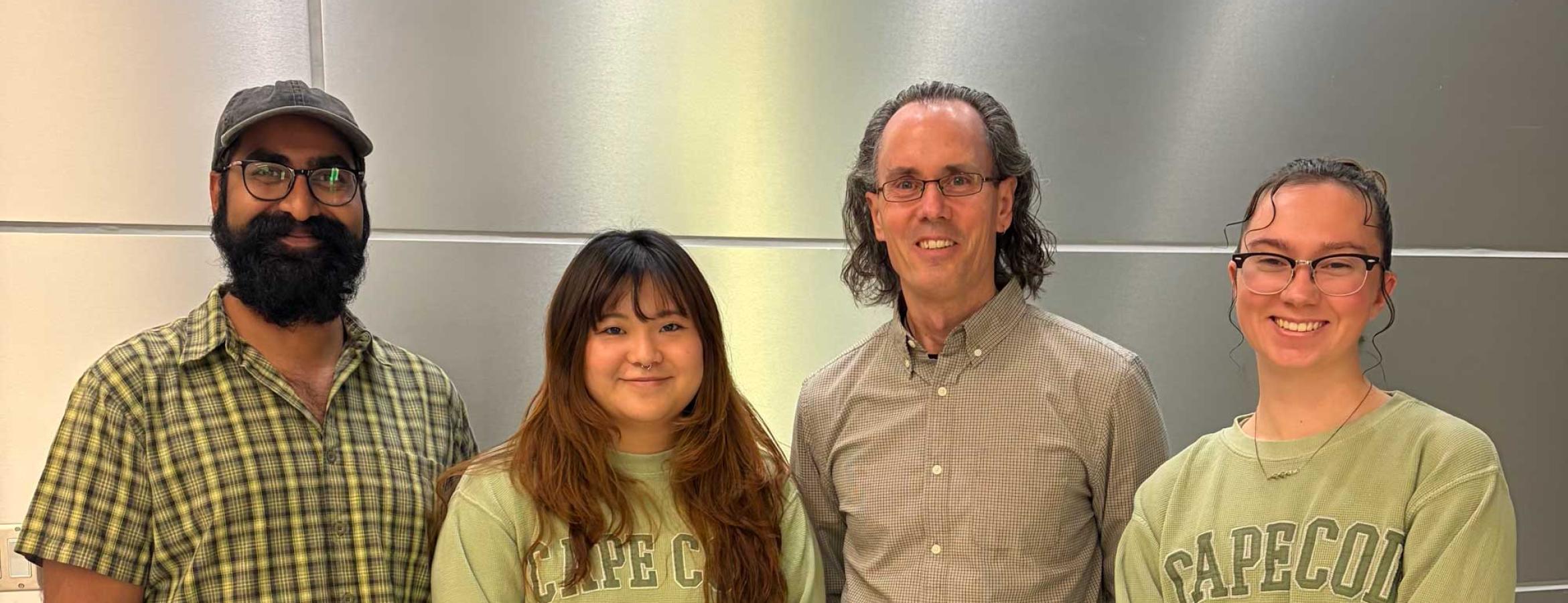
Hero image (left to right): Rajat Kumar, Kai Lynn Wong, Manuel Llinás, Sophie Olson. Image provided.