
Atom-scale model could help improve material growth for advanced electronics


Penn State researchers have refined an atom-scale model of how silicon carbide changes from a solid into vapor during crystal growth, work that could help manufacturers produce higher-quality material for advanced electronics while reducing costly trial-and-error experiments.
The study, published in The Journal of Physical Chemistry C, is the first publication from Penn State’s Silicon Carbide Innovation Alliance, or SCIA, an industry-university research partnership.
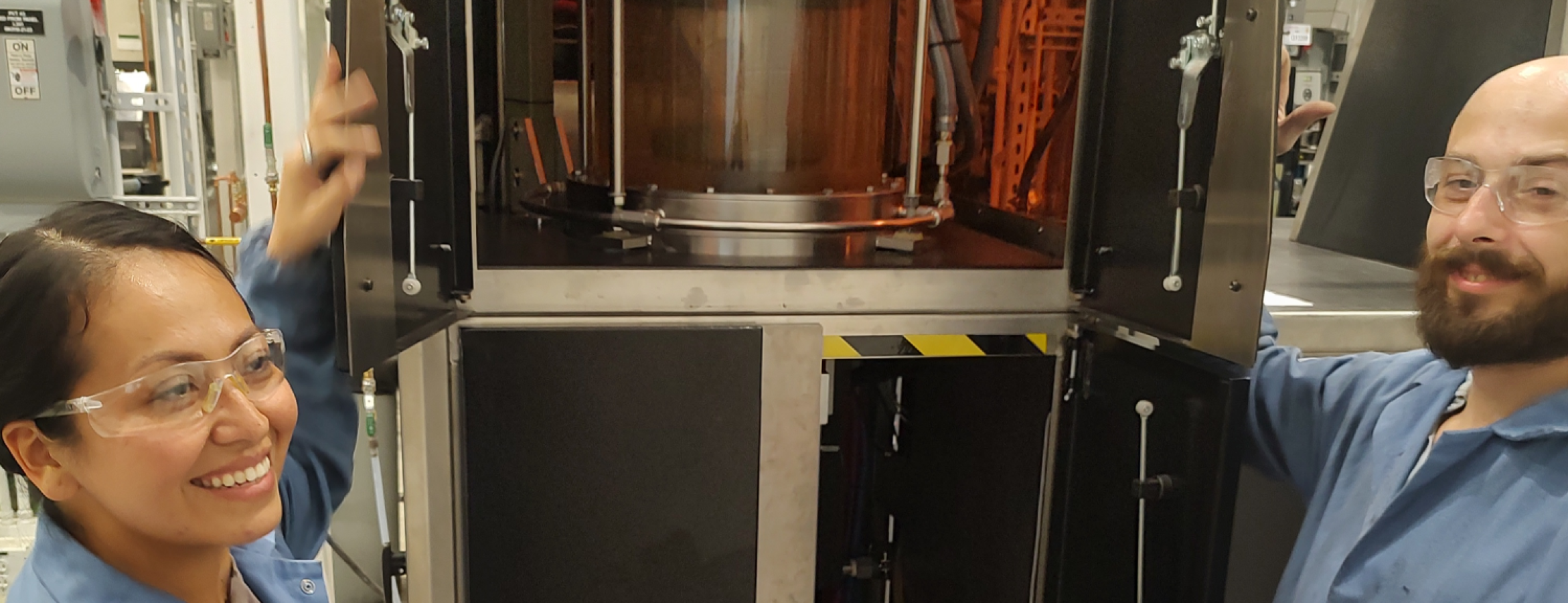
Silicon carbide (SiC) is a crystalline material used in high-power electronics, including electric vehicles and clean-energy systems. As opposed to other crystals, which can be grown by melting the material and then cooling it into a solid, silicon carbide is grown using physical vapor transport (PVT). In this process, solid silicon carbide is heated until it turns directly into vapor, which then settles onto a seed crystal and builds a larger crystal.
Because the process occurs at extreme temperatures inside a closed furnace, researchers cannot easily observe the early stages of sublimation, when a solid changes directly into a vapor without first becoming a liquid, or determine which molecules are present in that vapor.
“Due to these extreme conditions, direct in situ experimental observation inside a closed PVT furnace is nearly impossible, leaving a critical gap in our understanding of early-stage sublimation and vapor dynamics,” said Yun Kyung Shin, research professor of mechanical engineering at Penn State and lead author of the study.
To investigate that hidden process, the team refined ReaxFF, short for reactive force field, a computational method co-invented and developed by Adri van Duin, Evan Pugh University Professor of Mechanical Engineering, professor of Chemical Engineering, Engineering Science and Mechanics, Chemistry, Materials Science and Engineering, Director of the Materials Computation Center and corresponding author of the study. A force field is essentially a set of mathematical rules that calculates how atoms interact. ReaxFF can also simulate chemical reactions, allowing researchers to follow atoms as they move and watch chemical bonds break and form anew over time.
ReaxFF itself is not new. An earlier silicon-carbon force field had been parameterized mainly to study oxidation of SiC. Sublimation involves different chemical pathways, including breaking bonds in the solid and forming vapor species. The researchers therefore reparametrized the force field using an extensive set of quantum mechanical calculations.
The refined model let the researchers follow the different silicon- and carbon-containing molecules that form as silicon carbide heats up and turns into vapor. The results closely agreed with more detailed quantum mechanical calculations, and laboratory experiments supported the prediction that the solid material left behind becomes increasingly rich in carbon.
The simulations also showed that the makeup of the vapor changes as the temperature rises. The mixture of silicon and carbon — and in what ratio — reaching the seed crystal can influence how well the crystal grows.
“The temperature-dependent shift in vapor composition is driven by the distinct sublimation energies of different gaseous species,” Shin said. “At lower temperatures, silicon-rich species, such as silicon and silicon carbon, preferentially escape from the source material due to their lower activation barriers for evaporation.”
Vapor that is too silicon-rich can contribute to silicon droplets or large defects on the seed, while excess carbon can contribute to graphitization, other defects or an unwanted SiC crystal structure. Understanding how temperature changes the vapor could help manufacturers tailor heating conditions to improve crystal quality, Shin explained.
The team also calculated temperature-dependent rates for key sublimation reactions that could be incorporated into future computational fluid dynamics models. These models simulate furnace-scale conditions such as heat transfer, gas flow and temperature gradients but need accurate chemical information about the vapor.
Combining atom-scale reaction data with furnace-scale simulations could enable more realistic virtual growth experiments.
“Ultimately, this allows manufacturers to optimize furnace geometries and thermal recipes through simulations, thereby lowering the reliance on costly and time-consuming trial-and-error growth processes,” Shin said.
A related study published in the Journal of Crystal Growth and led by researchers at Morgan Advanced Materials, a global manufacturer of carbon, graphite and ceramic materials and a founding member of SCIA, provides a complementary view. Morgan has a five-year research partnership with Penn State focused on SiC crystal growth, and SCIA members contributed discussions and provided the SiC source material used in the Morgan-led study. While Shin and colleagues examined the atomistic evolution of vapor species during sublimation, the Morgan-led team developed a thermodynamic model of the equilibrium vapor composition above a SiC source under PVT growth conditions. Together, the studies examined SiC sublimation across scales, from the behavior of individual atoms and molecules to the overall vapor environment involved in crystal growth.
Silicon carbide is part of a class of materials known as wide-bandgap semiconductors, which can operate at higher voltages and temperatures than conventional silicon and are important for advanced power electronics.
“This work serves as a strong proof of concept for SCIA’s ecosystem, showing that collaborative, predictive modeling can accelerate the development of next-generation wide-bandgap semiconductors,” Shin said.
Along with van Duin and Shin, other Penn State authors of the study include Ga-Un Jeong, who earned her doctorate in mechanical engineering from Penn State earlier this year; Mengyi Wang, who earned her doctorate in materials science and engineering from Penn State earlier this year; Katherine Thompson, a SCIA postdoctoral scholar; Anirban Phukan, a graduate student in chemistry; Riasat Islam, a graduate student in mechanical engineering; Joshua Robinson, professor of materials science and engineering and director of the Materials Research Institute and SCIA; and Yuan Xuan, associate professor of mechanical engineering.
Support for the modeling and experimental research was provided by onsemi, a semiconductor manufacturer with a focus on power electronics, through SCIA and by SCIA industrial members. Additional support for this research was provided by the Office of Naval Research and the Air Force Office of Scientific Research. This content is the sole responsibility of the authors and does not necessarily reflect the views of the funders.