
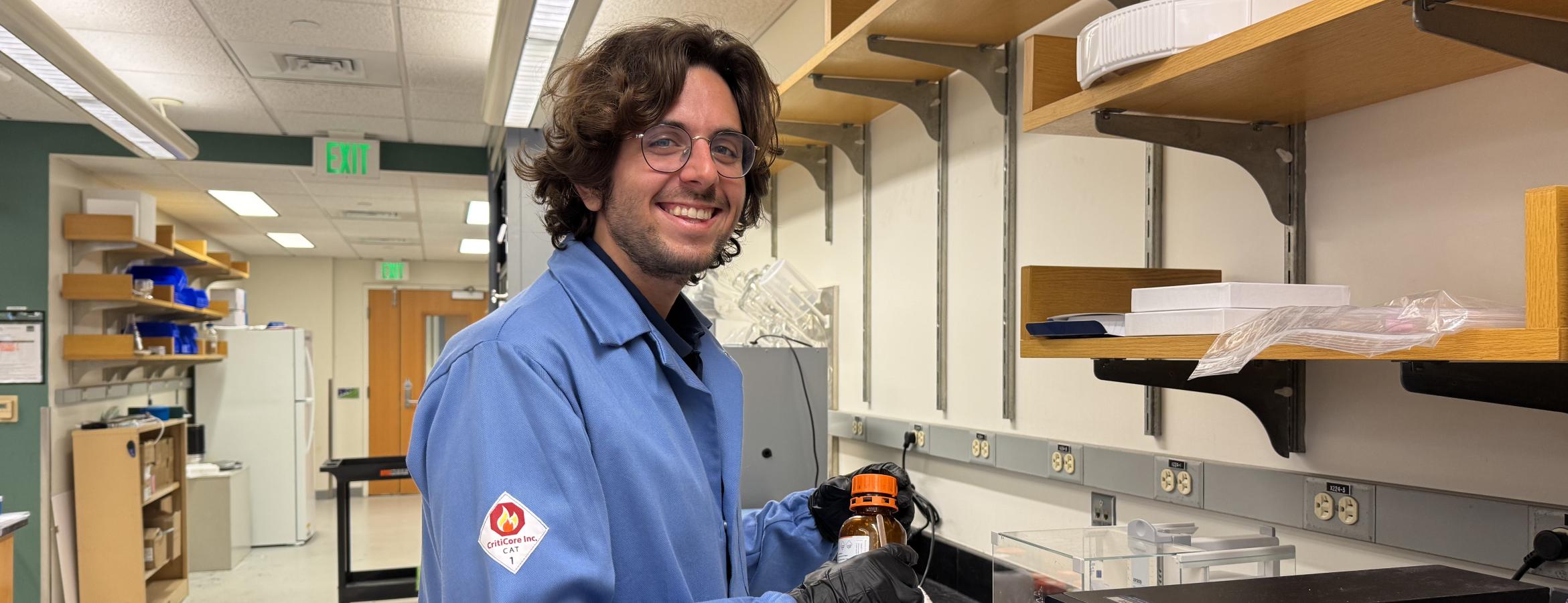
Q&A with Zachary Budimir, NIH Postdoctoral Fellow


Zachary Budimir, a postdoctoral fellow in the chemistry department shares what being a recipient of the Ruth L. Kirschstein National Research Service Award (NRSA) from the National Institutes of Health (NIH) means to him and advice he has for future applicants. The competitive F32 fellowship from the National Institute of General Medical Sciences is designed to support the research training and career development of early-career scientists.
The fellowship will also support Budimir's research on peptides, short chains of amino acids, and peptide natural products, which carry out specific functions in organisms ranging from bacteria to humans. Many of these peptide natural products have therapeutic and diagnostic uses.
“Zach was the first person to join my group last fall when I started here at Penn State,” said Carly Schissel, assistant professor of chemistry. “I was very excited to recruit someone who was as excited to study peptide natural products as I was. Zach has impressed me by how willing he is to jump into a brand-new research program.”
Q: What does being a NIH NRSA postdoctoral fellow mean to you?
ZB: Receiving the NIH NRSA fellowship gave me a real sense of relief and stability at an important point in my career. Research can come with a lot of uncertainty, especially early on, and having dedicated support for my work gives me the space to focus on the science and where I want to take my career next. Because the NRSA is a highly competitive, peer-reviewed NIH fellowship, receiving it also felt like meaningful recognition of both my research ideas and my potential as a scientist. More than anything, it gave me confidence that the scientific direction I have been building toward is one worth continuing to pursue.
Q: What is your area of research?
ZB: Peptide natural products are a remarkable source of molecular diversity, and many have complex three-dimensional shapes that are difficult to recreate using traditional chemistry. I am particularly interested in a class of these molecules called ribosomally synthesized and post-translationally modified peptides or RiPPs, in which bacteria can start with what looks like an ordinary peptide and use just a few specialized enzymes—sometimes even a single enzyme—to transform it into a complex molecule with important biological properties.
Successfully reproducing these transformations outside of a cell can be a significant synthetic achievement in itself, but I am interested in moving beyond producing one molecule at a time and instead applying these enzymes to generate large libraries of peptides containing complex natural-product-like structures. These libraries could give us access to types of peptide structures that are otherwise difficult to make and allow us to search for molecules capable of interacting with challenging biological targets and modulating pathways relevant to human health.
I am interested in whether RiPPs are part of this chemical communication and in identifying the molecules responsible for these interactions. Understanding how these natural products interact with human biology could reveal previously unknown ways that bacteria communicate with us, while also uncovering molecules or molecular scaffolds with potential therapeutic value.
Q: What advice do you have to share with anyone who is interested in applying for a similar fellowship?
ZB: My main advice would be to start earlier than you think you need to and get feedback from as many different perspectives as possible. An application like the F32 is not just a research proposal; it is also a training plan and an argument for how the fellowship will help you grow into the scientist you want to become. It is a demanding application to put together, but working through that process ultimately strengthened both my proposal and the way I think about my own scientific goals and career trajectory.
Q: What will you take with you from your time at Penn State?
ZB: Since I am still relatively early in my time at Penn State, I think one of the things that has stood out most to me is how much the environment here has allowed me to grow scientifically while also genuinely enjoying where I live and work. I came into my postdoctoral research with a strong interest in peptide natural products and biocatalysis—speeding up chemical reactions with biological substances; and Penn State has given me the opportunity to expand my research into other areas including questions surrounding how molecules produced by the human microbiome—which includes all the bacteria, fungi and other microorganisms living on or in a person—interact with human biology.
Just as importantly, Penn State and State College have been incredibly welcoming places to call home. There is a strong sense of community here, and I have really come to appreciate being in a place where I can be excited about the science I am doing while also having a life outside of the lab that I enjoy. That balance between scientific opportunity, community, and quality of life is something I think I will carry with me long after my time at Penn State.