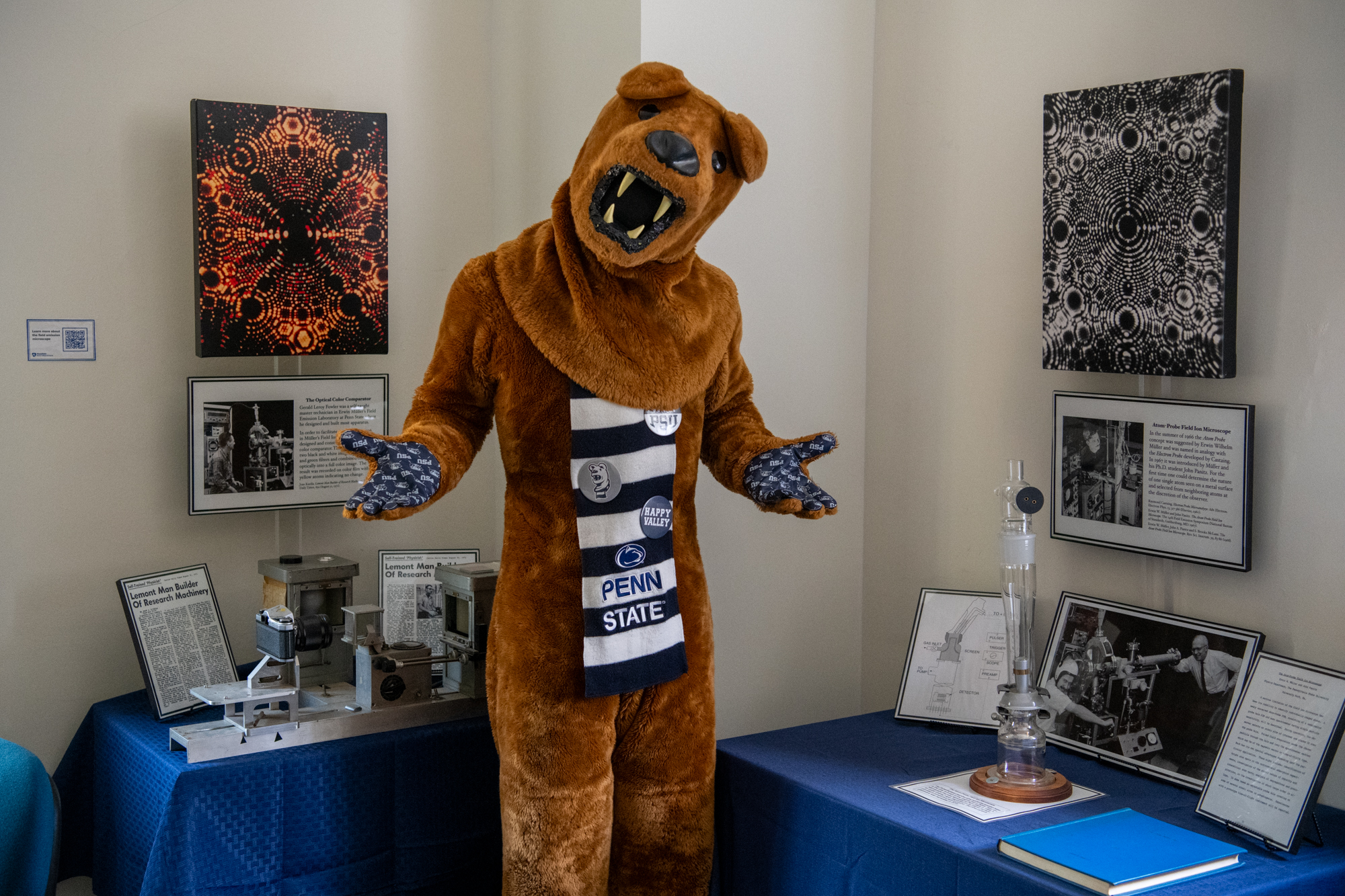
The Müller Exhibition
In 1955, Professor of Physics Erwin W. Müller became the first person to see an atom. Using a field ion microscope of his own invention—a landmark advance in scientific instrumentation that magnified these building blocks of the universe more than two million times—for the first time an individual could “determine the nature of one single atom seen on a metal surface and select from neighboring atoms at the discretion of the observer.”
Since Müller’s first viewing of an atom, atomic imaging technology has advanced such that individuals can now create three-dimensional reconstructions of materials and the atoms that make up these materials. Understanding the atomic properties of materials is essential for modern technologies such as semiconductors and material discovery.
Travel through this exhibition to learn more about Erwin Müller, his microscopes, the people who helped him “see” an atom, and more. Hear John Andrew Panitz, Penn State alumnus, former student of Erwin Müller, and professor emeritus of physics at the University of New Mexico, discuss the history and significance of each of the items in the collection.
Tour the Müller Exhibition
This webpage is designed for both virtual and in-person visitors. For those visiting in-person, the full exhibit can be found in the lobby of the Osmond Lab and on the second floor in 205 Osmond, Müller's old office, on Penn State University Park campus (4575 Pollock Rd, State College, PA 16801). Parking is available in the Hub Parking Deck (262 Shortlidge Road, University Park, PA 16802) and other various locations on campus.
Local Electrode Atom Probe
[For those in-person, start your tour in the lobby of the Osmond Lab.] The first local electrode atom probe was manufactured by the Imago Scientific Instruments Corporation and sold to the Oak Ridge National Laboratory in 2003. It was based on the 10 cm atom probe and culminated 35 years of atom probe development.
Hear from Panitz about the Müller exhibit. Then travel back in time by visiting the rest of the exhibition, upstairs, in 205 Osmond, Professor Müller’s old office.
205 Osmond Lab (Erwin Müller’s Office)
In 205 Osmond Lab, Erwin Müller became the first person to “see” an atom. Müller worked in this space from 1952, when he joined the Penn State physics department, until his death in 1977.
Currently, Mauricio Terrones, George A. and Margaret M. Downsbrough head of the Department of Physics, Evan Pugh University Professor of Chemistry and of Materials Science and Engineering, and his lab occupy the space.
Hear from Panitz about the history of this room and what it was like working with Erwin Müller.
In 205 Osmond Lab, Erwin Müller became the first person to “see” an atom.
Hear from John about the history of this room and what it was like working with Erwin Müller.
Optical Color Comparator
The first optical color comparator was designed to help facilitate image comparison in Müller’s field ion microscope. By projecting two black-and-white images through red and green filters, the comparator combined the images into a full-color image. The result was recorded on color film with yellow atoms indicating no change.
Hear more from Panitz about the purpose of the optical color comparator and why Müller needed one for his field ion microscope.
Gerry Leroy Fowler
Self-trained physicist Gerry Leroy Fowler was essential in helping Erwin Müller build his field ion microscope. Fowler is described as having hand-built approximately 80 percent of the field ion microscope without any formal training. This includes the Pyrex glass chamber attached to the wooden base, which is the only remnant of the original atom-probe field ion microscope that was fabricated at Penn State in 1966.
Once Panitz had left Penn State, Fowler would visit Panitz in New Mexico and bring back artifacts from the lab that were no longer in use. These items remained with Panitz until 2024, when they were donated back to the University.
Hear more from Panitz about Fowler.
Field Emission Microscope
In 1937, Erwin Müller placed the apex of a needle-like tungsten emitter opposite a fluorescent screen, and the field emission microscope was born.
The fluorescent screen of the microscope displayed a highly magnified image of electron emission from the emitter apex when a negative high voltage was applied. The image showed how the emission changed with surface crystallography.
Hear from Panitz on the difference between the field emission microscope and the field ion microscope.
Atom-Probe Field Ion Microscope
In 1967, the atom probe was introduced by Erwin Müller and John Panitz. The Pyrex glass chamber attached to the wooden base is the only remnant of the original atom-probe field ion microscope.
Since the creation of the atom-probe field ion microscope, scientists can now create three-dimensional reconstructions of atoms and distinguish them chemically.
Hear Panitz talk about the development of the atom-probe field ion microscope and the imaging process.
Tour the historic equipment and today’s state-of-the-art facilities
This fall, the Eberly College of Science and Materials Research Institute (MRI) will host special tours for the public see this very early, groundbreaking technology as well as the modern version of the equipment: state-of-the-art atomic resolution microscopes at the Materials Characterization Lab (MCL).
On home football game Fridays between 3 and 5 p.m., visitors can tour the original, historic Müller equipment in Osmond Lab and then walk over to the lobby of the MRI entrance of the Millenium Science Complex to tour imaging equipment in the MCL, one of three core facilities in the MRI that fuel the interdisciplinary, life-changing innovations of Penn State’s materials research.
Tour dates include:
- Sept. 12
- Sept. 26
- Oct. 10
- Nov. 7
- Nov. 21
Tours will be provided by physics postdoctoral scholar Hannah Wood in Osmond Lab and David Fecko, director of MRI industry collaborations in the MCL, and will be supported by Eberly College of Science undergraduate student volunteers from the college’s Science LionPride organization.