
Science Matters: Jainendra Jain
Jainendra K. Jain, Evan Pugh University Professor and Erwin W. Müller Professor of Physics and holder of the Eberly Family Chair in the Penn State Eberly College of Science, specializes in theoretical condensed matter physics. He uses theoretical approaches to understand the unexpected emergent behaviors of strongly interacting quantum many-body systems, especially in low dimensions. His interests include fractional quantum Hall effect, composite fermions, anyons, Majorana particles, graphene physics and various topological phenomena.
In 1988, Jain made theoretical advances that reshaped our understanding of quantum mechanics.
In 1982, physicists performed experiments on two-dimensional electrons in an extremely powerful magnetic field and low temperatures and made the surprising discovery that a property called the Hall resistance took on only some special values, jumping from one special value to another as the magnetic field was increased. When measured in natural units, these special values were certain fractions, such as 2/5 and 4/7, and the phenomenon was therefore called the “fractional quantum Hall effect.” The three researchers involved in the discovery were awarded the Nobel Prize in 1998 for “for their discovery of a new form of quantum fluid with fractionally charged excitations.”
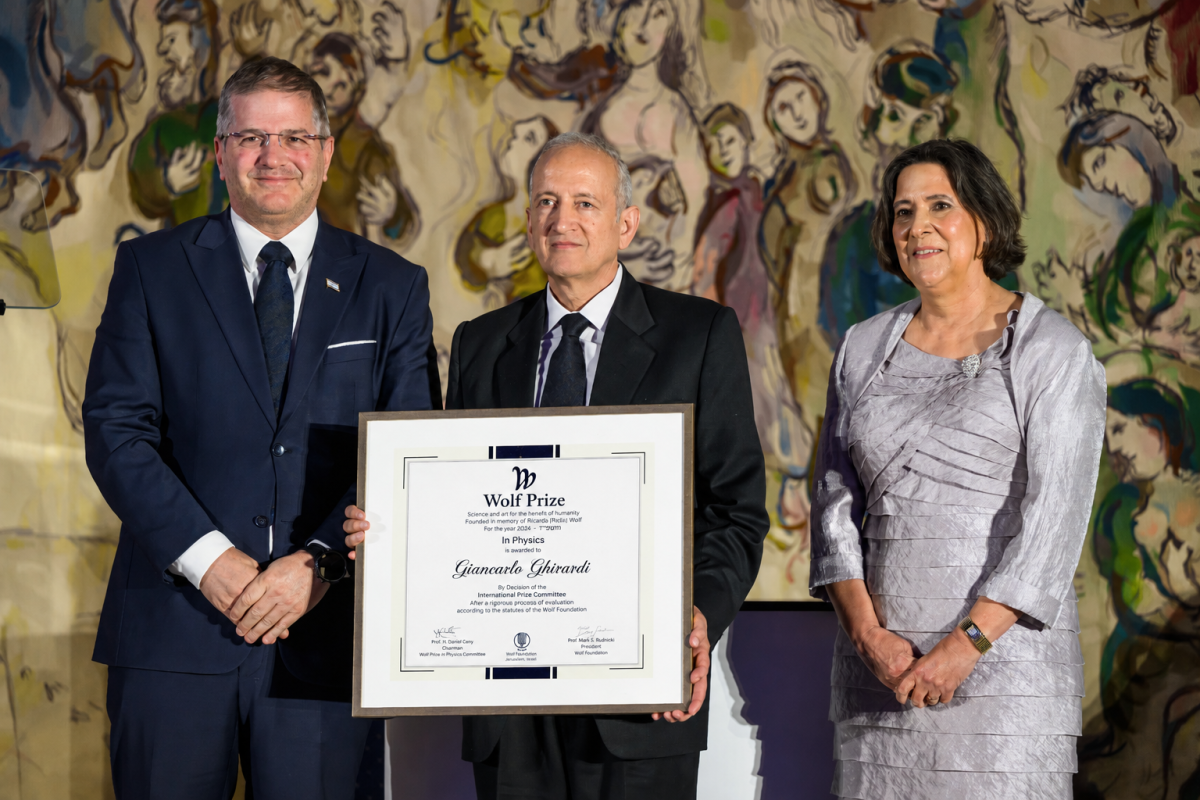
For his groundbreaking contributions to understanding quantum matter, Jain was awarded the 2025 Wolf Prize in Physics. At Penn State, Jain serves as founding director for Penn State’s newly established Center for Theory of Emergent Quantum Matter (C-TEQ). In 2026, he was also named founding director of the Lodha Theoretical Physics Institute (LTPI) in India.
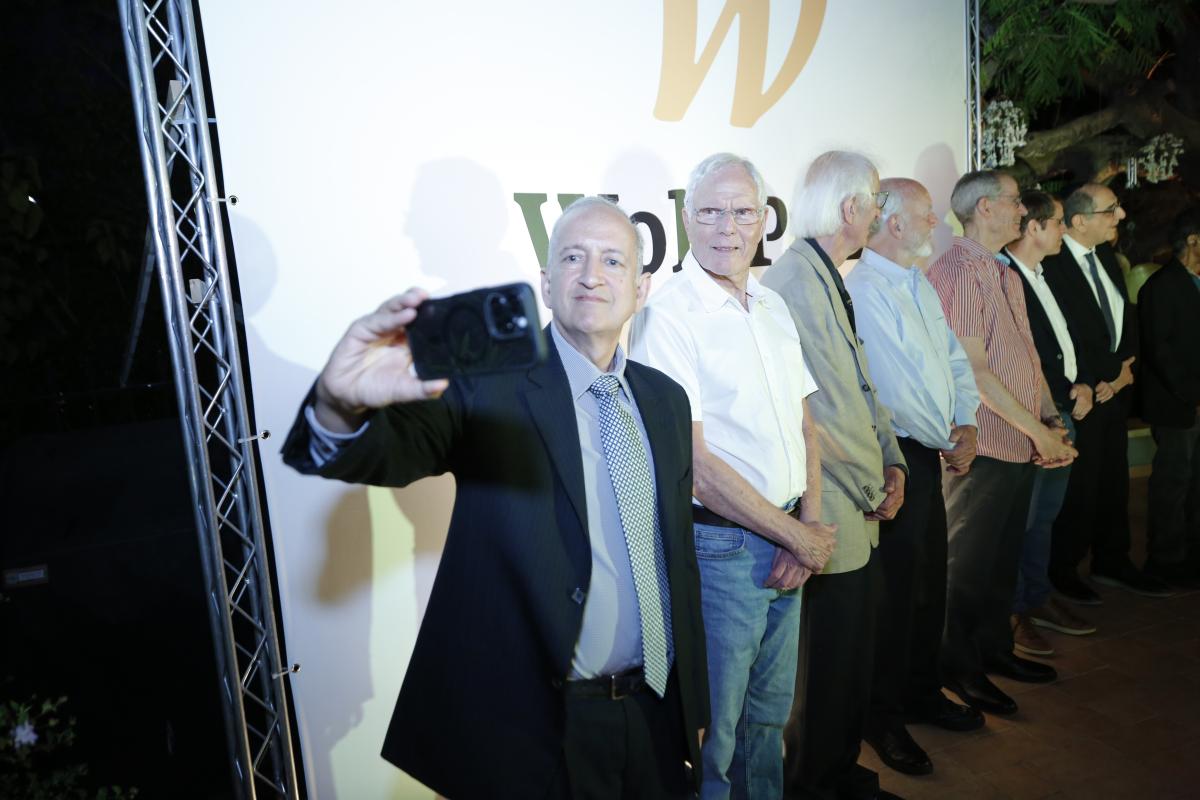
Below are photos from the Wolf Prize Ceremony, which recognized Jain and the other 2025 Wolf Prize winners, on June 18, 2026. Photo credit: Wolf Foundation.

What was the origin of the fractional quantum Hall effect?
Jain’s research answered this question. He introduced a class of exotic particles called composite fermions. Jain explained the origin of the phenomenon and predicted that the fractions appear in certain sequences, which are now called the Jain sequences. Hundreds of fractions in various two-dimensional systems belong to the Jain sequences. This new state of matter consists of the intricate sequence of fractional quantum Hall states, now known as Jain states. Jain described the composite fermion as an electron trapped inside a quantum vortex in this strange liquid, sometimes thought of as an electron bound to a quantized magnetic field.
What more can they do?
Composite fermions also form a metallic phase and a crystalline phase. Moreover, under certain conditions, they form a superconductor—or a material that can conduct electricity without losing any energy at low temperatures. Theorists predicted this is a special type of superconductor which would contain an even stranger particle, called a Majorana, which is its own antiparticle, or a particle with the same mass but different charge.
These discoveries advance high performance electronics, enabling ultra-low resistance materials and topological quantum computing. They reveal complex quantum behaviors, guiding novel materials with revolutionary properties.
Research and education
An Indian-American physicist, Jain was born in Sambhar, Rajasthan, India, a rural village located at the eastern margin of Thar dessert where he received his primary, middle and high school education. Read more about his early life and discovery of physics in this May 2025 Hindustan Times article.
Prior to joining Penn State in 1998, Jain was a professor of physics at Stony Brook University. He also was a postdoctoral scholar at Yale University and the University of Maryland. Jain earned his doctoral degree from Stony Brook University in 1985 after earning a bachelor's and a master's degree in physcs in India.
In the series of videos below, Jain discusses his thoughts on science, teaching, Penn State, and more.
“When the idea of composite fermions first struck me during the Christmas break of 1988, I did not know that these particles would occupy my mind every day for the next 37 years," he said. "My hope is that this prize will motivate a few more to experience the beauty of nature through composite fermions.”
“These discoveries advance high performance electronics, enabling ultra-low resistance materials and topological quantum computing,” the Wolf Foundation shared.
“I am on the theoretical understanding side of this spectrum, but I work closely with scientists who test whether the theories correspond to reality,” Jain said. “The news from Microsoft is an example of how basic research at universities could lead to real-world applications that drive innovation — like quantum computers.”