
Physical Sciences

NSF funds supercomputer cluster at Penn State
Image
An external view of the Tower Road Data Center that will house the CyberLAMP computer cluster (upper left). The new high-performance computing cores mounted in their racks (upper right). The new DataDirect Networks active storage for data that is accessed often (lower left). The inside of new Oracle tape storage system, used for backups of active data (lower right). Credit: Penn State University.
Three from Eberly College of Science awarded Alfred P. Sloan Research Fellowships
Image
Michael DeGiorgio, Kin Fai Mak, Kohta Murase
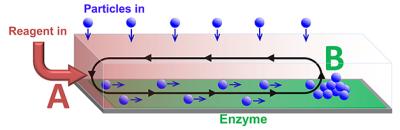
Catalytic Conveyer Belt: A new method for controlled delivery of particles via fluid flow
Image
Particles transported along a channel by chemically-driven fluid flow. The flow is generated by reagent entering at one end of the channel (A) and reacting at the enzyme covered surface. The cargo is deposited at position B, which can be controlled by varying the reaction rate. Credit: Balazs Laboratory, University of Pittsburgh.
Lasse Jensen Wins ACS 2017 Early-Career Award
Measuring entropy: A scanning-tunneling microscope provides a glimpse of the mysterious property
Image
Images of a single molecule of dibutyl sulfide captured by a scanning-tunneling microscope (STM) at temperatures ranging from 5.41 degrees Kelvin (K) to 16.03 K. As the temperature increases, the molecule changes shape more quickly resulting in an image that captures multiple configurations of the molecule. The tip of the STM influences the ability of the molecule to make these changes in shape allowing researchers to measure the entropy of the system. Credit: J.C. Gehrig, EMPA.
Three Eberly College of Science faculty members elected as Fellows of the AAAS
Image
Kathleen Postle, Paul Babitzke, Jorge Sofo
Mostafá and Dykstra awarded C.I. Noll Award for Excellence in Teaching
Image
Miguel Mostafá, Sheryl Dykstra
Coutu and Mostafá Elected as Fellows of the American Physical Society
Image
Stephane Coutu, Miguel Mostafá
Rebekah Dawson awarded Annie Jump Cannon Award in Astronomy
Image
Rebekah Dawson
A tale of two pulsars' tails: Plumes offer geometry lessons to astronomers
Image
An artist’s representation of what the three unusual tails of the pulsar Geminga may look like close up. NASA's Chandra X-ray Observatory is giving astronomers a better look at pulsars and their associated pulsar wind nebulae, enabling new constraints on the geometry of pulsars and why they look the way they do from Earth. Credit: Illustrations by Nahks TrEhnl
Subscribe to Physical Sciences