
Physical Sciences

Research Reveals How an Acid Dissolves, Molecule by Molecule
Image
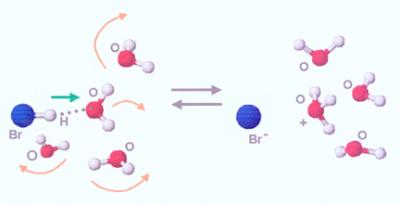
Caption: Schematic illustration of the excited state acid dissolution of HBr within the mixed cluster of HBr(H2O)4. The first step in the mechanism is the proton transfer from the acid to a water molecule which is followed by solvent reorganization. © 2002 Castleman Lab, Penn State
Revealed Today at NASA: Space Movie Shows Shocking Secrets of the Crab Pulsar
Image
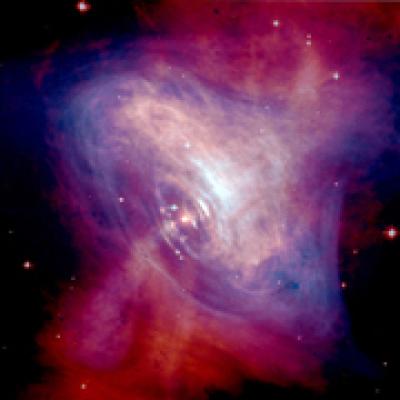
Crab Nebula Composite Image  A composite image of the Crab Nebula showing the X-ray (blue), and optical (red) images superimposed. The size of the X-ray image is smaller because the higher energy X-ray emitting electrons radiate away their energy more quickly than the lower energy optically emitting electrons as they move. Photo Credit: X-ray: NASA/CXC/ASU/J. Hester et al.; Optical: NASA/HST/ASU/J. Hester et al.
Sequencing of Bacterial Genome Reveals Distant Evolutionary Link to Plants
Three Faint Companions of Bright Stars Discovered with New Infrared Camera Developed at Penn State

Image
A Gaussian pupil mask designed for deep contrast imaging for faint companions around bright stars. This is the new generation coronagraph technique being supported by NASA for further technology development for the Terrestrial Planet Finder.
Astronomers Use X-Rays to Probe Gravitational Field of a Neutron Star
Image
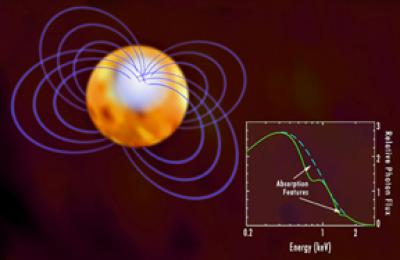
This artist's conception illustrates 1E 1207.4-5209, a neutron star with a polar hot spot and a strong magnetic field (purple lines).
Penn State Astronomer's Images of the First Stars Featured on Discovery Channel During June
Image
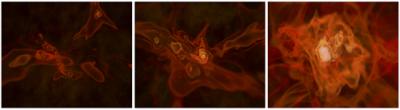
The first galaxies form hierarchically. Small object form at the intersection of filaments and merge into larger and larger objects. When these pre-galactic objects become as heavy as a million times the mass of our sun one massive star forms within them. (See copyright information below.)
Student Selected to Meet With Nobel Laureates
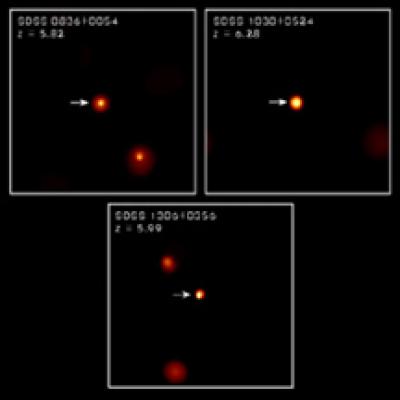
Penn State Astronomers Discover Well-Established Black Holes in Distant Quasars
Image
Penn State Astronomers Discover Well-Established Black Holes in Distant Quasars
Planets of the Phoenix: Astronomers Predict Rebirth of Planetary Systems in the Embers of Dead Stars
Image
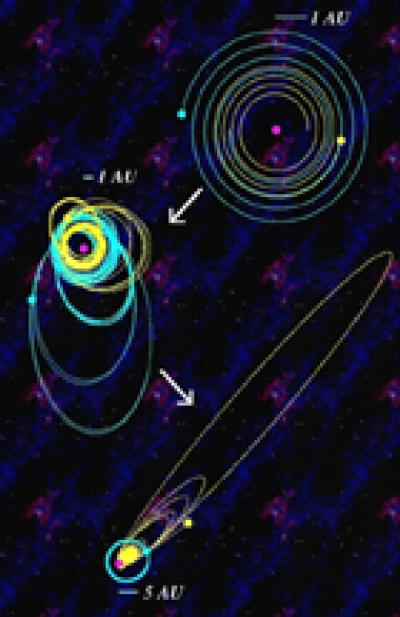
A diagram of how planets become unstable around white dwarfs. As a star becomes a white dwarf the planets expand their orbits slowly. They then become unstable and experience chaotic orbits that eventually become radically different, drastically affecting their surroundings. This illustration was created by actual output of computer simulations performed at Penn State and presented at the American Astronomical Society meeting in Washington, DC on 7 January 2002 PHOTO CREDIT: John Debes, Penn State
Penn State a Partner in New Global Data Grid
Subscribe to Physical Sciences