
Physical Sciences

Study Finds New Properties in "Non-Magnetic Materials"
Image
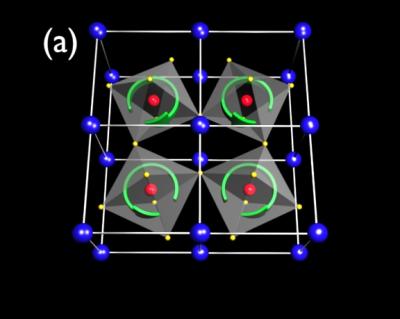
Figure A ("non-magnetic" material): The "non-magnetic" crystal structure of strontium titanate, SrTiO 3 , is composed of strontium (blue balls), titanium (red balls), and oxygen (yellow balls). Credit: Sava Denev, Penn State
New Map Locates Metals in Millions of Milky Way Stars
Image
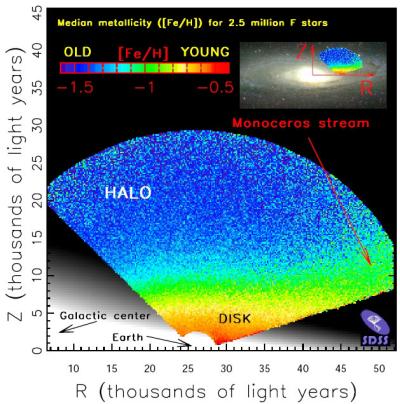
The new metallicity map, shown as the colored inset, indicates that the disk is composed of high-metallicity stars that typically are just a few billion years old (red and yellow shades). Credit: Zeljko Ivezic, University of Washington, SDSS-II Collaboration
A Slimmer Milky Way Revealed by New Measurements
Image
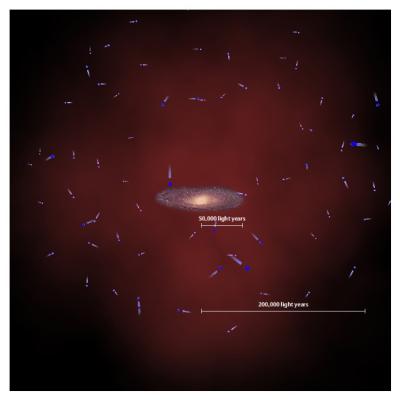
The visible, stellar part of our Milky Way in the middle is embedded into its much more massive and more extended dark matter halo, indicated in dim red. Credit: Axel Quetz, Max Planck Institute for Astrophysics (Heidelberg), SDSS-II Collaboration
Heart of the Crab Pulsar Probed — First Direct Look Into the Core of a Neutron Star
Image
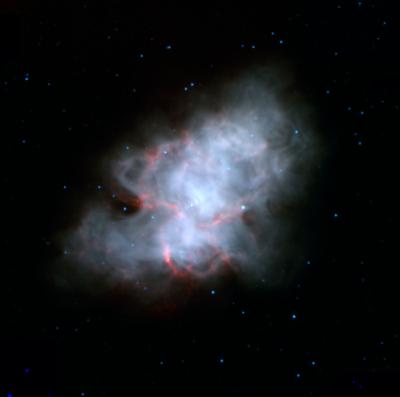
Image Credit: NASA/JPL-Caltech/R. Gehrz (University of Minnesota)  New information about the heart of one of the most famous objects in the sky -- the Crab Pulsar in the Crab Nebula -- has been revealed by an international team of scientists searching for gravitational waves. The team's achievement also is the first direct look into the interior of a neutron star.
NASA's Swift Satellite Catches First "Normal" Supernova in the Act of Exploding
Image
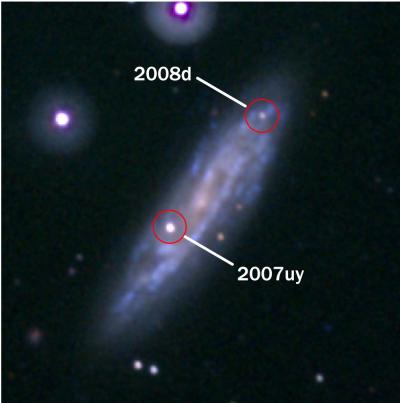
Seemingly out of nowhere, Supernova 2008D burst onto the scene on January 9, 2008, as seen in ultraviolet images (upper right) and X-ray images (beneath) taken by NASA's Swift satellite, giving scientists the unique opportunity to witness the birth of a supernova. CREDIT: NASA Swift team.
Pipsqueak Star Unleashes Monster Flare
Image
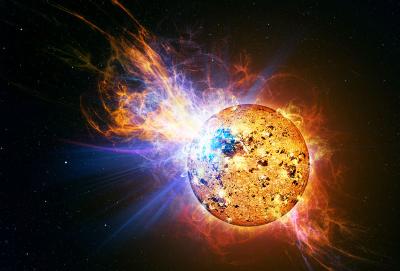
illustration credit: Casey Reed/NASA  An artist's illustration of EV Lacertae, which produced the brightest flare ever seen from a normal star other than our Sun on 25 April 2008.
Li and Roiban Receive Sloan Foundation Fellowships
Castleman Receives Thomas W. Phelan Fellows Award
Tae-Hee Lee Receives Dreyfus New Faculty Award
Wolszczan Honored at Extreme Solar Systems Conference
Subscribe to Physical Sciences