Physical Sciences

Penn State Science Research Faculty Participate in a Workshop Aimed to Improve Science Education

Image
Raymond Schaak, professor of chemistry
Nanoparticle Opens the Door to Clean-Energy Alternatives
Image
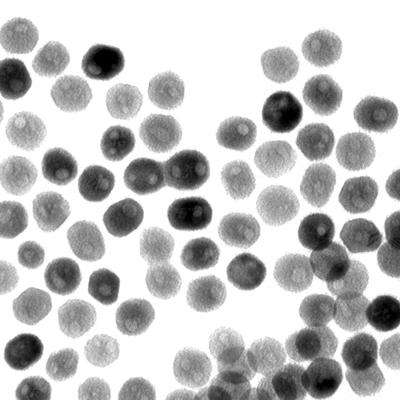
A transmission-electron microscope image of a collection of quasi-spherical nickel phosphide nanoparticles. A team led by Raymond Schaak of Penn State University has found that these nanoparticles can catalyze an important chemical reaction that generates hydrogen from water. Credit: Eric Popczun, Penn State University
Best Ultraviolet Map of the Nearest Galaxies Now Revealed
Image
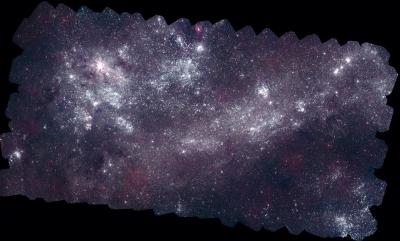
Nearly a million ultraviolet sources appear in this mosaic of the Large Magellanic Cloud, which was assembled from 2,200 images taken by Swift's Ultraviolet/Optical Telescope. UV image credit: NASA/Swift/S. Immler (Goddard) and M. Siegel (Penn State). Visible image credit: Axel Mellinger, Central Michigan Univ.
Super-dense Star is First Ever Found Suddenly Slowing Its Spin
Image
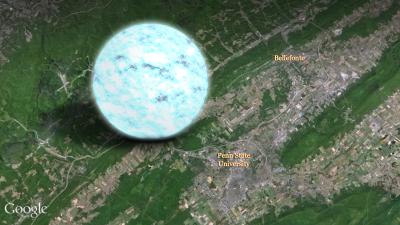
A neutron star is the densest object astronomers can observe directly, crushing half a million times Earth's mass into a sphere about 12 miles across -- roughly the size of Pittsburgh, or the distance between the Penn State University Park Campus and Bellefonte, Pennsylvania, as shown in this illustration. Credit: NASA's Goddard Space Flight Center and Penn State University
Record-Breaking High-Energy Particles from Space Detected by Telescope Buried in the Antarctic Ice
Image
Sensor descends down a hole in the ice as part of the installation of the IceCube telescope. IceCube is among the most ambitious scientific construction projects ever attempted. Credit:NSF/B. Gudbjartsson
Brendan Mullan Selected as a 2013 National Geographic Emerging Explorer

Image
Brendan Mullan
College marshal composes both musical compositions, chemical equations

Image
Josh Laughner
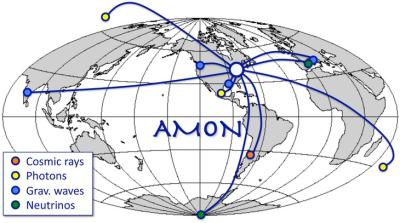
AMON: An Eye on the Universe
Image
Credit: Courtesy AMON
Probing Question: Are We Running Out of Helium?

Image
Moses Chan, Evan Pugh Professor of Physics at Penn State. Credit: Greg Grieco, Penn State
White-Dwarf Star, Blown Apart in 1604, Now Reveals New Secrets
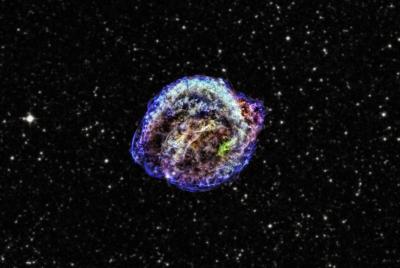
Image
This composite of images from NASA's Chandra X-ray Observatory shows the remnant of Kepler's supernova in low-energy (red), intermediate-energy (green) and high-energy (blue) X-rays. Credit: X-ray: NASA/CXC/NCSU/M.Burkey et al.; optical: DSS
Subscribe to Physical Sciences