
Life Sciences

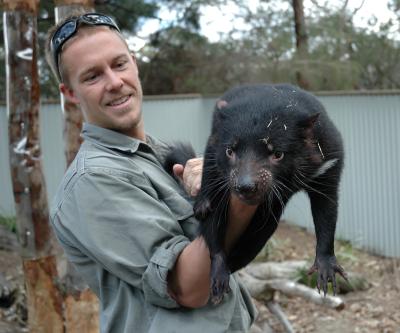
Scientists Sequence Endangered Tasmanian Devil's Genome
Image
Zoo keeper and breeder Tim Faulkner holds a Tasmanian devil -- an endangered marsupial found in the wild in the Australian island-state of Tasmania. Credit: Stephan C. Schuster, Penn State
Slowing the Spread of Drug-Resistant Diseases Is Goal of New Research Area
Image
This colored 2005 scanning electron micrograph (SEM) shows numerous clumps of methicillin-resistant Staphylococcus aureus bacteria, commonly referred to by the acronym, MRSA, magnified 2390 times. Credit: Janice Haney Carr/CDC/ Jeff Hageman, M.H.S.
Life-History Traits May Affect DNA Mutation Rates in Males More Than in Females
Image
Credit: Anton Nekrutenko, Penn State
Research in Arabian Peninsula Will Help Scientists Understand Coral Diversity and Adaptation to Climate Change
Image
Sampling a branch from a pink colony of Pocillopora coral.
Phagehunter Lab Has Undergraduates Searching for Tuberculosis Cure
Image
Field of bacteriophage plaques. A bacteriophage, or phage, is a virus that infects a bacterium and reproduces inside it killing the bacterium, then infecting those around it. Ultimately such infections spread to give clear areas in a lawn of bacteria
Packaging Process for Genes Discovered in New Research
Image
Like a strand of white pearls, DNA wraps around an assembly of special proteins called histones (colored) to form the nucleosome, a structure responsible for regulating genes and condensing DNA strands to fit into the cell's nucleus.  Credit: Karolin Luger
Melissa Rolls to Receive the 2011 Junior Career Recognition Award from the American Society for Cell Biology
Image
Melissa Rolls to Receive the 2011 Junior Career Recognition Award from the American Society for Cell Biology
Zombie Ants Have Fungus on the Brain, New Research Reveals
Image
A dead carpenter ant attached to leaf in the understory of a Thai forest. Before killing the ant, the fungus growing from ant's head changed the ant's behavior, causing it to bite into the leaf vein. Credit: David Hughes, Penn State University
Antibiotic-Resistant Bacteria Have Evolved a Unique Chemical Mechanism, New Discovery Reveals
Image
Scientists have discovered a novel strategy by which antibiotic-resistant bacteria change their genetic make-up to evade multiple antibiotics. Credit: National Institutes of Health
For Penn State Student Jason Gleditsch, Out-of-the-box Thinking is a Useful Scientific Tool
Image
Student Feature  - Jason Gleditsch
Subscribe to Life Sciences