Life Sciences

Genome instability studies could change treatment for cancer and other diseases
Image
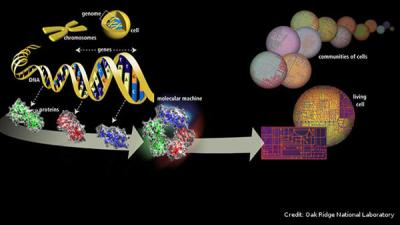
The genome is an organism’s complete set of DNA and is organized into chromosomes containing genes that encode for hereditary traits. Researchers at Penn State are studying mutations that cause inherited cancers and other hereditary diseases. Credit: Oak Ridge National Laboratory
Kyoto Prize Awarded to Penn State's Masatoshi Nei
Image
Masatoshi Nei
Alzheimer's, Schizophrenia, and Autism Now Can Be Studied with Mature Brain Cells Reprogrammed from Skin Cells
Image
Human neural stem cells (shown in red), reprogrammed originally from adult skin cells, differentiate efficiently into brain cells (shown in green), after being cultured with star-shaped cells called astrocytes. Credit: Chen lab, Penn State University.
New Kind of Antibiotic May Be More Effective at Fighting Tuberculosis, Anthrax, and Other Diseases
Image
Bacillus anthracis (anthrax) cells being killed by a molecule studied by Penn State University researcher Kenneth Keiler. The molecule is naturally fluorescent and it looks blue when it is excited by ultraviolet light in the microscope. Keiler and his team found that certain molecules inhibit the growth of very distantly related bacteria by stopping trans-translation, which is a quality control mechanism that is found in all species of bacteria. Credit: Keiler lab, Penn State University
Getting to the bottom of the zombie ant phenomenon
Image
The cadaver of a zombie ant clings to a leaf in the tropical understory. Emerging from its head are spores of the parasitic fungus that killed it. Credit: David Hughes
2013 Myriant Corporation Scholarship Winners Announced
Image
2013 Myriant Corporation Scholarship Winners Announced
Probing Question: Do Women Dominate the Field of Forensic Science?
Image
Penn State Forensics students entering a simulation experience.
Gene Offers Clues to New Treatments for a Harmful Blood Clotting Disorder
Image
Shown in blue is chromatin -- the condensed form of DNA that the cell remodels to form chromosomes. The PAD4 enzyme decondenses chromatin by loosening up the interaction between DNA and special proteins called histones. The histones modified by PAD4 are shown in fuchsia. This process helps to form both a bacteria-killing NET -- which is comprised of infection-combatting white blood cells called neutrophils -- and the fluffy, scattered ball that comprises a blood clot. Wang lab, Penn State University.
Claude dePamphilis Awarded Faculty Scholar Medal for Outstanding Achievement
Image
Claude dePamphilis
Rachel Chang to Represent Penn State's Eberly College of Science as Student Marshal at Spring Commencement 2013
Image
Rachel Chang
Subscribe to Life Sciences