Using satellite images to better target vaccination
Image
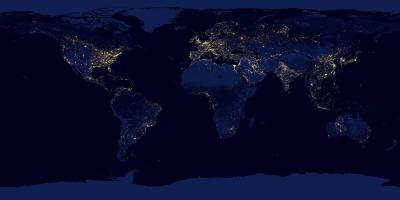
Composite image of the Earth at night assembled from data acquired by the Suomi National Polar-orbiting Partnership (Suomi NPP) satellite over nine days in April 2012 and thirteen days in October 2012. Population estimates based on similar satellite data can help improve vaccination campaigns. Credit: NASA Earth Observatory/NOAA NGDC.
Researchers harness 'big data' to see the big picture on lakes, nutrient cycles
Image
Lake
RNA, gravitational waves focus of two new grants
Freedman Group Makes Outreach Activities a Priority
Collaboration Leads to Great Achievement: Amie Boal and Squire Booker
Closing in on high-temperature superconductivity
Image
This composite image contains an equation in the foreground related to Penn State theory research in high-temperature superconductivity, and images in the background resulting from high-temperature superconductivity experiments. Credit: Penn State University
Tae-Hee Lee's August ACS Presentation covered by C&EN Magazine
Swift telescope detects slowest-spinning neutron star
Image
Composite photo of the slowest spinning neutron star discovered so far (9-2016): background stars photographed in optical wavelengths; colorful cloud is the supernova remnant RCW 103, photographed in X-ray wavelengths, with the white neutron star at its center. Image credit: X-ray:NASA/CXC/University of Amsterdam/N.Rea et al; Optical:Digital Sky Survey
NSF grant to promote more diversity, inclusion in STEM fields
Image
NSF-INCLUDES is aimed at broadening STEM participation among underrepresented groups, including women, Hispanics, African Americans, Native Americans, persons with disabilities, people from rural areas and people of low socioeconomic status. Image: © iStock Photo Steve Debenport
Coral conservation efforts aided by computer simulations: New research shows that endangered corals in the eastern Pacific Ocean are isolated from healthy coral populations in the west
Image
Coral releasing egg/sperm bundles which will be fertilised in the water to form poppy-seed-sized larvae. Credit: Jamie Craggs, Project Coral, Horniman Museum and Gardens
Subscribe to Research