AstroFest 2017 is Four Evenings of Astronomy Activities and Stargazing During Arts Festival
Image
Observatory on the roof of Davey Lab
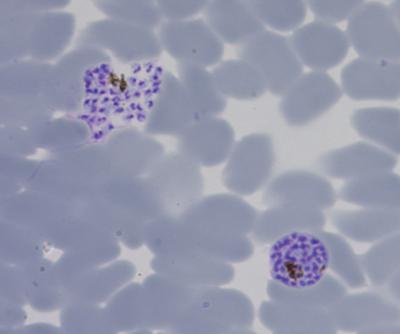
Malaria parasites sense and adapt to their host’s nutritional status
Image
Malaria parasites replicate into many daughter cells inside red blood cells. The red blood cells eventually burst (cell on the left), allowing the parasites to infect new red blood cells. In hosts with reduced calorie intake, fewer daughter cells are produced per round of replication, decreasing the severity of the infection and potentially allowing the host to survive longer. Credit: Maria Mota Laboratory, iMM Lisboa
Flexible flagella fight flow: Bacteria change a liquid’s properties and escape entrapment
Image
A three-dimensional computer-generated illustration of an Escherichia coli bacterium based on a scanning electron micrograph. These bacteria use flagella -- a collection of spinning hairs -- for propulsion. Credit: Alissa Eckert and Jennifer Oosthuizen, CDC.
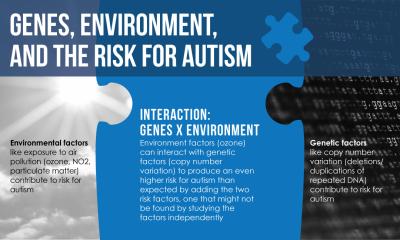
Genes, Ozone, and Autism: Increased risk for autism when genetic variation and air pollution meet
Image
Genes, Environment, and the Risk for Autism: Environment factors (ozone) can interact with genetic factors (copy number variation) to produce an even higher risk for autism than expected by adding the two risk factors, one that might not be found by studying the factors independently. Credit: Penn State University
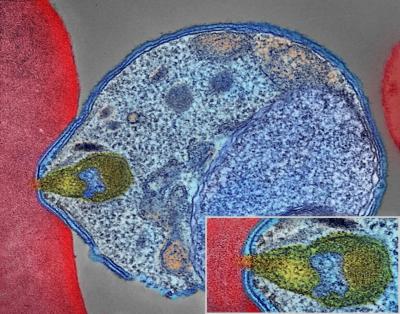
Potential new target for antimalarial drugs identified
Image
A colorized electron micrograph of a malaria-causing Plasmodium parasite (right) attaching to and invading a human red blood cell. The inset shows the attachment point at higher magnification. Credit: National Institute of Allergy and Infectious Diseases, NIH
New way to weigh a white dwarf: Use Hubble Space Telescope
Image
This drawing shows the observed versus actual positions of a distant star whose light is distorted by the curvature of space around a heavy star that is between the distant star and the observer. In this case, the observer is the Hubble Space Telescope. Credits: NASA, ESA, and K. Sahu (STScI)
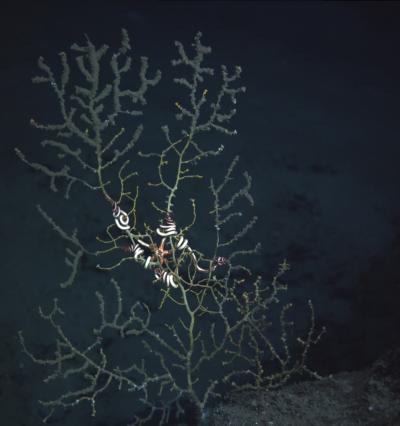
Research expedition continues monitoring impact of Deepwater Horizon oil spill on deep sea corals
Image
Deepwater coral covered in oil and dispersant. Credit: ECOGIG and Penn State (2010)
Two-part system turns stem cells into whatever you want
Image
Schematic illustrating the reduced leakage expression, tight drug induced regulation, and retained functionality of new plasmid system in stem cells and differentiated cell types. Credit: Lauren N. Randolph / Penn State
New planet found to be hotter than most stars
Image
A newly discovered Jupiter-like world is so hot that even its nights are like the flame of a welding torch. Planet KELT-9b is hotter than most stars. With a day-side temperature of more than 7,800 degrees Fahrenheit (4,600 Kelvin), it is only about 2,000 degrees Fahrenheit (1,200 Kelvin) cooler than our own sun. Credit: R. Hurt (IPAC), NASA/JPL-Caltech
Low cost, scalable water-splitting fuels the future hydrogen economy
Image
Molecular models representing a 2D heterostructure made of graphene (gray background hexagonal lattice), and islands on top of hexagonal WS2 and MoS, as well as an alloy of the two. Water (H2O) molecules in red (oxygen) and gray (hydrogen) come from the bottom left hand side and get transformed catalytically after interacting with the heterostructures into H2 bubbles (top right hand side). Credit: Terrones Group/Penn State
Subscribe to Research