Innovative Nanoparticle Purification System Uses Magnetic Fields
Image
"Nano-olives" are made up of an iron oxide "olive" with an iron and platinum "pimento." Together the components make a highly magnetic particle structure, which may one day be useful for data storage in computers. Credit: The Schaak/Williams research groups, Penn State.
Atomic Clock with the World's Best Long-term Accuracy Is Revealed by Research
Image
Credit: National Physical Laboratory, United Kingdom
Distant Black Hole Discovered Devouring a Sun-like Star
Image
Images from Swift's Ultraviolet/Optical (white, purple) and X-Ray telescopes (yellow and red) were combined to make this view of Swift J1644+57. Evidence of flares is seen only in the X-ray image, a 3.4-hour exposure taken on March 28, 2011. Credit: NASA/Swift/Stefan Immler
Video: New Forensic Fingerprinting Approach Retrieves Elusive Prints
Ancestry of Polar Bears Traced to Ireland
Image
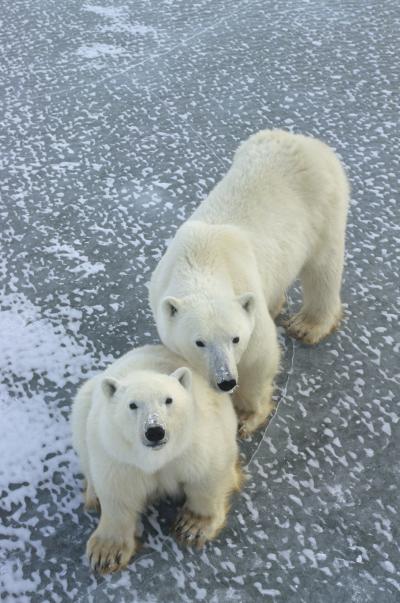
Beth Shapiro's research team concluded that all living polar bears trace their maternal ancestor to a brown bear that lived near present-day Britain and Ireland just prior to the last ice age. Credit: Daniel J. Cox/NaturalExposures.com
Scientists Sequence Endangered Tasmanian Devil's Genome
Image
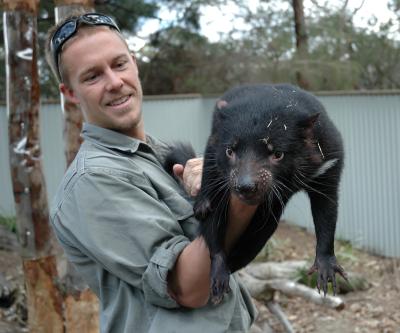
Zoo keeper and breeder Tim Faulkner holds a Tasmanian devil -- an endangered marsupial found in the wild in the Australian island-state of Tasmania. Credit: Stephan C. Schuster, Penn State
Slowing the Spread of Drug-Resistant Diseases Is Goal of New Research Area
Image
This colored 2005 scanning electron micrograph (SEM) shows numerous clumps of methicillin-resistant Staphylococcus aureus bacteria, commonly referred to by the acronym, MRSA, magnified 2390 times. Credit: Janice Haney Carr/CDC/ Jeff Hageman, M.H.S.
Life-History Traits May Affect DNA Mutation Rates in Males More Than in Females
Image
Credit: Anton Nekrutenko, Penn State
Cosmic Explosion is New Candidate for Most Distant Object in the Universe
Image
Credit: Gemini Observatory / AURA / Levan, Tanvir, Cucchiara
Nearby Supernova Factory Turns On
Image
This large Chandra image shows the Carina Nebula, a star-forming region in the Sagittarius-Carina arm of the Milky Way a mere 7,500 light years from Earth. Chandra's sharp X-ray vision has detected over 14,000 stars in this region, revealed a diffuse X-ray glow, and provided strong evidence that massive stars have already self-destructed in this nearby supernova factory.  Credit: NASA/CXC/PSU/L.Townsley et al.
Subscribe to Research