Penn State Scientists Participate in the Construction of the Largest Three-Dimensional Map of the Universe
Image
Galaxies are concentrated into clusters and filaments with voids in between. The SDSS-III is exploring this structure to determine the nature of dark energy and the distribution of dark matter in the Universe.  Credit: Yushu Yao and Prabhat (Lawrence Berkeley National Laboratory, NERSC), Miguel A. Aragon (Johns Hopkins University), and the SDSS-III Collaboration
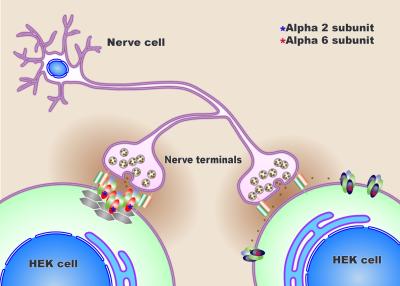
New Model Synapse Could Shed Light on Disorders Such as Epilepsy and Anxiety
Image
Model synapses revealed that, when a GABA-A receptor had Alpha 2 subunits, the receptor tended move toward and form at the synaptic region. However, when a GABA-A receptor had Alpha 6 subunits, the receptor tended to move toward the extrasynaptic region. Credit: Gong Chen lab, Penn State
Vaccine Research Shows Vigilance Needed against Evolution of More-Virulent Malaria
Image
A female Anopheles albimanus mosquito feeding on a human host and engorged with blood. Credit: Centers for Disease Control and Prevention, public domain image.
Polar Bear Evolution Tracked Climate Change, New DNA Study Suggests
Image
A polar bear at rest, but alert, looking directly at camera. Credit: U.S. Fish and Wildlife Service.
National Science Board Recommends Giant Survey Telescope
Image
An artist's rendering of the proposed Large Synoptic Survey Telescope.
Viruses' Copying Mechanism Demystified, Opening the Door to New Vaccine Strategies
Image
Motif D shown next to a nucleotide
Penn State Physics Professor Helps Keep World on Schedule Through Work on the Accuracy of Clocks
Image
Credit: National Physical Laboratory, United Kingdom
Andrew Read Presents at TEDMED 2012
Image
Read Named a Fellow of the American Association for the Advancement of Science
Acoustic Tweezers Capture Tiny Creatures with Ultrasound
Image
A device shown next to a dime for comparison
Nerve Pathway for Combating Axon Injury and Stress May Hold Benefits for Individuals with Neurodegenerative Disorders
Image
Neurons expressing a toxic form of spinocerebellar ataxia type 3 (SCA3) with protective pathway enabled (left) and blocked (right). Credit: Melissa Rolls.
Subscribe to Research