New Effort to Learn How Our Galaxy Formed Makes Public Release of Its First Data
Image
This map shows an infrared view of the Milky Way, as seen from Earth, plus the infrared spectra of two stars. Credit: Peter Frinchaboy (Texas Christian University), Ricardo Schiavon (Liverpool John Moores University), and the SDSS-III collaboration. Infrared sky image from 2MASS, IPAC/Caltech, and University of Massachusetts.
Using interdisciplinary tools to find cure for human herpesvirus
Image
Paired fluorescence and phase (white light) images of uninfected neurons (top and bottom left) and neurons infected with HSV (top and bottom right). As is clearly visible in the white light images, these neurons form dense networks of connections. Fluorescent dyes can be used to stain and highlight the individual filaments of these networks (top left) as well as to detect a specific viral protein expressed during HSV infection (top right). Image: Moriah Szpara
Biologist investigates lasting ecological impacts of Deepwater Horizon oil spill
Image
This photo, taken as part of a major research project led by Penn State Professor of Biology Charles Fisher, shows a reef formed by the coral species Lophelia pertusa at 450m below the surface of the Gulf of Mexico with an orange brisingid starfish in the foreground and a school of fish overhead. Credit: Image courtesy of Lophelia II 2010 Expedition, NOAA OER BOEM
Infectious Disease Research Gets a Boost from Websites, Blogs, and Social Media
Image
An article by Marcel Salathé and his colleagues in the New England Journal of Medicine describes a new field of research known as digital epidemiology. This field is of increasing importance for tracking outbreaks of infectious diseases such as the one caused by a novel coronavirus, pictured here.  Credit: Rocky Mountain Laboratories, National Institute of Allergy and Infectious Diseases, National Institutes of Health
Genome instability studies could change treatment for cancer and other diseases
Image
The genome is an organism’s complete set of DNA and is organized into chromosomes containing genes that encode for hereditary traits. Researchers at Penn State are studying mutations that cause inherited cancers and other hereditary diseases. Credit: Oak Ridge National Laboratory
Nanoparticle Opens the Door to Clean-Energy Alternatives
Image
A transmission-electron microscope image of a collection of quasi-spherical nickel phosphide nanoparticles. A team led by Raymond Schaak of Penn State University has found that these nanoparticles can catalyze an important chemical reaction that generates hydrogen from water. Credit: Eric Popczun, Penn State University
Alzheimer's, Schizophrenia, and Autism Now Can Be Studied with Mature Brain Cells Reprogrammed from Skin Cells
Image
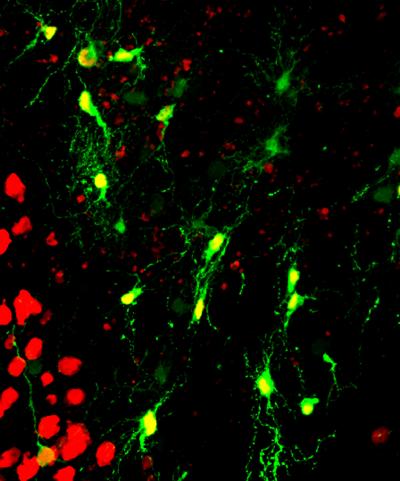
Human neural stem cells (shown in red), reprogrammed originally from adult skin cells, differentiate efficiently into brain cells (shown in green), after being cultured with star-shaped cells called astrocytes. Credit: Chen lab, Penn State University.
New Kind of Antibiotic May Be More Effective at Fighting Tuberculosis, Anthrax, and Other Diseases
Image
Bacillus anthracis (anthrax) cells being killed by a molecule studied by Penn State University researcher Kenneth Keiler. The molecule is naturally fluorescent and it looks blue when it is excited by ultraviolet light in the microscope. Keiler and his team found that certain molecules inhibit the growth of very distantly related bacteria by stopping trans-translation, which is a quality control mechanism that is found in all species of bacteria. Credit: Keiler lab, Penn State University
Best Ultraviolet Map of the Nearest Galaxies Now Revealed
Image
Nearly a million ultraviolet sources appear in this mosaic of the Large Magellanic Cloud, which was assembled from 2,200 images taken by Swift's Ultraviolet/Optical Telescope. UV image credit: NASA/Swift/S. Immler (Goddard) and M. Siegel (Penn State). Visible image credit: Axel Mellinger, Central Michigan Univ.
Super-dense Star is First Ever Found Suddenly Slowing Its Spin
Image
A neutron star is the densest object astronomers can observe directly, crushing half a million times Earth's mass into a sphere about 12 miles across -- roughly the size of Pittsburgh, or the distance between the Penn State University Park Campus and Bellefonte, Pennsylvania, as shown in this illustration. Credit: NASA's Goddard Space Flight Center and Penn State University
Subscribe to Research