
NSF funds national user facility for $17.8 million to develop 2-D crystals
Image
Artistic representation of growth and characterization of 2D materials -- tungsten disulfide on graphene Credit: Terrones Lab / Penn State
Mikael Rechtsman receives Alfred P. Sloan Research Fellowship in physics
Image
Mikael Rechtsman
New clues in the hunt for the sources of cosmic neutrinos
Image
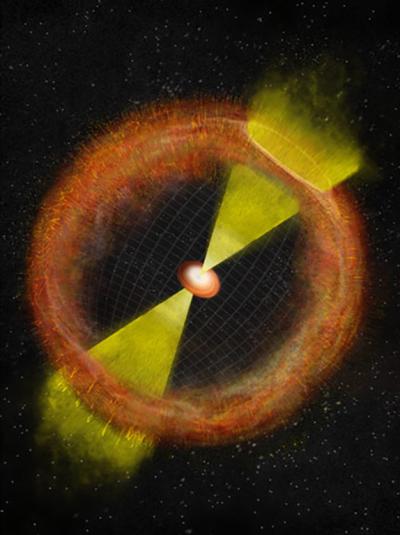
This illustration is an example of a hidden cosmic-ray accelerator. Cosmic rays are accelerated up to extremely high energies in dense environments close to black holes. High-energy gamma rays (marked by the “Y” gamma symbol) are blocked from escaping, while neutrinos (marked by the “V”nu symbol) easily escape and can reach the Earth.  Credit: Bill Saxton at NRAO/AUI/NSF, modified by Kohta Murase at Penn State University
Gravitational waves detected 100 years after Einstein's Prediction: Opens New Window on the Universe with Observation of Gravitational Waves from Colliding Black Holes
Image
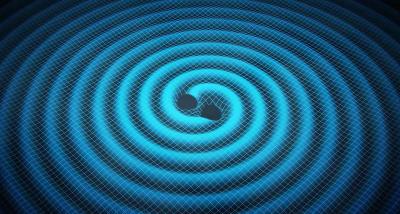
Merging black holes ripple space and time in this artist's concept.  Image credit: Swinburne Astronomy Productions
What Happens When LIGO Texts You to Say it's Detected One of Einstein's Predicted Gravitational Waves
Image
These plots show the signals of gravitational waves detected by the twin LIGO observatories at Livingston, Louisiana, and Hanford, Washington. The signals came from two merging black holes, each about 30 times the mass of our sun, lying 1.3 billion light-years away. LIGO, CC BY-ND
Transforming Science Education with Tombros Fellowships
Image
Science Journal generic logo
Robinett’s Advising Enhances the Student Experience
Image
Science Journal generic logo
Penn State Scientists part of team that wins 2016 Breakthrough Prize in Fundamental Physics
Image
Fish-eye photo of the SNO Detector. Credit SNO
Ultrasensitive Sensors Made from Boron-Doped Graphene
Image
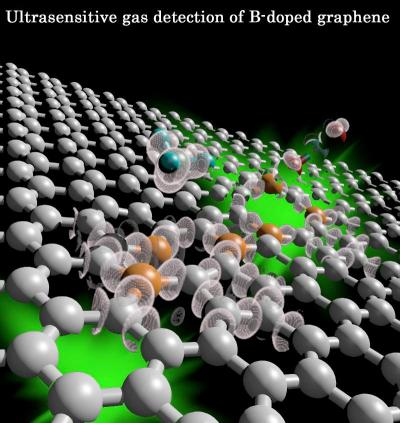
Boron atoms (orange) in a lattice of graphene (gray) sense gas molecules on the graphene surface. Credit: Terrones Lab/Penn State
Penn State receives two awards for materials research and education
Image
Partnerships for Research and Education in Materials (PREM) involve outreach to excite budding scientists. Here, students discover how scientists control structure and defects to create certain properties in materials using a sheet of ball bearings. The students were visiting the Strange Matter Exhibit at the Casa Roig Museum in Humacao, Puerto Rico.
Subscribe to Physics