
NASA set to launch Penn State led experiment
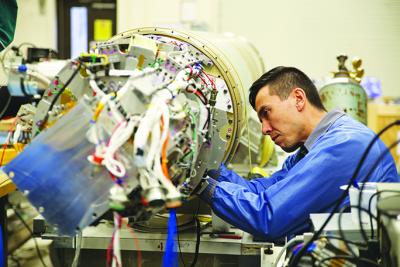
Image
Randall McEntaffer, professor of astronomy and astrophysics and of physics at Penn State and principal investigator of WRX, works on the instrument during integration at the NASA Flight Facility.   Credit NASA/Berit Bland
Study of climate change could lead to understanding future of infectious disease
Three from Eberly College of Science named Alfred P. Sloan Research Fellows
Image
Sloan Fellowships Logo
Three types of extreme-energy space particles may have unified origin
Image
This image illustrates the "multi-messenger'' emission from a gigantic reservoir of cosmic rays that are accelerated by powerful jets from a supermassive black hole. Credit: Kanoko Horio
Four-dimensional physics in two dimensions
Image
Illustration of light passing through a two-dimensional waveguide array. Each waveguide is essentially a tube, which behaves like a wire for light, inscribed through high-quality glass using a powerful laser. Many of these waveguides are inscribed closely spaced through a single piece of glass to form the array. Light that flows through the device behaves precisely according to the predictions of the four-dimensional quantum Hall effect. CREDIT: Rechtsman laboratory, Penn State University
Two discoveries by international collaborations involving Penn State scientists make list of Physics World Top Ten Breakthroughs of 2017
Image
Physics World Top 10 logo. Credit: Physics World.
Sky-high observatory sheds light on origin of excess anti-matter: New study excludes nearby pulsars, points to dark matter as possible culprit
Image
High-energy photon emission around the pulsars Geminga and PSR B0656+14, as captured by the High-Altitude Water Cherenkov Observatory. Credit: High-Altitude Water Cherenkov Collaboration (moon image Gregory H. Revera)
Two-dimensional materials gets a new theory for control of properties
Image
A grain boundary forms when graphene growth advances past an apex on a conical bump, where the curvature resembles that on a sphere; it terminates at the foot of the bump, where curvature is saddle-like. Credit: Crespi Lab / Penn State
Rechtsman awarded 2017 Packard Fellowship for Science and Engineering
Image
Mikael Rechtsman
Gravitational waves + new clues from space reveal new way to make a black hole
Image
Artist impression of gravitational waves generated by binary neutron stars. Credit: R. Hurt, Caltech/JPL
Subscribe to Physics