
Lab Bench to Commercialization 2018–19 grant recipients announced
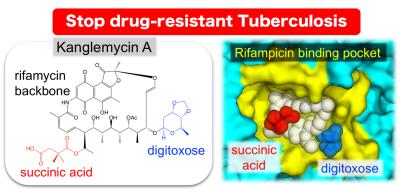
A naturally occurring antibiotic active against drug-resistant tuberculosis
Image
The natural antibiotic kanglemycin A binds bacterial RNA polymerase at the rifampicin binding-pocket, but maintains potency against rifampicin-resistant mutants due to two unique chemical groups (digitoxose and succinic acid) that increase its affinity to rifampicin-resistant RNA polymerase by binding just outside the rifampicin-binding pocket. Credit: Murakami Laboratory, Penn State
Family genetic background vital for understanding progression of autism and other neurodevelopmental disorders
Wendy Hanna-Rose named head of Department of Biochemistry and Molecular Biology

Image
Wendy Hanna-Rose
Finding the proteins that unpack DNA
Image
DNA is typically wrapped tightly around proteins called histones (colored) to form a nucleosome, a structure that condenses DNA strands to fit in a cell’s nucleus. A new method allows scientists to identify specialized proteins called nucleosome-displacing factors that unwrap these nucleosomes, making the usually dense DNA more accessible for gene expression and other functions. Image: Karolin Luger
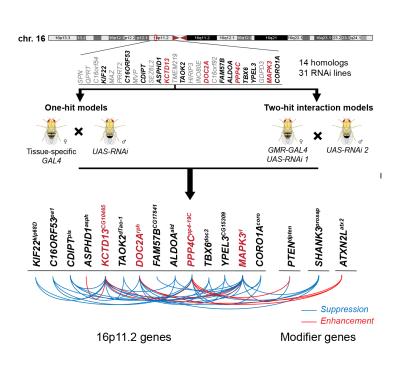
The hidden complexity underlying a common cause of autism: Uncovering genetic interactions responsible for neurodevelopmental disorders
Image
Illustration of chromosome 16 showing the 14 fly counterparts of the 25 human genes located in a deletion on the chromosome that is associated with autism risk. Researchers used RNA interference (RNAi) to the reduce the expression of these genes individually and in tandem to test how the interactions of these genes modulate neurodevelopmental symptoms associated with the deletion. Interactions between genes that either enhance or suppress the affect of reduced expression are shown by red or blue lines.
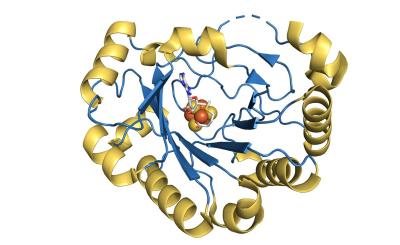
Compound made inside human body stops viruses from replicating
Image
A structural model of viperin, a naturally occurring enzyme in humans that is known to have antiviral effects on viruses such as West Nile, hepatitis C, rabies, and HIV. A new study led by researchers from Penn State and the Albert Einstein College of Medicine reveals the mode of action of viperin, which facilitates an important reaction that results in the production of ddhCTP, a molecule that prevents viruses from copying their genetic material.
Penn State student Paige Laughlin receives PennACE Student of the Year Award

Image
PennACE undergrad award winner Paige Laughlin
Squire Booker honored as an Evan Pugh Professor
Image
Squire Booker
Amie Boal receives 2018 Camille Dreyfus Teacher-Scholar Award
Image
Amie Boal
Subscribe to Biochemistry and Molecular Biology