
Kristina Kaldon Receives USRA Education Award
Image
L-R: Donald Schneider, professor and head of the Department of Astronomy and Astrophysics; John Nousek, professor of astronomy and astrophysics, and director of the NASA Swift Satellite Mission Operations Center; Kristina Kaldon; and Kevin Luhman
Mystery of rare 5-hour space explosion explained with help from US/Russia and US/UK/Italy satellites
Image
The X-ray image from the Swift X-ray Telescope of the gamma-ray burst GRB 130925. The white object in the center is the gamma-ray burst.  The large diffuse region to the right is a cluster of galaxies. The other objects are X-ray-emitting celestial objects, most likely supermassive black holes at the centers of distant galaxies. The full image is approximately the size of the full moon. Credit: Phil Evans/ University of Leicester
Niel Brandt Named Verne M. Willaman Professor of Astronomy and Astrophysics
Image
Niel Brandt
Eric Feigelson Awarded Faculty Scholar Medal for Outstanding Achievement
Image
Eric Feigelson
Penn State is a Member of the New $678 million Telescope Now Approved for Construction
Image
Click on the image for a high-resolution version. Artist's drawing of LSST in profile. Credit: Todd Mason, Mason Productions Inc. / LSST Corporation
Penn State Joins New Project to Map the Universe
Image
The new SDSS will measure spectra at multiple points in the same galaxy, using a newly created fiber bundle technology. Credit: Dana Berry / SkyWorks Digital, Inc., David Law, SDSS Collaboration Hubble Space Telescope image credit: NASA, ESA, the Hubble Heritage (STScI/AURA)-ESA/Hubble Collaboration, and A. Evans (University of Virginia, Charlottesville/NRAO/Stony Brook University)
Controversial Clues of Two 'Goldilocks Planets' That Might Support Life are Proven False
Image
This image shows the location of the three planets remaining in 2014. Credit: NASA/Penn State University
Photos of New Comet Approaching a Very Close Encounter with Mars
Image
his composite of Comet Sliding Spring (C/2013 A1) merges images taken between May 27 and May 29, 2014 with the Ultraviolet Optical telecsope (UVOT) on the NASA's Swift satellite. Sunlight reflected from the comet's dust, which produces most of the light in this image, appears yellow. Ultraviolet light produced by hydroxyl (OH), a molecular fragment of water, appears violet in this image. Credit: NASA/Swift/D. Bodewits (UMD), DSS.
NASA Ranks Swift Satellite Number One
Image
Artist rendering of the Swift satellite. Credit: NASA, Sonoma State University, Aurore Simonnet
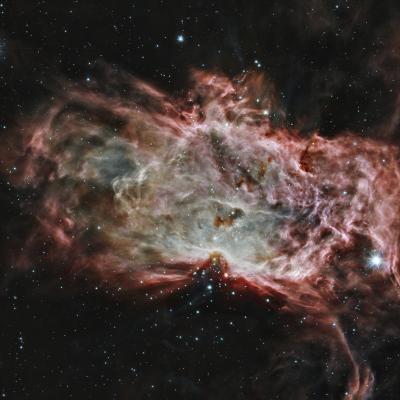
X-Ray Satellite Delivers Surprising New Clues about Formation of Clusters of Sun-like Stars
Image
An important advance in understanding how clusters of stars like our Sun are formed has been made by a team that includes seven Penn State astronomers. One of the clusters that the astronomers studied is shown in this image. Credit: X-ray: NASA/CXC/Penn State/K.Getman, E.Feigelson, M.Kuhn & the MYStIX team; Infrared:NASA/JPL-Caltech
Subscribe to Astronomy and Astrophysics