
Space observatory controlled by Penn State captures its 1,000th gamma-ray burst
Image
This illustration shows the positions of 1,000 gamma-ray bursts (GRBs) detected by the Swift orbiting observatory on an all-sky map. Credit: NASA's Goddard Space Flight Center and 2MASS/J.Carpenter, T. H. Jarrett, and R. Hurt
World's 3rd largest optical telescope gets $25 million upgrade
Image
The Hobby-Eberly Telescope. CREDIT: Ethan Tweedie Photography
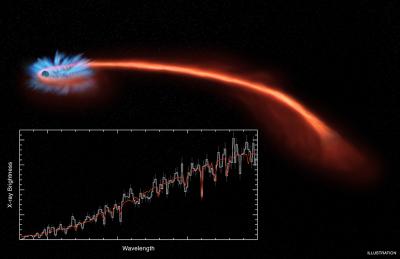
Black hole caught in the act of ripping apart a star
Image
Astronomers have observed material being blown away from a black hole after it tore a star apart in the center of a galaxy that is about 290 million light years away from Earth. The event, known as a “tidal disruption,” is depicted in this artist’s illustration. Credit: NASA's Goddard Space Flight Center/CI Lab
New Milky Way Map Reveals Stars in Our Galaxy Move Far from Home
Image
A single frame from an animation shows how stellar orbits in the Milky Way can change. It shows two pairs of stars (marked as red and blue) in which each pair started in the same orbit, and then one star in the pair changed orbits. The star marked as red has completed its move into a new orbit, while the star marked in blue is still moving. Credit: Dana Berry / SkyWorks Digital, Inc.; SDSS collaboration
Clump of a star's gas, catapulting into space at 40 million miles per hour, appears to be picking up speed
Image
This artist's drawing and trio of X-ray images from NASA's Chandra  X-ray Observatory illustrate that a clump of stellar material has  been jettisoned away from a double-star system at incredibly high  speeds.  Credit:X-ray: NASA/CXC/PSU/G.Pavlov et al; Illustration: NASA/CXC/M.Weiss
Jane Charlton selected as Penn State Teaching Fellow
Image
Jane Charlton
Charlton honored with President's Award for Excellence in Academic Integration
Image
Jane Charlton
Black hole, quiet since 1989, now caught burping a rare X-ray flare
Image
On June 15, NASA's Swift caught the onset of a rare X-ray outburst from a stellar-mass black hole in the binary system V404 Cygni. Astronomers around the world are watching the event. In this system, a stream of gas from a star much like the sun flows toward a 10 solar mass black hole. Instead of spiraling toward the black hole, the gas accumulates for decades in an accretion disk around it. Every couple of decades, the disk switches into a state that sends the gas rushing inward, starting a new outburst.
Lord of the Rings: Astronomers Pinpoint the Location of a Mysterious Neutron Star with Superlative Rings of X-ray Light
Image
Chandra data of the Circinus X-1 star system reveal a set of four rings that appear as circles around the system's neutron star, providing a rare opportunity to determine the distance to an object on the other side of the Milky Way galaxy. CREDIT: X-ray: NASA/CXC/U. Wisconsin/S. Heinz et al.; Optical: DSS.
Song Tan awarded Faculty Scholar Medal for Outstanding Achievement
Image
Song Tan
Subscribe to Astronomy and Astrophysics