
Visiting students explore sustainability through physics REU program




Students visiting Penn State for its Physics Research Experiences for Undergraduates (REU) program not only conduct hands-on research, but also explore the environmental, social, and global impacts of that research. The program, hosted by the Department of Physics in the Eberly College of Science and the Center for Nanoscale Science — a U.S. National Science Foundation-funded Materials Research Science and Engineering Center — supports students from across the country who may not otherwise have access to research opportunities.
Titled “Sustainable Physics at Penn State: From the Subatomic to the Cosmos,” the physics REU program was designed by Luiz de Viveiros, associate professor of physics, and Kirstin Purdy Drew, teaching professor of physics and funded by the National Science Foundation. During the program’s second summer in 2025, 29 students from 20 universities, including Penn State, participated in the 10-week summer research program. Students from Penn State not only are a part of in the REU cohort, continuing their ongoing research, but also act as hosts to visiting students.
The students conduct paid research with Penn State faculty in areas ranging from astro-particle physics to nanoscale condensed matter, to material memory physics, to optics and photonics to gravitational waves and cosmology.
“One of the most meaningful impacts of the REU program is its ability to bring together dozens of talented students from institutions all across the United States, exposing them to sustainable practices and perspectives within physics research,” Purdy Drew said. “These students don't just gain hands-on research experience; they become ambassadors for a new way of thinking about science. When they return to their home institutions and continue on their career paths, they carry those ideas with them, planting seeds of change in labs, classrooms, and communities far beyond Penn State's campus.”
During the summer, participants learn about social, technological and environmental sustainability challenges within scientific research, experience sustainable practices and approaches through their own research, and make plans to incorporate sustainability into their daily lives.
“As a human activity, research has an impact on society as well as the environment,” de Viveiros said. “With this program, we wanted to bridge cutting-edge physics research with the global conversation around sustainability.”
Students from a variety of science, technology, engineering, and mathematics (STEM) majors work closely with a faculty member in the Department of Physics or the Center for Nanoscale Science, together with graduate students and postdoctoral scholars in their research group. Additionally, the program hosts rigorous career development workshops, seminars, sustainability-themed activities and community outreach. Students ultimately present their work as a poster at a research symposium on campus and share information about physics, astrophysics, or sustainability during the annual Central Pennsylvania Festival of the Arts in downtown State College.
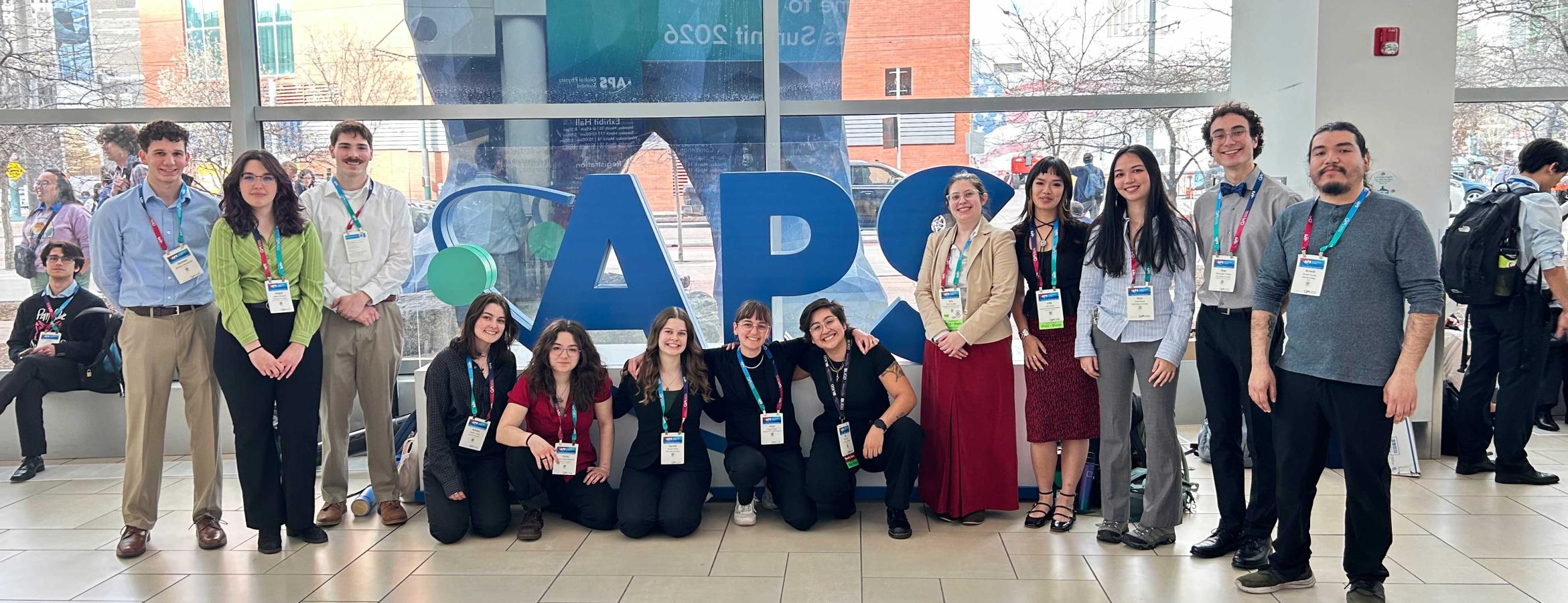
In March 2026, 13 members of the 2025 cohort also traveled to Denver, Colorado, to attend the Global American Physical Society (APS) meeting. They presented the research they conducted during their time at Penn State, sharing their findings with physicists and researchers from around the world.
“It was a proud moment for the entire program to see so many students stepping confidently onto a national stage,” said Purdy Drew. “Perhaps even more heartwarming was the sight of the REU cohort reuniting at the conference — students who had bonded over shared curiosity and hard work during their time at Penn State, coming back together to celebrate each other's achievements. It is exactly this kind of lasting connection — between students, between ideas, and between science and society — that makes the Penn State Physics REU special.”
Hero image provided by Rachel White.