
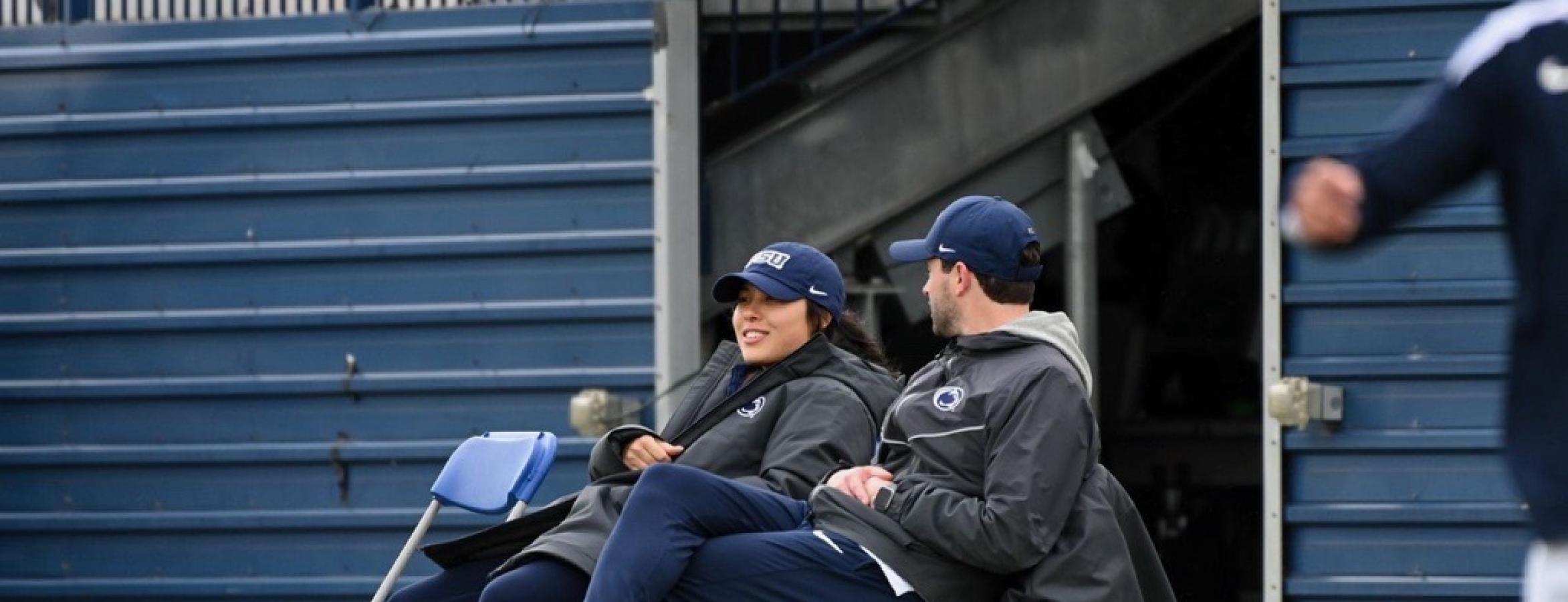
From the lab to the boardroom to the field




As the scientific heart of Pennsylvania’s land-grant university, the Penn State Eberly College of Science drives world-renowned research, foundational STEM education, and interdisciplinary innovation.
Ninety percent of all University Park undergraduate students—whether pursuing a major in or outside of our college—engage with Eberly through core math and science courses, making the college a gateway to discovery. And as the gateway to discovery, the college prepares students for careers from academia to industry by emphasizing early engagement in hands-on research and experiential learning to build the knowledge and skillsets that drive discoveries and careers with widespread impact.
About 50 percent of Eberly graduates enroll in graduate and professional programs (M.S., Ph.D., M.D., D.O.) and 50 percent become leaders in public service and companies like AstraZeneca, Deloitte, Highmark Health, Eurofins Scientific, Wells Fargo, and many others.
Alumna Abby Han graduated from Eberly in 2023 with a bachelor’s degree in science and through the college’s B.S./M.B.A. program, went on to earn her M.B.A. from the Penn State Smeal College of Business before landing her position as the director of operations and player care with the Penn State Men’s Soccer team.
We sat down with Han to discuss her Eberly experience, career path, and how she leveraged her science degree to land her dream job in athletics.
Q: How did you choose Penn State and the Eberly College of Science?
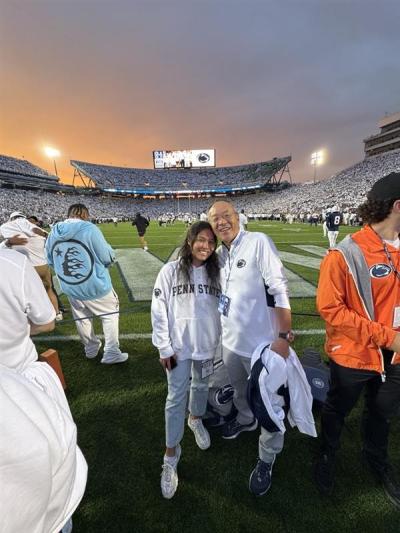
Han: I grew up in Hershey, Pennsylvania, both of my parents went to Penn State, my dad worked for the University, and brother went here, so I grew up bleeding blue and white. We always came to events like Arts Fest and sports like football games, wrestling and basketball. We were always around. So when I was in high school, Penn State was obviously on the list, and very much toward the top of the list, but I applied to a couple of other schools to give myself some options to make sure I was making the decision.
But, to be honest, I've always felt so at home [at Penn State], and it kind of was always my destiny to end up here. I definitely just kind of grew up in a Penn State family. And I think that's what is so special and unique about Penn State: There are families that are Penn State families. What steered me into Eberly was growing up and throughout middle and high school, I was always very STEM focused. I always enjoyed math and science classes.
So, from that sense, it was a no-brainer. I knew that I wanted to stay in that field of study. Because I didn't know exactly where I wanted to end up, I did end up exploring different options within Eberly quite a bit.
Q: Tell me more about your major and what attracted you to pursue it?
Han: I initially started as an intended chemistry major. When you're 17 or 18 and you're trying to pick what you want to study, it seems like a really big decision, and to me, I just knew I liked chemistry class. So, I thought that sounded like a good place to start.
After that first semester and having taken some classes, and I started thinking more seriously about, okay, what is it that I want to study? During winter break, my dad showed me a flyer for the college’s B.S./M.B.A. program that we had gotten in the mail, which is ultimately where I ended up after applying for getting into the program. I remember a line on the pamphlet that said something along the lines of “do you enjoy science, but you don't necessarily want to work in a lab setting,” and that really resonated with me. What attracts me to science and STEM areas is the line of thinking and approach to solving problems. I could stay in science, but wasn't necessarily setting myself up for a research and lab trajectory, which was important to me.
The structure of the B.S./M.B.A. program also introduced another set of decisions about what I wanted to focus on. I considered biology in addition to chemistry, but ultimately landed on a math and statistics focus and also earned a minor in math. For me, that decision ultimately stemmed back to my attraction to analytical thinking and logistics approaches to problem solving.
What is really so great about Penn State, and specifically within Eberly, is that there is that flexibility to move around and find your match. At no point in my time locked into what I was doing. Everyone is supportive of you exploring different things and taking different classes.
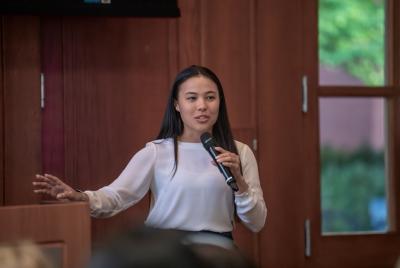
As part of B.S./M.B.A. program, you have to do a co-op, which is a six month work experience, and then a three-month internship for credit. I did my co-op with Johnson and Johnson, where I was doing data analytics. It was a very structured nine to five position. And, something that I like to share with other students is that it was a great experience for several reasons. I learned so much. I gained a lot of skills. I worked with some really amazing people. But reflecting on it, it also helped me realize what I didn’t want. That position was not something that I could see myself doing long term as a career. Having experiences to learn that something that you don't want to do is just as important as spending that time to figure out that's exactly what you want to do. Those pieces of information are both very, very valuable.
Q: What sparked your interest in sports leadership and how did your Eberly College of Science experience help prepare you?
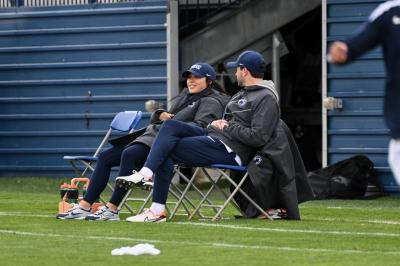
Han: The first summer that I was going to be at Penn State, I was planning to stay in State College. I had a couple classes that I was going to take, and it was kind of right on the tail of COVID-19, so I was just excited to have the opportunity to be somewhere different.
And I had a family friend at the time who was on football staff, and so I reached out to ask about any potential opportunities, like a summer position, to fill my time. I didn't really expect anything serious out of it, but the team had an internship opening that I was offered. It progressed beyond the summer, and I very quickly fell in love with the environment, the people and the kind work. I worked with football that summer, every semester following, and every summer following. It just became part of my life, which I think is just the nature of that industry is, if you're in sports, you are in it 24/7. One of the great things about it is that anyone who you find in these areas like they all recognize that, and they all want to be there.
Initially I had just seen it as it was really important for me to find something to do at Penn State that didn't necessarily feel like school. At the time, I did not see myself pursuing a career in sports. That was not at all the idea. And then it just kind of snowballed into a passion of mine.
I discovered that the job really aligned with my interest in being analytically focused and played into the skill sets I was learning and my strengths. I realized that I could use my math stats background in the internship and was able to eventually use it to earn credit toward my degree, too. So, it kind of came full circle. And here I am, now a year and a half post grad and still in sports, which, like I said, is not at all where I thought I was going to end up, but I love it.
Q: So, you found some overlapping or translatable skills between your science major, campus experiences and eventual career?
Han: Yeah! One thing for sure is the importance of being hyper organized. I'm sure many fields could claim this, but I feel like with STEM in particular, there is a very high emphasis on organization, tracking things properly, and high attention to detail. That kind of thinking and approach to challenges and problems is also very critical for my job.
In general, my experiences going through classes and practicing problem solving and working with different groups of people, like lab groups or partners, was very beneficial. All of those experiences taught me how to hold relationships and to have tough conversations. There are many soft skills like these that I've definitely brought with me.
And I think those soft skills and scientific way of thinking is applicable to almost any line of work that you can go into. I think it's important for any student to understand that. For me, if I was sitting in a math class learning about matrices, I might not use that particular math skill day to day in my job now, but what translates is sitting with something in front of you that you have no idea how to even tackle and to develop the skills to find resources, ask for help, and ultimately, to tackle a challenge and accomplish something that, when initially put in front of you was, felt completely foreign.
Q: Do you have any advice for current students?

Han: Find something that you're doing at Penn State that you're not solely doing just because you think it's going to help you land that job. Find something that you're doing generally because you're passionate about it and you enjoy spending your time doing beyond the classroom. College can absorb you so much—in school, classes, grades and exams. And I think it's really important to have that outlet. For me, I was fortunate enough that my outlet turned into my career. I'm sure that happens for a lot of people, too, because college is that time that you can explore so many different things. It's hard to know when you're 17 years old what you want to do for the rest of your life, but it’s also the time to leverage those resources and explore as much as possible.
Similarly, I would say to leverage alumni as much as possible. For me, that was huge. I remember calling people on the phone, and I just wanted to talk to them about how I didn't know what I wanted to do or what I wanted to major in. It was reassuring to hear other people say they were in my exact shoes once and then to see where they are now and how they've found their footing and created their own paths. It's very comforting to know that you don't have to have everything together and that it’s normal not to know what you want to do. Just hearing that other people went through that and of came out on the other side can be really give you a good confidence boost.
Q: Why do you #StayForSCIENCE?
Han: For me, it's just the fact that I see science in everything that I do. Here I am working in sports, and I'm still using and leveraging the skills that I learned coming up through a science program. I feel like in every aspect of my life I utilize those skills: analytical thinking, problem solving, attention to detail and organization. That background gave me such a foundation and a toolbox to kind of carry with me throughout life. And so, it's almost like I'm not necessarily making the choice to stay for science, but it's just with me. It becomes part of who you are, and you know how you approach life. It's really preparing you to follow your passion and go wherever you want to go.