

Three Penn State researchers awarded scientific grants from Kaufman Foundation


The Charles E. Kaufman Foundation — a supporting organization of The Pittsburgh Foundation, which works to improve the quality of life in the Pittsburgh region — has selected three Penn State researchers to receive scientific research grants. The foundation awards grants to scientists at institutes of higher learning in Pennsylvania who are pursuing research that explores essential questions in biology, physics and chemistry, or that crosses disciplinary boundaries.

Carlos Blanco, assistant professor of physics and co-hire of the Institute for Computational and Data Sciences, received a $150,000, two-year New Investigators Grant, which provides support to innovative scientists at the beginning of their careers. Blanco will use machine learning techniques to design materials that could directly detect dark matter — the mysterious substance that is thought to make up 85% of all matter in the universe but has not yet been directly detected. Most signals of dark matter are based on its gravitational impact on matter that can be observed but, Blanco said, these signals are often drowned out by noise, even in the most sensitive experiments. Blanco’s group has identified crystals built from carbon-based molecules that may be able to help researchers see through the noise. He will use machine learning to design molecules with the strongest and most direction-sensitive response and validate the leading candidates with polarized-light spectroscopy — an approach he developed with partners at the Massachusetts Institute of Technology and the Fermi National Accelerator Laboratory.
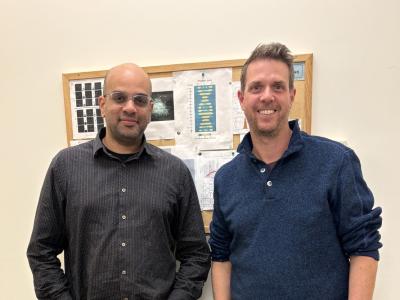
Ribhu Kaul, professor of physics, and Bryce Gadway, professor of physics, received a $300,000, two-year New Initiatives Grant, which supports the development of interdisciplinary, novel approaches to address fundamental scientific questions that require expertise beyond that of any single researcher. Kaul and Gadway will attempt to develop a three-dimensional quantum simulator of the complex behaviors of materials as they change phases, such as from a liquid to a gas. Although these phase transitions can be modeled in two dimensions with existing computer simulations, the researchers said that extending to three dimensions is beyond the reach of even the largest supercomputers. By combining abstract theoretical physics with real-world experiments and engineering based on qubits, Kaul and Gadway said they hope to overcome this hurdle and produce the first such simulation, called a Rydberg atom quantum simulation, in three dimensions.
Since 2014, the foundation has selected at least one Penn State faculty member for funding each year, supporting a total of 35 principal investigators at Penn State to date. These researchers represent multiple units across the University, including the Eberly College of Science and the Colleges of Engineering, Agricultural Sciences, Earth and Mineral Sciences, and Information Sciences and Technology. The foundation’s grants have supported projects in a range of subject areas as disparate as quantum physics, brain function, electrochemical reactions, nanomaterials and drug resistance in cancer cells