
SURE Student Spotlight - Fall 2026


Meet some of our students who participated in the Summer Undergraduate Research Experience (SURE) program.
Aristea Alexopoulos
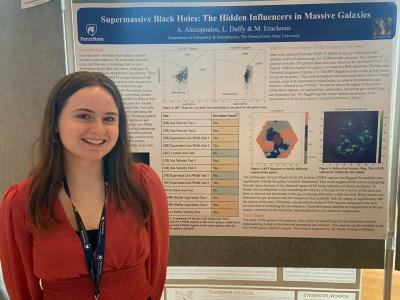
- Expected graduation: 2027
- Major: Astronomy and Astrophysics
- Minor: English
- SURE Mentor: Michael Eracleous, professor of astronomy and astrophysics
Q: When was your SURE experience?
Alexopoulos: Summer 2024, and I have continued to work with the research group.
Q: Tell us about your research.
Alexopoulos: We studied how supermassive black holes at the center of galaxies impact how dust and gas move in the area. Preexisting models explain gas dynamics in about 50% of galaxies, but I’m working with graduate student Laura Duffy to help explain unusual gas behavior in other cases. There are several theories, like the central black hole causing extra chaos, or nearby hot stars impacting the area, or shockwaves from cosmic events moving through the area, or a mix of everything. We’re investigating how these power sources might explain the dynamics we see.
Q: Tell us about your SURE experience.
Alexopoulos: That summer was the first time I seriously learned to code, and sometimes my mentor would sit me down and give a mini-lecture about physics that would help me do my research. I have enjoyed expanding on this work over the last few years.
Q: Where has this research taken you?
Alexopoulos: This summer, I participated in a Research Experience for Undergraduates (REU) program at the University of Wyoming, where we explored the geometry of supermassive black holes. It’s been interesting to explore a different aspect of these black holes and see how other research groups work.
Q: What are your future goals?
Alexopoulos: I plan to apply to graduate school in astronomy or to pursue other post-baccalaureate opportunities. I am also very interested in science communication and may see where that interest takes me.
Adam Lieb
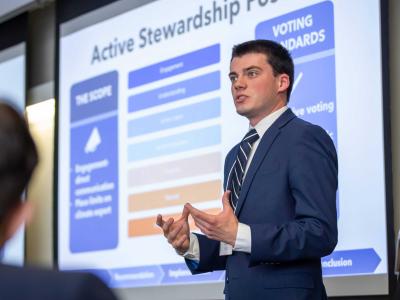
- Expected graduation: 2027
- Major: Integrative Science
- Minors: Entrepreneurship and Innovation, Political Science, and Legal Studies
- SURE Support: Drs. Chou and Chia Undergraduate
Research Program Scholarship - SURE Mentor: Jean Pual Armache, assistant professor of biochemistry and molecular biology
Q: When was your SURE experience?
Lieb: 2025, and I have continued to work in the lab.
Q: Tell us about your research.
Lieb: I studied a protein that is involved in the malaria parasite’s transition from replicating inside human red blood cells to developing into a form that can be transmitted to other mosquitos. I focused on the structural characterization of this protein to better understand its role and, ultimately, how it might be targeted to interfere with this transition and prevent the spread of malaria.
Q: Tell us about your SURE experience.
Lieb: Although I had some experience from class, this was my first time really working in a wet lab and feeling like my work was making a difference.
Q: How did you get into science?
Lieb: I was born and raised in State College, and as a kid I was always sort of intimidated by science and math. But one summer I attended a Science-U camp, where I interacted with Penn State students and saw role models that captivated an interest in STEM. Penn State became a place where I could push my limits and take on challenges I once thought were beyond me, while having a strong network of support along the way. I wanted to give back to the institution that helped me realize what I was capable of.
Q: How does your interest in science intersect with your other academic pursuits?
Lieb: I’ve always been passionate about public speaking, debating, and competition, which led me to the business ethics team, housed in the Smeal College of Business. During competitions, which are sometimes international, our team must create and present a solution to a real-world business problem that is financially and fiscally responsible, in line with legal standards, and is ethically responsible. I help to bring a different method of problem analysis and solving to the team, which is comprised mainly of students in business. The work done compliments and synthesizes rhetorical and scientific argument to help build my law toolkit.
Q: What are your future goals?
Lieb: I would like to attend law school and pursue a career in intellectual property law. To practice in this field, you need a STEM background, and my major and work in the lab have really set me up well for this path.
Julia Mudryk
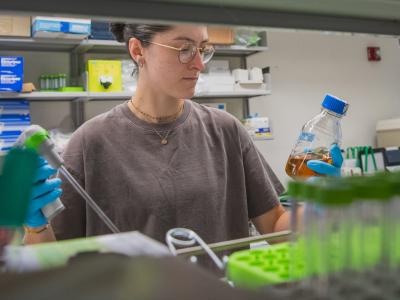
- Undergraduate Major: Biology 2023
- Undergraduate Support: Homer F. Braddock Scholarship
in Biology - Graduate Program: Biotechnology
- SURE Mentor: Claire Thomas, associate professor emeritus of biology
Q: When was your SURE experience?
Mudryk: 2023, and I worked in the lab for an additional semester.
Q: Tell us about your SURE research.
Mudryk: The summer of my SURE program was my first experience with an independent research project. I spent a lot of time learning fundamental techniques in molecular biology, like gel electrophoresis and CRISPR, which set me up to study an important structural protein during my fall semester.
Q: Where has this research taken you?
Mudryk: I graduated a semester early, but I wasn’t really sure what direction I wanted to go in, and Tiffany Mathews helped me find a lab tech position with Melanie McReynolds, Dorothy Foehr Huck and J. Lloyd Huck Early Career Chair in Biochemistry and Molecular Biology. That ended up being one of the best career moves I could have made. I had thought about applying to Ph.D. programs, but after working in the lab and better understanding what I like about science and research, I realized the master’s program in biotechnology was a perfect fit for me.
Q: What do you do in the McReynolds lab?
Mudryk: My funding comes from the multi-institution Center for Advanced Bioenergy and Bioproducts Innovation (CABBI), which is funded by the U.S. Department of Energy. I am studying an essential molecule involved in metabolism called NAD+ and am using isotope tracing to understand its flux in a species of yeast called Yarrowia lipolytica. Understanding NAD+ metabolic activity can give further insight into how the species can be optimized to produce high-value bioproducts like lipids/fatty alcohols that could be used to produce biodiesel.
Q: Tell us more about the biotech program and your future goals.
Mudryk: The program involves some coursework and has a built-in cooperative experience, where you get to work at a company or in academia for six months. I have continued to work in the McReynolds lab while working on coursework, and the program organizers have been really flexible and understanding about making this work for me. After graduation, I hope to pursue a career in industry.
Heer Patel
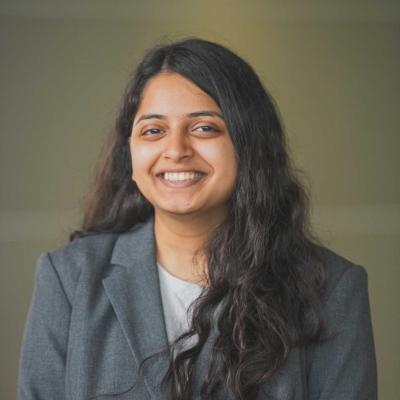
- Expected graduation: 2027
- Major: Physics
- Minor: Astronomy and Astrophysics
- Undergraduate Support: Homer F. Braddock Scholarship in
Physics - SURE Mentors: Louis Leblond, teaching professor of physics, and Kohta Murase, professor of physics and of astronomy and astrophysics
Q: When was your SURE experience?
Patel: I originally participated in 2025 and continued working on that project through the fall. I returned as a program assistant in 2026.
Q: Tell us about your research.
Patel: I had been a learning assistant in math and physics classes and really enjoyed teaching, so my first SURE summer I studied the effectiveness of learning strategies used in introductory physics classes. We surveyed students about conscious or unconscious practices that they use when they study, like reviewing notes, going to teaching assistants, making study groups, or using AI.
Q: Tell us about your SURE experience.
Patel: I did not have any research experience before joining the program, and I learned so much from the professional development activities. I was originally very nervous, but by the end I could successfully give a scientifical talk.
Q: Why did you choose to return as a program assistant?
Patel: The program assistants during my first SURE summer said they learned so much, and I was also looking for a leadership opportunity in STEM.
Q: Tell us about your research in your second SURE summer.
Patel: After I added a minor in Astronomy and Astrophysics, I wanted to do research in that field. X-ray telescopes focus their observations at certain wavelengths of light, but there is a gap between the most common ranges that today’s telescopes use. We’re using computational methods to try to fill in missing values between them, so we can calculate the overall flux and then narrow down the prospects for cosmic objects that might also be emitting neutrinos.
Q: What are your future goals?
Patel: I plan to apply to graduate school and hopefully become a professor of astrophysics.