
From Microbiology to Space Biology


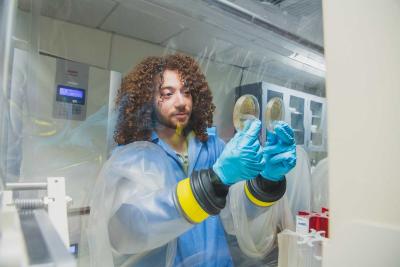
Your genes are a core part of your biological identity: a genetic blueprint passed from generation to generation, and you only get the ones that you are born with. But what if you could exchange genes with your friends? Perhaps you could change your hair color or improve each other’s health or athletic ability. Some bacteria that live in the human gut inadvertently do just that, with a little help from a virus. Graduate student Shane Connolly is studying this specific case of “horizontal gene transfer,” how a person’s diet can influence the process, and its implications for human health.
“The human digestive tract contains a variety of microorganisms, from bacteria to fungi to viruses,” said Connolly, a fourth year in the Biochemistry, Microbiology and Molecular Biology program in the Eberly College of Science. “These microorganisms can be beneficial, neutral, or harmful, and can play important roles in digestion and can impact our health. I am particularly interested in a type of virus called a bacteriophage, which infects bacteria.”
Bacteriophages inject their genome into their bacterial host, where the phage genome hijacks the host’s molecular machinery to produce copies of itself. Eventually the bacterial host cell breaks down, releasing the newly produced phages, which seek out other bacterial cells to infect. But sometimes, some of the host bacteria’s DNA can accidentally be packaged into the phage, Connolly said. Then, when the phage infects a new host, the bacterial DNA that it picked up from its last host can be transferred into the new host in a process called transduction. If the bacterial DNA contained functional genes, they can be expressed in the new host, potentially changing its biology.
“The transferred genes can encode virulence factors that enhance the pathogenicity of bacterial strains or confer antibiotic resistance, with potentially significant consequences for human health,” said Connolly, who studies in the lab of Jordan Bisanz, assistant professor of biochemistry and molecular biology and Dorothy Foehr and J. Lloyd Huck Early Career Chair in Host-Microbiome Interactions. “We often think of antibiotic resistance as emerging in places where selective pressures are high, such as hospitals with heavy antibiotic use, soils contaminated with heavy metals, or wastewater facilities. But the gut may be an underappreciated reservoir for the transfer of antibiotic resistance genes.”
Connolly specifically studies how restricting the amount of calories that a human consumes can impact the numbers and kinds of bacteria in the gut as well as the transduction process. He said the diet they use involves a fairly extreme caloric restriction composed of ultra-processed food additives but may still provide insight into how the gut microbiome responds during less extreme cases, including with more prevalent use of GLP-1 medications. Eventually, he said, the lab hopes to leverage a better understanding of how diet impacts microbe-host interactions to improve human health.
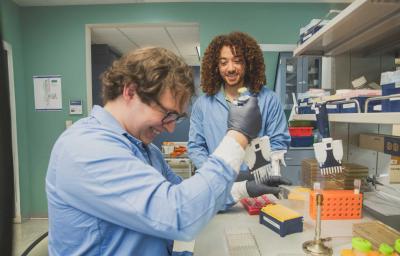
Connolly said he was drawn to Penn State in part because of the reputation and expertise within the One Health Microbiome Center. In his third year, Connolly was selected as one of the center’s inaugural Biotechnological and Integrative Opportunities in Microbiome Science (BIOMS) doctoral training fellows. The rigorous program, funded by the National Institutes of Health, provides technical and professional training for the next generation of microbiome scientists.
“We initially participated in several workshops, including a computational workshop where we were exposed to commonly used tools in the field; a professional development workshop; and a hands-on practical workshop, which covered everything from sample preparation, DNA extraction and library preparation, and metagenomic sequencing,” Connolly said. “Throughout the year, we’ve also had access to a wide variety of microbiome-dedicated trainings, professional development opportunities, and a journal club to discuss recent scientific literature across the different fields within the one health microbiome spectrum. It’s been a very positive experience.”
Connolly said he was also drawn to Penn State because he could obtain a dual degree in astrobiology, a field that includes the exploration of life outside of Earth as well as the origins and early evolution of life on Earth. The dual-title program is facilitated through the Department of Geosciences in the College of Earth and Mineral Sciences.
“I have been really passionate about life in the universe, and the dual-degree program combined with the One Health Microbiome Center meant Penn State was the best of both worlds,” he said.
Connolly said he has enjoyed learning about the broad range of topics within the field of astrobiology, which include planetary science and the search for potentially habitable planets, the geological conditions required to support life, and the evolution of Earth from primordial to modern conditions. Connolly’s specific interest in space biology, a subfield of astrobiology that investigates life as we know it existing in space, could one day connect with his research on the human microbiome.
“We are interested in how long-term consumption of processed foods might impact the microbiome and overall health of astronauts in space for long periods, such as the proposed future manned missions to Mars,” Connolly said.
Astrobiology also considers life in extreme environments, and Connolly said the best model for that on Earth tends to be microorganisms, so his background in microbiology has been helpful.
“My goal is to pursue a career that combines microbiology and astrobiology, like at a NASA research center or another institution that supports space biology. The support I have received at Penn State to pursue my interdisciplinary passions has put me in the best possible position to achieve that goal.”